0
0

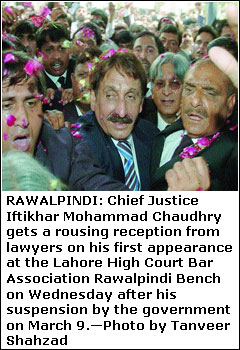 RAWALPINDI, March 28: In his first appearance before the bar since being restrained by the government from carrying out his professional duties, Chief Justice Iftikhar Mohammad Chaudhry told an impressive assembly of lawyers here on Wednesday that no organ of the state had the authority to cross its prescribed constitutional limits and interfere with the domain of others.
"It is impermissible for an organ to exceed its prescribed limits for that would constitute interference in the domain of another," the non-functional chief justice observed while addressing a huge gathering of lawyers at the Rawalpindi High Court Bar Association.
The suspended chief justice’s address to the bar came against the backdrop of a debate whether the government would allow him to come out of his house and go all the way to Rawalpindi to deliver a lecture.
However, better sense prevailed, it seems, as the administration offered no resistance to the non-functional chief justice who came all the way from his official residence in Islamabad to the high court bar in a large motor cavalcade.
Lawyers gave an animated welcome to the non-functional chief justice at Kutchery Chowk when he passed by the district courts.A huge number of lawyers stood on both sides of the GT Road to receive him and showered rose petals on the vehicle of the chief justice that was driven by Barrister Aitzaz Ahsan.
Amidst greetings, cheers and applause, he appeared before the bar to deliver a lecture on "Justice for All" in the company of lawyers who had come from different district bars and associations.
He, however, regretted that his planned address to a similar gathering at the NWFP bar on Friday had been rescheduled on the suggestions by a panel of lawyers defending him in the reference before the Supreme Judicial Council (SJC). The next date will be announced later.
And while speaking, Justice Chaudhry deliberately avoided mentioning the reference President Pervez Musharraf referred before the SJC for abusing his office and clarified at the very outset that he would limit his lecture to his profession and would not venture into any political arena.
His defence lawyers also requested the audience repeatedly to maintain decorum by refraining from raising political slogans.
Justice Chaudhry and other speakers before him also appreciated the judges both from the superior as well as the subordinate judiciary, namely Justice Jawad Khawaja, Civil Judge from Bahawalpur Saeed Khurshid and Deputy Attorney General Nasir Saeed Sheikh, who resigned in protest against what they called blatant assault on the judiciary by the government.
A sitting civil judge from Gujar Khan, Sajida Chaudhry, was also present among the audience and resolved to participate in lawyers’ struggle. The senior-most judge of the AJK Supreme Court, Justice Manzoor Hussain Gillani, who was superseded in violation of the principle of seniority, also spoke on the occasion.
Before leaving the venue, Justice Chaudhry briefly visited a camp where a number of lawyers were observing a token hunger strike as a mark of protest against government's intrusion by making him non-functional.
In his written speech, Justice Chaudhry said the inbuilt system of checks and balances in the separation of powers allowed every organ to function effectively within its demarcated field.
The rule of law, he emphasised, was a basic and crucial ingredient of effective and successful governance in a society and the constitution mandated the superior courts to watch and zealously guard the system of governance, based on principle of separation of powers.
“Numerous judgments of the Supreme Court bear testimony to the fact that it is the bounden duty of the superior courts, in particular the Supreme Court, to ensure that the constitutional requirements are fully adhered to.”
A civilised society was unthinkable in the absence of a free, fair and impartial system of administration of justice, he observed and said a society or nation, devoid of essential attributes of justice and fair play could not sustain for long.
It is duty of the state, he said, to establish a system of administration of justice which could dispense justice freely, fairly, impartially and expeditiously. “This is important because we know that failure to do justice strikes at the very foundation of nationhood or the statehood. This is the dictate of our constitution and the mandate of the Holy Quran," he added.
Earlier, Supreme Court Bar Association President Munir A. Malik demanded unconditional withdrawal of the reference against Justice Chaudhry and said March 9, 2007 would not only be remembered as a day of infamy in the annuls of history but also a day of courage.
"This is the first time in the judicial history of Pakistan that a chief justice looked daringly in the eyes of the army chief and refused to resign," he observed and said time had come that the judiciary should play its due role.
Rawalpindi High Court Bar Association President Sardar Ismatullah Khan also spoke on the occasion. (With additional reporting by Mudassir Iqbal Raja)