



 0
0

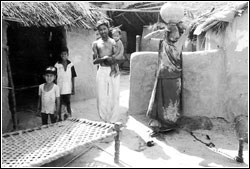 THE Indian economy has been growing at between eight and nine per cent annually over the past few years, with sectors like manufacturing and services growing at double-digit rates. But despite such a vibrant economy, critics have pointed out, there is despair in the villages where the vast majority of Indians live.
The reason for this is obvious: agriculture, which sustains over 650 million Indians, has been witnessing an anaemic growth rate of between one and three per cent. Economic reforms, which have freed Indian entrepreneurs from bureaucratic controls and boosted growth rates in the manufacturing and services segments, have still not been initiated in the farm sector.
There is stiff resistance to agricultural reforms, ensuring the continued exploitation of farmers by politicians and bureaucrats; on the eve of elections — general, state and local — politicians across the country have made a habit of promising free power and water for rural areas, continued subsidies on fertilisers, guaranteed prices (or minimum support price) for food grains and other agricultural products, and a procurement system that has no relevance to market conditions and reality.
Finance Minister P. Chidambaram, who had initiated some reforms in the farm sector, was forced to back-pedal while presenting his annual budget last month. Futures trading in wheat and rice were suspended, despite the government, senior ministers and even many farmers, backing these innovative tools.
The federal government, and even many state governments, arbitrarily impose restrictions on the import and export of agricultural products — even between states — on the basis of fraudulent claims by powerful lobbies. This hurts India’s reputation as a reliable supplier of farm products, and import bans could also lead to higher domestic prices, hurting consumers.
The farm sector — which includes agriculture, horticulture, floriculture and even food processing — is a sensitive one in India, and even moderate and pragmatic politicians are reluctant to tinker around with the laws, for fear of alienating powerful lobbies who claim to speak on behalf of farmers and the poor.
But the fact that agriculture has been acting as a drag on the Indian economy is finally pushing some bold reformers to push ahead with changes. Some key ministries — including agriculture, commerce and food processing industries — are now calling for a ‘second green revolution’ that would transform the farm sector.
Farmers in many states, who have benefited from partial liberalisation, are also seeking changes. The entry of large, organised industry players — including Reliance Industries, ITC and Hindustan Lever — into the farm sector has seen better returns for farmers. Reliance, which has made a huge foray into the retailing of farm produce, has seen phenomenal response from consumers and the trade to its new chain of retail outlets in the country.
INTERNATIONAL consultancy Dun & Bradstreet estimates that India loses nearly $15 billion worth of farm products every year because of inadequate processing and cold-storage facilities in the country.
The federal commerce ministry, and the food processing ministry are now demanding opening up of agri-business to foreign direct investment (FDI). This would enable foreign retailers to set up supermarkets to sell farm produce, and also set up agriculture and food parks, on the lines of special economic zones.
Most farmers in India are exploited, as middlemen and traders deprive them of remunerative price, though they sell the produce in the cities at hefty profits. The entry of organised retailers has hurt the intermediaries, who are naturally trying to lobby with petty politicians to curb the entry of big retailers.
But FDI in the agri-business would ensure that financially sound companies are able to invest in cold storages, chilling plants, washing, grading and sorting facilities, temperature-controlled warehouses, testing facilities, and other requisite infrastructure.
India has an appalling lack of food processing infrastructure. Bad roads, linking farms to towns and cities, pathetic storage facilities, absence of processing units, and equally bad infrastructure at airports have led to dismal performance on the export front.
There are moves to allow contract farming, so that organised players are able to access farms and their produce. Different clusters are also likely to be set up across the country, for different agricultural, horticultural and floriculture produce.
Sharad Pawar, the federal agriculture minister, says that high quality cold chain is essential to ensure an increase in India’s exports of processed vegetables and fruits. According to Subodh Kant Sahai, the junior food processing industries minister, the absence of a strong cold chain sector could delay prove to be dear for Indian agriculture.
Though India is one of the world’s leading agro producers, it has a cold storage capacity of just 20 million tonnes, much of it used for the storage of potatoes.
The government has set up six agri export zones (AEZs) for floriculture in states like Karnataka, Tamil Nadu, Maharashtra, Uttarakhand and Sikkim, and cold storage and cargo handling facilities are being established at airports including Mumbai, Delhi, Bangalore, Hyderabad, Chennai, and Cochin. But the AEZs policy has been a non-starter, even in states like Karnataka.
The government is now considering allowing private and even international players, to set up airports exclusively for cargo operations. This is likely to boost exports, especially of perishable cargo, including flowers.
DESPITE India being described as an emerging ‘flower power,’ its performance in floriculture exports has been disappointing. There have been instances where entrepreneurs, who invested millions of dollars in facilities in the country, have had to abandon their projects, because of delays at airports, resulting in cancellation of orders.
Some of the floriculture exporters have relocated to countries like Ethiopia, and have seen their business blossom. India has a rich variety of agro climatic zones, which results in a fascinating range of flowers, including temperate ones, being raised.
India’s share in the international floriculture trade though is negligible: the global floriculture trade is worth nearly $12 billion, but India accounts for exports of less than $70 million. The government hopes to raise this figure to about $230 million over the next five years.
The industry, however, is more bullish, and hopes to earn about a billion dollars through exports in just three years. While the US is the largest market for Indian flowers, Europe (including the UK and the Netherlands) and the Middle East are emerging as major destinations. Japan is also likely to be a significant buyer of Indian flowers — both dry and cut flowers.
The Agriculture Products Export Development Authority (APEDA) has a market facilitation centre in the Netherlands, and plans to set up similar facilities in the Middle East and Japan.
But all the efforts of the industry could go waste if the infrastructure in India continues to remain poor. Power shortages are rampant in rural areas, especially in states like Maharashtra and Karnataka. Cold chain and refrigerated warehouses are meaningless concepts in the absence of regular and good quality power.
Similarly, if the industry has to invest huge sums in diesel power generators and back-up units, the price of flowers would become prohibitive, adversely affecting exports from India.
Domestic demand for flowers is also growing at an estimated 40 per cent annually. The setting up of hundreds of shopping malls and fancy stores in urban India is giving a boost to the floriculture trade in the country. The likely entry of international retail chains — including Wal-Mart, Carrefour, Tesco, Sainsbury and others — is expected to further boost demand in the cities.
Indian companies like Reliance and ITC, which are emerging as big players in the agro-business, also have ambitious plans for the floriculture sector. The area under flower cultivation — which was just a little over 50,000 hectares in the early 1990s — is expected to nearly quadruple in a few years.






























