0
0

 KARACHI, March 24: Every year 280,000 people in Pakistan develop tuberculosis, a disease that has been effectively controlled in Bangladesh. The failure lies in lack of commitment on the part of the government and the ineptness of doctors in correct diagnosis and providing treatment.
This was stated by Professor of Medicine and Consultant Chest Physician at Ziauddin Medical University and Hospital, Dr Sohail Akhtar at PMA House yesterday. The event was one of the many programmes held in the city to observe World TB Day.
Dr Akhtar said tuberculosis was the biggest cause of death in the world, claiming two million lives every year. Every third person in the world was infected with TB germs and over 9 million new cases were reported annually.
Highlighting the severity of the TB scenario in Pakistan, Dr Akhtar said though the World Health Organisation (WHO) declared it a global emergency in 1993, Pakistan reacted seven years later. Lack of government commitment is evident from the fact that every year 280,000 new cases are reported, most of them are adults in their reproductive years. The incidence rate is 177 per 100,000 population.
Pakistan, he said, today ranked sixth among the 22-high burden countries where 80 per cent of new TB cases were reported despite the fact that effective drugs were available. The emergence of multidrug-resistant TB and TB-HIV co-infection were growing concerns, he said.
The underlying causes for continued rise in TB cases included poverty, poor health infrastructure, increasing population, poor compliance and lack of commitment of government. Besides, doctors’ inability to diagnose the disease and prescribe the right medicine was also a major factor contributing to the rise in TB cases. He said surveys in Karachi and NWFP showed only 10 to 15 general practitioners were able to write a correct anti-drug prescription and fewer knew what DOTS (Directly Observed Therapy Short Course) was. A shining example in TB control was Bangladesh which, he said, was declared a role model by WHO in 2002.
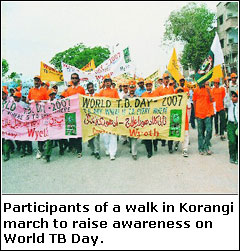
In other programmes, UC nazims and councillors, school students, doctors, paramedical staff and area residents participated in a World TB Day walk under the aegis of Sindh Government Hospital, Korangi. The walk aimed at creating awareness among the people about the disease.
A seminar was held at the Chest Medicine Department of the Hospital. The speakers stressed the need for a timely diagnosis of TB in patients in order to save precious human lives.
Dr Abbasi said drugs to cure TB were available. He said that free sputum tests and free medicines were supplied regularly to all the patients registered at the Sindh Government Hospital Korangi. Dr Siddiqui, Head of Chest Medicine Department of the hospital, said that despite all efforts TB still remained the major cause of mortality in Pakistan and was spreading. TB posed a serious and ever increasing problem in Pakistan affecting health and social welfare. He added that any person with a cough for more than three weeks, fever, weight loss should be screened for TB.
A seminar organised by Sada Welfare Foundation at the National Institute of Child Health (NICH), discussed the problem of TB among children and observed that 100 per cent coverage of all children against BCG could ensure protection against tuberculosis among children.
Director NICH, Dr Afroze Ramzan, said that the children with weak immunity can easily contract the disease and as such it was advisable that parents pay special attention to little children in case their coughing continued for two months. She warned that physicians should not delay referral of children suspected of TB to major treatment centres so that further complications could be avoided.
Chairperson Sada, Fawzia Siddiqui, said her organisation was adopting children with TB at NICH since 2002. To date 2,500 patients had been registered, of which 1875 were treated successfully. Another 600 were under treatment. Children in 8-12 years age group seem to be the worst affected.