0
0

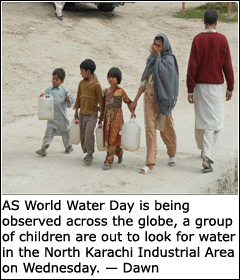 KARACHI, March 21: ‘Coping with Water Scarcity’ is the theme for World Water Day 2007, which is being observed today. The theme was decided by all members of UN Water at World Water Week in Stockholm, in August 2006.
This year’s theme highlights the increasing significance of water scarcity worldwide and the need for increased integration and cooperation to ensure sustainable, efficient and equitable management of scarce water resources, both at international and local levels.
Equity and rights, cultural and ethical issues need to be addressed when dealing with limited water resources. Imbalances between availability and demand, the degradation of groundwater and surface water quality, inter-sectoral competition, inter-regional and international disputes, all centre round the question of how to cope with scarce water resources.
In the World Water Congress in China last year, the World Conservation Union (IUCN) said water problems were more related to mismanagement than scarcity. It said water gives life to many of the natural resources that people use. Rivers sustain food from fish, trees, and plants. For those who cannot afford irrigation, natural flooding of rivers is often the basis of agricultural practice. It is clear that the poorest of communities are most dependent on the natural resources that healthy ecosystems sustain.
Providing water to those downstream ecosystems is thus vital to maintain river health, alleviate poverty, and ensure economic development.
‘Environmental flows’ refer to water provided within a river, wetland or coastal zone to maintain ecosystems and their benefits where there are competing users and conflicts over water. Taking an ‘environmental flows’ approach is a way to link social, ecological, hydrological and economic concerns and enable different stakeholders to come to the table to negotiate the best way to manage a river system.
Thus, the IUCN said ‘environmental flows’ need to be established within the context of river basin planning and Integrated Water Resources Management. It said strategies need to safeguard the entire water chain provision from source to sea. This requires the adoption of an ecosystem approach to water management. Key elements include the adaptation of water resources management to climate change, the protection of surface and groundwater sources, the provision of water for downstream users and ‘environmental flows,’ the treatment and re-use of wastewaters.
The IUCN, with partners, is piloting the development of the ‘Water X Schools’ campaign, which aims to scale-up the provision of water and sanitation to schools and increase water education and water care amongst schoolchildren. There will be a number of pilot areas around the world. Various environmental organizations and NGOs have planned to hold programmes and campaign vis-à-vis this year’s theme on Thursday (today).