0
0

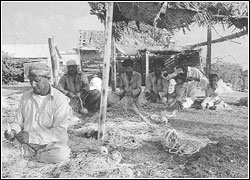 THE State Bank of Pakistan has announced policy guidelines for financing of fisheries, now under-served by banks. The sector with a potential of domestic consumption of one million metric tons and export potential of $1 billion per annum receives a mere 0.4 per cent of the total agricultural credit. The total marine and inland fish production last year was 0.6 million metric tons.
If implemented by banks, the SBP policy will have a positive impact on development of fisheries in Balochistan. The province’s coast makes up 70 per cent of Pakistan’s total coastal line. The province has 770-km long coastal belt along the Arabian Sea which links Lasbela and Gwadar districts. The coastal and off-shore areas of the province have rich natural habitats. The sea resources including enormous fish and seafood potential of Balochistan coast are yet to be tapped.
According to an estimate, 60 species of fish and 10 of shrimps, including the best in the world, are found in the province. It produces 200,000 tons of fish per year, of which 80,000 tons are fished by trawlers from Sindh. In real sense, the province has been confined to merely on-shore water fishing due to lack of infrastructure facilities. The catch is spoiled as it is exposed to sun and impurities. In the absence of quality control regime, fresh and good quality fish do not find access to national and international markets on large scales.
Fisherman of Balochistan still follow the old, and obsolete methods of fishing. They are unaware of latest fishing technologies and l use old and smaller vessels. Local fishermen have no processing plant for preservation of their catch. Recently, government, a processing plant has been established.
Local fishermen have no access to national and international markets. There is a need to rehabilitate and improve the conditions under which they work. Increasing cost of transportation and lack of preservation technology are the main hurdles barring them to fish in deep waters.
The State Bank research report suggested that the working capital should be provided to purchase fuel, ration and ice and for overhead expenses i.e. labour, packaging, processing and cleaning items required for export of fish. Credit for consumable items for curing and drying would also be provided while a long list of items regarding freezing, packaging charges, etc. has been submitted for purposes of financing.
There have been reports of illegal fishing by big trawlers on Balochistan coast. Trawlers and big fishing boats equipped with sophisticated nets pose a direct threat to the marine life and the fish stocks. They simply make a catch of several tons in one go. On the other hand, local fishermen with small boats suffer due to poaching The provincial cabinet recently decided to enhance the fine and punishment for all those illegal fishing vessels and the trawlers found poaching. There is also a need to reform Balochistan Coastal Development Authority (BCDA) that was established to check poaching.
In the past 15 years, some change has been brought about in fishing techniques. Most of the sail boats local fishermen use, have motors. An integrated development project for fisheries has helped improve fishing techniques, fish handling, distribution practices and the vocational skills. The Pasni Fish Harbour Authority can purchase engines from 15 to 55 horse-power for the fishing fleet. Fish is transported by roads in insulated trucks. Turbat in Makran has emerged as a big centre of fresh fish. Workshops have been set up at Ormara, Pasni ,Gwadar and Jiwani for repair of boats and engines. There are also government operated ice plants at Ormara and Pasni besides private plants at many places.
Shrimp farming is an important economic activity which can be developed. The land along coastal belt has enormous potential for development of shrimp farming and processing projects. Shrimp farming is currently under consideration of the provincial government. Technical assistance from National Institute of Oceanography (NIO) may be sought in this regard. Establishment of a dehydration plant is under consideration of the federal government.
The federal government recently decided to evolve a pro-active strategy for boosting exports by promoting shrimp farming along side the coastal line in Sindh and Balochistan. Export Promotion Bureau (EPB), Small and Medium Enterprise Development Authority (SMEDA) and various government agencies involved with trade and industry are trying to prepare a national road map to promote the shrimp farming..