



 0
0

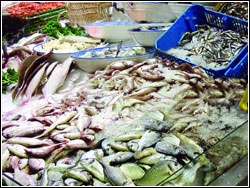 NOT too long ago, it was heartening to know that surgical instruments’ industry had responded to the requirements of American buyers and fisheries too had fulfilled the requirements of European buyers. The period proved to be short-lived for fisheries. Following EU mission inspection of Karachi fish harbour and processing units in January 2007, the European Commission (EC) decided to delist 10 Pakistani fish exporters from the list of approved processing units.
This was a follow-up to a visit early 2005 for inspection with regards to hygienic practices. The objective was to also determine whether the Marine Fisheries Department (MFD) of Pakistan was competent to exercise control on fish plants according to the EC regulations. Latest penalty is EC ban on fish export from Pakistan to EU states after April 12.
It was concluded after the January 2007 inspection that the guarantees made earlier were not fulfilled at both the government and the processing units’ level. And, various stages of fish processing leave a lot to be desired. All of this neglect despite a warning that was given a year ago. A ban on seafood exports is, therefore, not too surprising. Will alternative markets in China help fisheries for too long even if Chinese hygiene requirements are less stringent for the time being?
There are business organisations that blaze new trails and create new environments that I call Type-1 organisations. Then, there are organisations that anticipate external environmental developments and prepare a timely response that are Type-2. These are proactive organisations. Organisations that are taken unawares and then adapt to external environmental developments are Type-3. These are reactive organizations. Then there are organisations that wonder what happened. These are Type-4. Where would our fisheries be placed?
As though this was not enough, majority of PIA’s fleet is likely to experience a ban in the EU countries because of the airline’s failure to meet international safety standards. This certainly is a Type-4 situation in which a once “great people to fly with” organisation is reportedly neglecting something as basic as safety standards. This too was in the air for sometime but, it was not taken a serious note of by the airline.
In both the cases of fisheries and the airline, the organisations were not caught unawares. They were apprised of the requirements that they were not able to fulfill. Questions then remain about their lack of responsiveness to market requirements.
In the case of PIA, safety should not be provided in response to market demand. For, safety is a basic capability without which no airline should function. Similarly, in the case of food/seafood, hygiene is a basic requirement without which no food industry should be allowed to operate. In third world countries, however, people and organisations continuously interact and exchange even if the safety and hygiene requirements are not being met according to international standards.
For instance, in Pakistan, wearing seat belts in cars is unusual as people find it very comfortable to continue to travel without seat belts. In the US, it is a major legal offence to travel without seatbelts. Similarly, the environment in which our roadside “delicacies” are prepared and consumed would be unthinkable in international food chains. Does this mean that we need not improve our safety and hygiene standards?
Most certainly, our standards are far from satisfactory but these go on for as long as they can sell with our consumers hard of cash and not too informed or concerned about quality. The onus, however, still lies on the seller to give quality wherever and whenever they do not. Sellers are always criticised for their deviant behaviour.
In international markets, business cannot be done unless international standards are adhered to. The onus then on the business is to know what the international standards are, how they are changing, and what all the business needs to do to strike a fit with the international environment. If they are unable to do the same, an organisational study would be in order to know where and why are things going awry.
Marketing is not just about advertising, catchy slogans, trendy uniforms of the crew, or publicity of a few fancy aircraft whose purchase may even be disputed by others. Marketing is about needs identification and needs satisfaction and to also explore and determine how best the needs might be satisfied in a dynamic environment. However, there is nothing that the marketing function can perform in an organisation unless there is a company-wide marketing effort. That is, if marketing is about needs satisfaction, then there is nothing that marketing can accomplish on its own unless the organisation is capable to deliver the services and goods that the marketing may have identified.
R&D, operations, human resource, procurement, finance, and accounts must all operate in sync to view the company’s customers as their own. Closing the design-production-marketing gap is to give a marketing orientation at each functional level. Without this cross-functional horizontal view of the organisation, the function of marketing will not have much to accomplish except to build an image that may turn out to be a bubble image. Bubble images vitiate in thin air at some point in time. Could this have happened in PIA because of which its parwaz ceased to be la jawaab over time and also risky now to the extent that the EU has grown too wary of it to allow its flights?
A market-driven PIA ought to have known what was coming in terms of EU regulation and it ought to have prepared a selling response in good time. In fact, a market-driven PIA ought not to have reached a point where the possibility of restrictive EU regulation arose. A market-driven PIA ought to have been proactive enough to continue to give the level of security sought by international markets. After all, PIA is an organisation staffed with professionals in engineering and business management. It is expected to operate as an integrated well-knit cohesive organisation coalescing around a shared mission that apparently it no longer is. The seafood industry, on the contrary, is staffed with lower levels of education and skills. However, there is no reason why it should not be gauging and responding to the international requirements of doing business. A blanket ban on Pakistan’s seafood exports is cause for immense concern. Reportedly, there are tensions between the government representatives and fishermen’s elected representatives. The MFD supposedly exercises control for compliance with the EC regulations. State of the art in quality management has moved on to empower the persons on the job with a view to building quality into the product as a part of total quality management (TQM).
The fisheries workforce may not be completely ready for TQM at this stage but a transition to fishermen’s involvement might be required sooner by beginning to factor in their concerns as the controlling approach may not prove to be productive. Also, the involvement of those whose livelihood depends on successful operations will eventually broaden their horizon to be able to see the market requirements in good time and to prepare an effective response.
The MFD may facilitate the process by introducing them to technology and skills needed for the purpose of improving processing and scanning the market with a wide angle lens. But, MFD, by itself cannot run the fisheries as this is the preserve of the fishermen. This again is a case of internal-external fit that the MFD can facilitate with the active support of the elected fishermen’s representatives who should be partnered with and not alienated.
Educated or otherwise, the issue boils down to active involvement of the workforce without which there will be people arriving daily at the workplace to only mark time and the top management too helpless to steer the course of organization single-handedly.
However, what managements need to additionally do especially PIA’s is to also factor politics or global politics in their environmental scan if they have not done it already. This required to anticipate the ramifications of global politics on organisational performance in good time.
Second. there just might be discrimination in the air too if the standards are made or implemented tighter for one or a few only. However, best way to fight dis crimination is to be good enough to expose discriminatory policy.






























