



 0
0

Without a trace
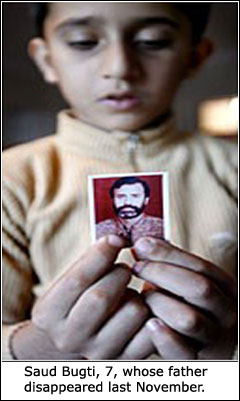
Seven-year-old Saud Bugti’s father was picked up by secret police on a street corner in Karachi last November. No one has heard from him since. He has joined the ranks of Pakistan’s ‘disappeared’ - victims of the country’s brutal attempts to wage war on both Al Qaeda and those who fail to support the government. But how many innocent people are being caught up in this? And what is America’s connection to the barbaric torture of suspects?
 THEY vanish quietly and quickly. Some are dragged from their beds in front of their terrified families. Others are hustled off the streets into a waiting van, or yanked from a bus at a lonely desert junction. A windowless world of sweat and fear awaits. In dark cells, nameless men bark questions. The men brandish rubber whips, clenched fists, whirring electric drills, pictures of Osama bin Laden. The ordeal can last weeks, months or years.
These are Pakistan’s disappeared — men and women who have been abducted, imprisoned and in some cases tortured by the country’s all-powerful intelligence agencies. The Human Rights Commission of Pakistan has counted 400 cases since 2002; it estimates hundreds more people may have been snatched.
The phenomenon started with the great sweeps for Al Qaeda suspects after September 11, but has dramatically increased in recent years, and now those who disappear include homegrown “enemies of the state” — poets, doctors, housewives and nuclear scientists, accused of terrorism, treason and murder. Guilty or innocent, it’s hard to know, because not one has appeared before a court.
An angry Pakistani public wants to know why. The disappearances are increasingly perceived as Pakistan’s Guantanamo Bay — a malignant outgrowth of the “war on terror”. This week, the issue moved centre stage with the showdown between President Pervez Musharraf and Pakistan’s Chief Justice, Iftikhar Mohammad Chaudhry. Many believe the judge is being victimised for championing the cases of the disappeared. “These are Gestapo tactics,” says Iqbal Haider, a former minister. “The more we protest, the more innocent people are being hurt. And what frightening stories they tell.”
For Abid Zaidi it started with a phone call one afternoon last April. The softly spoken 26-year-old was at work at Karachi University’s department of zoology in a cavernous room of stuffed animals, sagging skeletons and yellowing name tags. The voice on the phone instructed him to report to Saddar police station in the city centre. There, a handful of men were waiting for him: he believes they belonged to Inter-Services Intelligence (ISI), the army’s powerful spy agency. They clapped cuffs on his wrists, wrapped a band around his eyes and drove him to a cell. Then, he says, the torture started.
The men beat him, he says, with a chain, until he collapsed. He was brought to a military hospital; there doctors brushed off his pleas for help. Then he was flown to another detention centre, where he was shown graphic images of torture. “People’s skin was being removed with knives and blades and they were being drilled,” he says. “It was really terrible.” Then they hung him upside down from a butcher’s hook, his face dipping into a pool of sewage water.
The interrogators wanted Zaidi to admit his supposed part in the Nishtar Park bombings. In early April, a suicide bomber had killed 50 people at a Sunni religious gathering in central Karachi. The officials accused Zaidi, a prominent young Shia, of orchestrating the massacre. Zaidi tried to explain he was more interested in zoology than zealotry. They did not believe him.
In July, an official told him he had been sentenced to hang. Zaidi wrote a will. “I felt at peace because I knew God was with me,” he says. But it was a ruse. At 4am on the morning of the ‘execution’, having refused to admit his guilt, a dramatic reprieve was announced. Shortly afterwards, he underwent a lie detector test and on August 18 he was flown to Karachi. The blindfold was lifted. Zaidi was driven through the city. The car stopped, a man handed him 200 rupees and pushed the car door open. “He said, ‘Don’t open your eyes,’ ” says Zaidi. When the engine noise had receded, he found himself standing at a bus stop near Karachi University. He got down on his knees and prayed. Then he phoned his brother to take him home.
Zaidi’s account cannot be verified because, officially speaking, he was never in government custody. However a senior police officer familiar with the case describes it as a major embarrassment. “That boy was picked up by a young officer,” says the official, who asks not to be named. “(The police) knew it was the wrong guy. But they refused to listen.”
The ISI is the most powerful arm of Pakistan’s intelligence establishment, commonly referred to as “the agencies”. Founded by a British army officer in 1948 and headquartered at an anonymous concrete block in Islamabad, the ISI is famed and feared in equal part. Its influence soared during the 1980s, when it smuggled vast amounts of American-funded weapons to mujahideen guerillas fighting the Soviets in Afghanistan. The other major agencies in Pakistan are Military Intelligence and the civilian Intelligence Bureau, and all three of these major agencies have variously been accused of rigging elections, extra-judicial assassinations and other dirty tricks.
But until 9/11, disappearances were rare. Then, in late 2001, as Al Qaeda fugitives fled from Afghanistan into Pakistan, Gen Musharraf ordered that the agencies show full cooperation to the FBI, CIA and other US security agencies. In return, the Americans would give them equipment, expertise and money.
Suddenly, Pakistan’s agencies had sophisticated devices to trace mobile phones, bug houses and telephone calls, and monitor large volumes of email traffic. “Whatever it took to improve the Pakistanis’ technical ability to find Al Qaeda fighters, we were there to help them,” says Michael Scheuer, a former head of the CIA’s Osama bin Laden unit. An official with an American organisation says he once received a startling demonstration of the ISI’s new capabilities. Driving down a street inside a van with ISI operatives, he could monitor phone conversations taking place in every house they passed. “It was very impressive, and really quite spooky,” he says.
The Al Qaeda hunt became a matter of considerable pride for President Bush’s close friend, the president of Pakistan. “We have captured 672 and handed over 369 to the United States. We have earned bounties totalling millions of dollars,” wrote Gen Musharraf in his autobiography last year. The boast sparked outrage at home in Pakistan and was scrubbed from later Urdu-language versions of his book. Prize captures included the alleged 9/11 mastermind Khalid Sheikh Muhammed, who has apparently confessed to a string of terror plots after four years as a captive, and Abu Faraj al Libbi, another alleged Bin Laden lieutenant. But certain innocents were also swept up in the dragnet.
Brothers Zain and Kashan Afzal, for example, were detained and beaten many times over eight months by Pakistani agents convinced they belonged to Al Qaeda. Zain, now 25, remembers that, in between the thrashings, the “FBI wallahs” — a woman and two men — would come to visit. “They showed me a picture of Osama and asked if I knew him,” he says at his home in Karachi. “I told them I had only seen him on television.” As American citizens — the brothers were born in the US, where their father lives — they might have expected better treatment. Instead, they got threats. “The Americans said if we did not tell them everything, they would send us to Guantanamo Bay,” says Zain.
Like many of the disappeared, the Afzals had a colourful past that drew the attention of the agencies. According to a well-informed source, their names appeared on a list of potential recruits found on a laptop belonging to Naeem Noor Khan, an Al Qaeda computer expert arrested weeks earlier, in July 2004. They were also questioned about a visit they had made to the lawless tribal belt of Waziristan. But whatever they had done, it was clearly not enough to warrant prosecution by either Pakistan or the US. In April 2005, they were brought to Lahore airport, handed a pair of aeroplane tickets in other people’s names, and set free.
The physical damage has healed — Zain suffered a burst eardrum — but the mental scars remain. “He hears voices in the night coming to take him away again,” says his wife Sara. The couple agreed to meet the Guardian and give their first newspaper interview in an attempt to press their case for a new American passport. Despite numerous entreaties, the US consulate in Karachi has stonewalled requests to re-issue their passports, which were confiscated during their arrest. “I am scared because of what has happened,” says Sara. “Pakistan is not a reliable country, you know.” A US embassy spokeswoman in Islamabad declines to comment on their case.
The truth is that the American government still quietly supports the disappearances of Al Qaeda suspects, says Ali Dayan Hasan of Human Rights Watch, which has documented many cases. “The abuse has become even more brazen because of US complicity,” he says.
He claims that American officials are regular visitors to ISI safehouses in Islamabad, Lahore and Rawalpindi where torture has occurred. They have supervised interrogations from behind one-way mirrors, he says. In FBI internal documents, he says, torture is referred to as “locally acceptable forms of interrogation”.
In its annual human rights report published recently, the US State Department acknowledged the disappearances but skated around the US’s own role. “The country experienced an increase in disappearances of provincial activists and political opponents,” it noted.
In fact, most recent disappearances have nothing to do with Al Qaeda. To quell an insurgency in Balochistan the agencies, in particular Military Intelligence, have rounded up hundreds of suspected rebels in the past two years. Of the 99 abductions registered by the Human Rights Commission of Pakistan last year, 73 were from Balochistan. Officials believe many more have gone unreported. Shamsa Toon, a 70-year-old woman, crouches on the pavement outside Karachi’s Press Club clutching a giant photograph of her son, Gohram Saleh. He has been missing since August 8, 2004, she says; this was the 166th day of her vigil. Her 13-year-old granddaughter is threatening to commit suicide if there was no news. “He’s just a cab driver, not any rebel,” she says, tears streaming down her face. “His only crime is that he is a Baloch.”
Musharraf’s officials swat the issue away with blunt denials. “I can say with authority that these people are not with any agency or government department,” says Brigadier Iqbal Cheema, head of the “crisis management cell”, which spearheads anti-terror operations, at the Interior Ministry. “Most of these people creating a hue and cry belong to the militant organisations and have jihadi backgrounds. They are involved in these activities themselves.” But the current confrontation with the chief justice has brought a renewed focus. Western diplomats are queasy about such obvious abuses from an ally they claim is “moving towards democracy”. And the death of Hayatullah Khan, a tribal journalist who was found dead last June after seven months apparently in the custody of the agencies, has further fuelled the outrage.
Last November, Justice Chaudhry ordered the agencies to “find” 41 people who had gone missing. Subsequently, half were quietly released. But the court actions have mostly just underlined the impotence of the civilian institutions in the face of a powerful military machine. When ISI lawyers plead that they “cannot locate” certain detainees, the judges can only fume and bang their benches.
Meanwhile, tearful relatives are left grasping for even a shred of news. Kazim Bugti, the mayor of Dera Bugti, a small town in Balochistan, was picked up last November.
His wife Asmat, left behind to look after their five children, weeps when she talks of her husband’s disappearance. “Does President Musharraf not have children of his own? Would he like to see them treated like this?” she says in the family’s Karachi apartment. She agrees to speak despite whispered phone warnings to keep quiet: the agencies do not appreciate publicity.
Several relatives say they have been instructed not to contact the media or human rights groups. Khalid Khawaja, who led a pressure group on behalf of some detainees, himself went missing last month.
He was reportedly taken to Attock Fort, a notorious military prison. But the most audacious disappearance, perhaps, is that of Abdul Rahim Muslim Dost.
During his three years of captivity in Guantanamo Bay, Dost, 37, became known as the “poet of Guantanamo” for his sharp verse. After his release, he wrote The Broken Shackles of Guantanamo, and it was published in the Pashto language last September; it became an instant hit in Peshawar’s bookstalls, selling more than 10,000 copies. It also contained stinging criticism of the ISI. Weeks later, policemen in a van abducted Dost as he walked from his local mosque after Friday prayers. His brother, Badruzzaman Badr — also a former Guantanamo detainee — says, “The book is the reason behind this. They are angry about what we have written.
“They claim to have democracy and freedom of expression in this country, but it is not real.”
When Dost’s case came before a local court for the third time in January, the judges again asked the ISI to produce the missing man. Again there was no answer. Now Badruzzaman, who has abandoned his gemstone business and no longer sleeps at home, fears he will be next. “I do not feel safe, they could arrest me any time. But where can I go?” he says.
Abid Zaidi, the zoology student from Karachi, has also learned the price of going public. In late October, he travelled to Islamabad to describe his ordeal before a press conference organised by Amnesty International.
Shortly afterwards he was picked up again, this time by men in uniform. Zaidi says they were flushed with anger. “They told me: ‘Next time, we will not pick you up. We will kill you.’ ” —Dawn/The Guardian News Service
Reactions in Karachi to a dark day
ANOTHER dark day in the history of Press and journalism in Pakistan. Sanity went a begging on Friday afternoon when belying reason, ethics and all codes of decency, the country’s existing state machinery dealt its severest blow yet, this time on the institution of the media.
Swinging batons, a police contingent broke into the Islamabad offices of the Geo News TV and its investigation cell on Friday afternoon, breaking through its entrances, smashing glass doors and threatening its staff.
The media is up in arms.
In Karachi newsrooms, shocked journalists seeing the events unfold on TV couldn’t believe their eyes at the blatant assault on the Press. One veteran uttered, “So we are back in the Zia era, it seems…”
No logic can be applied to the insane incident. While news was coming in of the tear gas shelling and beating up of staff, Information Minister, Muhammad Ali Durrani stood in the midst stating, “we condemn the police action. The staff inside are all safe.” The Minister’s dazed look is hard to swallow. His feeble attempts at passing the onus of the police action from the government to some ‘other’ reason would be laughable if it wasn’t so grave an issue.
Law minister, Wasi Zafar reportedly stated that the police action was in retaliation because the media had burnt a police car. We would advise the honourable minister to refrain from bizarre allegations, since he has already put his foot in his mouth rather awkwardly with indecent comments hurled at a senior journalist.
Furore at the action in Karachi is at an all time high. Demonstrations began outside the Karachi Press Club within minutes of the ignoble incident and the media fraternity has banded together to condemn the incident and take it up on a larger level. In a show of solidarity expected of a united institution, all newspapers and rival channels have jointly expressed shock and have demanded retribution.
Following the ban on Geo TV’s programme hosted by senior journalist Kamran Khan, the government at this point can do little to save its face. The international media has been quick to point out President Musharraf’s inability to handle domestic matters and the lie has been exposed that the Press in Pakistan is NOT without fetters.
The buffoonery that the government officials have been displaying since the judicial crisis with their loyalist attitudes has been replete with cheap dramatics. And now, every politician – retired; semi active and aspiring – has jumped on the band wagon of Press freedom and judicial supremacy. What kind of media management is the President’s office paying wages to? Is this an engineered scenario? Is this comedy part of the Millennium Development Goal?
With video broadcast of police with helmets, riot shields and batons kicking in windows being re-run on every channel, nothing really can be done by the government to salvage the situation. The President’s apology is not enough the information minister’s resignation SHOULD be the first step.
The late Ahmed Ali Khan’s statement given in an interview after his retirement regarding the present government’s stand in the months after General Musharraf’s takeover, ring ominously true after seven years. He said, “Do not be fooled by the General’s soft stand. The Press in Pakistan today is in sufferance – tolerated but not liked…”
| © DAWN Group of Newspapers, 2007 |


























