



 0
0

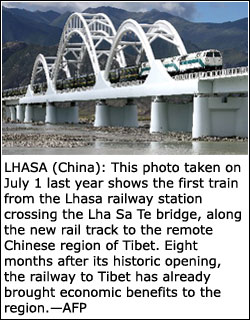 LHASA (China): Eight months after its historic opening the railway to Tibet has already brought economic benefits to the remote region.
“I have returned home,” said Wang Ping, a few days after stepping off the train as it arrived in Lhasa.
Wang, originally from the suburbs of Shanghai about 3,000 kilometres away, moved to Lhasa a year ago to open a small restaurant.
“The train ticket is only one third of the cost of a plane ticket,” he said as he took his son by the hand.
Wang is not the only one to arrive in Tibet seeking a new life. Many of Lhasa’s taxi drivers, most of whom are ethnic Han Chinese, see a good future on the Tibetan plateau.
“Everything is changing here very quickly, partly due to the train, and this is only the beginning,” said a 27-year-old driver who came to Lhasa last year with his wife and child from central Henan province.
For tourist agencies too business is booming.
“The number of our clients tripled in 2006 and this is thanks to the train,” said Luosang Caiwang, head of Saikang Travel in Lhasa.
“The train is great for us, and for the local population it is beneficial,” said the Tibetan, aged in his 40s.
Luosang said both the economy and society in general had benefited from the railway as it had linked Tibet, formerly one of the most remote regions in the world, to China’s wealthy and developed eastern seaboard and helped break its isolation.“About 60 per cent of investment in the hotel industry is done by Tibetans,” he said.
For the government, the benefits of the railway are evident. Tibet’s gross domestic product grew by 13.4 per cent in 2006, the highest level of growth since 1995.
But the authorities also acknowledge that the impact of the train — the highest in the world with parts surpassing 5,000 metres in elevation — is not only economic.
“It will promote cultural communication and religious harmony between Han (Chinese) and Tibetans and will advance the evolution of human civilisation,” said Ge Quansheng, vice director of Tibetan tourism at the ministry of railways.
Lhasa looks like any other Chinese city — and although it has yet to acquire the skyscrapers that dominate the more developed towns throughout the country, the current rate of development hints that a jagged skyline cannot be too far off.—AFP





























