0
0

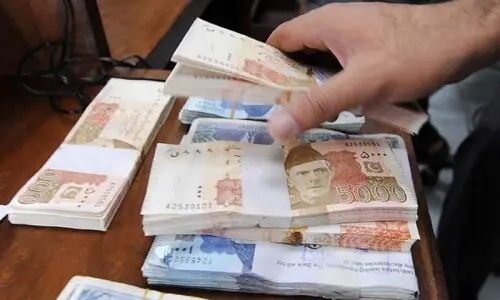
KARACHI, March 9: Banks borrowed massively on Friday as the shortage of liquidity forced them to get help from the State Bank.
The State Bank said that banks borrowed Rs25.025 billion from the SBP and this was mainly because of the settlement day, which demands meeting the weekly cash reserves requirement.
The banks have been facing tight liquidity position for more than a week and the inter-bank money rates were at their peak. Market experts said that the overnight rate was 9.4 per cent just below the discount rate of 9.5 per cent.
They said the heavy discounting was the reflection of tight monetary policy, which was also obvious from the slow credit growth for the private sector as it dropped significantly compared to last year.
“Despite this tight monetary policy there is no hope for interest rate hike,” said a banker adding, “State Bank’s policy does not favour any increase in the interest rate.”
It is generally believed that the less availability of credit leads to the costly money, which means higher interest rates but the experts said the State Bank would not allow further increase in the rate.
“Any increase in the interest rate could add to the inflation, which has already turned into the most sensitive issue for the government as well as the public,” said Afzal Khan, an analyst.
Though the main inflation CPI (Consumer Price Index) has dropped significantly in January but the average inflation of seven months was still over 8 per cent.
“The tight monetary policy would continue and the SBP may not allow any thing which could fuel the inflationary pressure, a hurdle to reach its target of 6.5 per cent CPI by the end of the current fiscal 2006-7,” said Afzal.
Analysts said that the figures for February would decide the inflation trend for the whole year. “If the CPI remains below 7 per cent during February the target of 6.5 per for the year would come closer for the SBP,” said Anwar Ahmed, a banker.
The banker said the SBP succeeded to get hold on the monetary growth (M2), which is still within the bracket set for its movement and it is less than last year in terms of percentage.
During the last eight months M2 grew by 7.74 per cent compared to 8.68 per cent during the corresponding period of last year. The M2 growth would enable the SBP to reach its target of 13.46 per cent for the whole year.
“The slow M2 growth will help to curtail the inflationary pressure, which rose mainly because of high food prices,” said an analyst. However, he said that over 60 per cent of the current fiscal period has lapsed; it would be difficult to reach the average inflation target of 6.5 per cent for the whole year.
He said the tight liquidity position would continue to prevail next week and might not change till the end of the current fiscal.