



 0
0

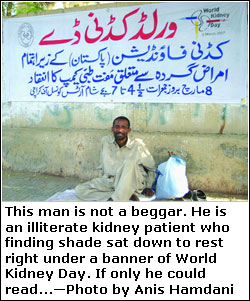 KARACHI, March 7: Are your kidneys okay? This question may offend you, but will surely make you pause and think about your kidneys. Pakistan and other countries around the globe are observing the second World Kidney Day today, Thursday, March 8.
Experts fear thousands of Pakistanis may be affected by early stage kidney diseases and not even be aware about it. Kidney disease is a silent killer; it can cause a loss of up to 90 per cent of a kidney function before one feels sick. So it’s good to know about your kidney’s health right now.
“The WKD is perhaps more relevant to Pakistan where the number of kidney patients is rising rapidly. At least 10 million people are affected in the country,” notes Dr Tazeen H Jafar, head of the nephrology section at Aga Khan University.
“The consequences of this serious condition are debilitating and may lead to the need for lifelong dialysis or transplantation, both of which are prohibitively expensive for most patients. The condition can cause heart attacks, strokes even premature death.
The World Kidney Day was jointly launched for the first time in 2006 by the International Society of Nephrology and the International Federation of Kidney Foundation in response to the alarming prospect that chronic kidney and other major chronic non-communicable diseases will claim the lives of 36 million people by the year 2015. The World Health Organisation has recommended a goal of reducing deaths from chronic diseases by two per cent every year over the next decade.
Human kidneys, are two bean-shaped organs the size of two fists, located on both sides of the spine just above the waist. They are amazing organs that play a crucial role in keeping people alive as well. The kidneys are responsible for filtering the blood to separate waste products and maintain fluid balance through the production of urines.
It is said that one kidney must function properly for life to be maintained.
Some of the most common kidney diseases and conditions are: polycystic kidney disease (an inherited disease), nephrosis (disturbance in the filtration function), lupus nephritis (inflammation), diabetic nephropathy, rhabdomyolysis (a disorder involving injury to the kidney), kidney stones and renal tubular acidosis.
According to Dr Tazeen, kidney disease sets in silently with no symptoms associated with its early stages. Therefore, patients go unnoticed until the disease is fairly advanced. Then it is too late to prevent complications. “Unfortunately, this is the most common scenario among patients in Pakistan,” she said.
She said it is important to know that kidney disease is easy to detect with simple, routinely available blood and urine tests. All individuals at high risk for kidney disease such as those with hypertension, diabetes, aged 50 years or over, smokers, and family history of kidney disease should undergo annual testing for early detection.
The public health mandate for World Kidney Day is clear: government needs to urgently introduce reforms in health care system to address the detection and prevention of chronic kidney disease given the escalating burden of this condition and those associated with it, she emphasises.
Dr Abdul Manan Junejo, a consultant nephrologist and faculty member at Jinnah Postgraduate Medical Centre, says the WKD mission is to raise awareness that kidney disease is common, harmful and treatable. This year’s theme is a simple slogan “Are your kidneys ok?’’
He says that studies around the world have shown that even in better educated and developed countries less than five per cent of the population can provide accurate answers to questions about where the kidneys are and what they do.
In the Pakistani context, Dr Junejo observed that diabetes is the leading cause of chronic renal failure, followed by high blood pressure as the second most common cause.
Hypertension is both a victim and culprit because it can originate from kidney malfunction and also cause kidney disease. Chronic glomerulonephritis and stone disease are also common in the country.
Good management of kidney can be achieved by strict control of high-blood pressure, vigorous control of blood sugar in diabetic patients, quitting smoking, avoiding misuse of drugs and obesity. Control weight, eat more vegetables and fresh fruits, reduce salt intake and avoid junk foods, Dr Junejo suggests.
Dr Khemchand Moorani, in-charge Pediatric Nephrology ward at the National Institute of Child Health stresses on the need for screening tests to detect kidney diseases in children. Maternal ultra sound, urine DR for protein, red blood cell and pus cells, serum creatine and bicarbonate tests may help diagnose kidney failure and renal tubular acidosis which can lead to stone formation.
He calls for the dilatation of kidney and ureters on antenatal U/S and subsequent work up and management to prevent long term effects of urinary tract obstruction like urinary tract infection, stone formation, hypertension and renal failure.
He says there are various management processes in case a child develops renal failure. He also stresses on prevention methods like early diagnosis of vesico-ureteric reflux, posterior urethral valves, calculi and other congenital renal anomalies which result in kidney failure.
Medical professionals are of the opinion WKD an international approach to address chronic kidney diseases (CKD) as a major public health problem. The risk of premature death, primary from cardiovascular disease is, on average, 1,000 times higher in patients with CKD than the risk of developing end-stage renal disease.
Various hospitals, health care bodies and NGOs have organised seminars, conferences and walks in connection with WKD in the city during the week. The Sindh Institute of Urology and Transplantation is also holding a public awareness symposium at its premises on Thursday.





























