0
0

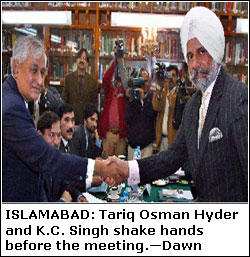 ISLAMABAD, March 6: The first round of the inaugural meeting of Pakistan-India joint anti-terrorism mechanism established last year to tackle the issue that has for long bedevilled relations between the two South Asian nuclear neighbours ended here on Tuesday amid questions of what it is capable of achieving given the trust-deficit that exists between the two countries.
Foreign Ministry’s Additional Secretary Tariq Osman Hyder led the Pakistani delegation at the talks while the Indian side was led by K. C. Singh, Additional Secretary of India’s External Affairs Ministry.
The five-member team from each side included representatives of the foreign and interior ministries as well as security agencies.
Much to the disappointment of Pakistan the Indian side shared no specific information or leads on the Samjhota Express blasts in which most of the victims were Pakistanis. Instead the Indian side presented a sketch of an alleged suicide bomber and claimed he resembled a Pakistani who had disappeared in India in 2006, informed sources said. The sketch was drawn on the basis of information collected by the Indian security agencies from the train passengers who had survived the attack, the Pakistani delegation was told.
The Pakistani side in turn gave a comprehensive dossier to the Indian delegation with very specific information about systematic involvement of Indian security agencies in terrorist acts in Balochistan, it is learnt.
The two sides have decided to meet again on Wednesday to finalise a joint statement, diplomatic sources told Dawn, adding that no joint press conference was on the cards. The head of the Indian delegation K. C. Singh will also call on foreign secretary Riaz Mohammad Khan during the day.
The Pakistani side, which found the Indian claim as to the Pakistani origin of the alleged suicide bomber rather disconcerting, conveyed to the Indians that it was deeply interested in the findings of the Samjhota Express probe given that most of the victims were its citizens.
The picture of a severed head of an alleged suicide bomber was also handed over to the Pakistani side in the context of the July 2006 Mumbai train blasts suggesting a Pakistani link. This was seen as a contradiction of the earlier Indian position that the Mumbai blasts were caused by planted devices and not a suicide attack.
According to informed sources both sides entered the talks equipped with their respective demand sheets. Reportedly the Indian side had a list of 40 alleged terrorists on their demand sheet.
Pakistan on its part gave a response to the information regarding an earlier incident (not Mumbai train blasts) provided to foreign secretary Riaz Mohammad Khan when he visited Delhi in November 2006, it is learnt.
A Pakistani official rejected the impression given by the Indian side after the talks that Pakistan had said it would not cooperate in old cases. The official maintained that Pakistan’s position was that it would cooperate on the basis of solid evidence and information provided to it.
Officials here said Pakistan on Tuesday gave some specific cases to the Indian side to look into and expected it to get back on them soon.
Apparently at the outset of the talks the Pakistani side underscored the need to cut out on polemics, finger-pointing and to make a fresh start.
On the sidelines of the meeting Indian High Commissioner to Pakistan told an Indian TV channel that there would be no talks about joint investigations into Samjhota Express blasts but indicated that more information would be shared with Pakistan. According to officials on both sides the next meeting of the mechanism would depend on the response each side gets from the other on specific cases. Meanwhile, the expectation at both ends is to hear from each other soon on their respective demands under the two-way mechanism.
The anti-terror panel, headed by the additional secretaries (UN) of the two foreign ministries, is mandated to “identify and implement counter-terrorism initiatives and investigations”.
The objective of establishing this particular mechanism was to facilitate rapid action. Foreign Office Spokesperson Tasnim Aslam characterized it as the “quick, informal method” for sharing of information if the two countries required each other’s assistance in this regard.
The joint mechanism was an outcome of a meeting between President Pervez Musharraf and Indian Prime Minister Manmohan Singh in Cuban capital Havana in September last year. The initiative followed the July 2006 train bombings in Mumbai which led to India postponing peace talks with Pakistan.
The formal constitution of the panel was announced in November 2006 when foreign secretaries of the two countries resumed peace talks in New Delhi.
Although the two countries already have a working group on counter-terrorism as part of the Composite Dialogue, the Tuesday meeting provided the opportunity the first-time ever for representatives of key intelligence and security outfits of the two countries to sit across the table as part of this new joint anti-terrorism panel.