



 0
0

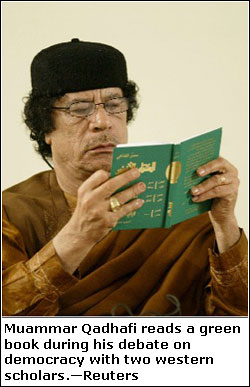 SEBHA (Libya): Libyan leader Muammar Qadhafi criticised the world financial system as a dictatorship based on fear on today but said Libya’s only pragmatic choice after sanctions was to accept the unfair reality of world trade.
Speaking in a rare public debate with Western scholars, Qadhafi added Libya, whose press is state controlled, accepted the Internet and international satellite television because it showed Libyans what he called the weakness of Western democracy.
“The prevailing powers today are in the hands of those who have economic and military power which puts fear in others. They can make you starve. They can close the doors for your exports of raw materials such as coffee or oil,” Qadhafi said.
“This is an international dictatorship that is being practised against people, especially poor people,” he said of conditions imposed by Western aid donors on poor countries.
“Those who threaten you with military power or with the (UN) Security Council are the people who are controlling the world and if you go against the tide you might be destroyed.”
“The Libyans ... realised this very well. From this realistic and pragmatic point of view Libya has improved its relations with the world,” he told the debate, intended to mark the 30th anniversary of his declaration of a Jamahiriyah or state of the masses.
The two-hour discussion was held in a small room in front of a small group of invited journalists in the southern desert town of Sebha where Qadhafi made the proclamation on March 2, 1977.
The system of town hall meetings is seen by critics as cover for authoritarian rule. Admirers say the system guarantees ordinary people a direct say in ruling themselves.
Qadhafi, shunned internationally for much of his rule because the West accused him of terrorism, improved his standing in 2003 when Libya accepted civil responsibility for the bombing of a passenger plane over Lockerbie, Scotland.
Months later Tripoli announced it would abandon its weapons of mass destruction programmes. The announcement drew praise from London and Washington and in September 2004, US President George W. Bush formally ended a US trade embargo.
Dressed in sweeping brown African robes and occasionally holding a copy of his 1970s Green Book of political philosophy, Qadhafi said Libya accepted that economic transformation could come in the shape of globalisation even though, he said, it was driven by powerful financial interests.
He added: “Libya is part of this changing world which is dominated by globalisation. ... The IMF (International Monetary Fund) and the World Bank impose very harsh and unsuitable conditions on poor countries.
“We can criticise them but we cannot be outside those institutions. It’s impossible at the present time.”
The veteran Libyan leader reiterated his view that representative democracy was the dictatorship of the 51 per cent.
“Fifty-one per cent – this is not democracy. This means that 49 per cent is against the winner,” he told US political scientist Benjamin Barber and British sociologist Anthony Giddens in a discussion moderated by British journalist David Frost.
His country of about six million would keep Jamahiriyah because it gave more say to ordinary people than Western polls, which, he added, was a system enfeebled by voter apathy.—Reuters





























