0
0

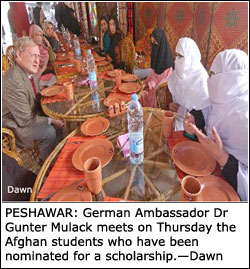 PESHAWAR, March 1: German Ambassador Dr Gunter Mulack has urged Pakistan and Afghanistan to put in place an effective mechanism for “joint border management” in order to check cross-border infiltration of extremists.
“Pakistan has done a lot for securing its porous border with Afghanistan. However, the two sides have to concentrate more on building close liaison for vigilance on the border. This will help improve economic and political stability besides countering terrorism in the region,” Dr Mulack told a press conference here on Thursday.
Joint border management, he explained, could be achieved through coordinated steps taken for border security and overall development of the communities living on both sides of the Durand Line.
Supporting the North-Waziristan peace agreement, Dr Mulack said that dialogue was imperative to find the root-cause of disputes because military action alone was no solution to the problem.
“We encourage peace accords, however, quantification of its benefits was difficult,” he said, and added that Pakistan was certainly monitoring the situation on the ground.
About similar accords inside Afghanistan, the German envoy said that the issue was recently discussed in the German parliament and it was believed that the solution of the problem did not lie in using military means.
He said the British had a peace agreement with the local Taliban at Musa Qala, which by and large remained successful. He, however, lamented that there were certain elements in the Taliban and Al Qaeda who did not want peace.
When asked about Pakistan’s intention for fencing and mining the Afghan border, Mr Mulack was of the view that fencing the border was purely an internal issue of the Pakistani government.
However, as far as mining the border is concerned, Germany like most other European countries was signatory to the Ottawa Convention 1997, thus it could not support such a move because landmines often killed innocent civilians.
Highlighting Germany’s efforts in Afghanistan’s reconstruction, Dr Mulack said that the German government since 2002 has pledged a total of 800 million euros for reconstruction in Afghanistan.
Similarly, its 2,900 combat forces were currently part of ISAF making Germany one of the largest troop-contributing nations to the UN-mandate, he maintained.
The German diplomat explained that his country was eager to have a durable peace in war-ravaged Afghanistan and steps were being taken at bilateral as well as international forums in this regard.
AFGHAN STUDENTS: Dr Mulack said that Germany has awarded more than 1,000 scholarships to Afghan male and female students in various higher educational institutes of Pakistan because knowledge was the key to progress.
“We want a durable peace and sustainable development in the war-ravaged country that cannot be achieved without skilled manpower,” he said, and added the main idea behind the scholarships was to provide Afghans an opportunity to play a pivotal role in the rebuilding of their homeland.
The German Government in collaboration with the UNCHR granted scholarships for 85 male and female Afghan students to continue their higher education under the Albert Einstein Refugee Initiative.
PAK-GERMAN RELATIONS: About Pak-German relations, Mr Mulack said that cooperation between the two friendly countries was increasing with the passage of time, and added that the volume of bilateral trade had reached $2 billion. He said that Germany was contributing significantly in development of various sectors in Pakistan, particularly where the field of education was concerned.
He said that Germany was providing financial assistance for the establishment of a technical university at Lahore as part of the Pakistani government’s plan to set up eight foreign universities in the country.