0
0

 PAKISTAN wants to import many essential items from India which will certainly tilt the balance of trade in favour of New Delhi. It is estimated that at the end of this financial year Pakistan’s trade deficit is likely to be one billion dollars.
Already between July and November, 2006, the deficit has risen to $416 million or 779 per cent of the deficit during the same period last year.
According to India, Pakistan imports only those essential items which are urgently needed, such as vegetables and meat. These items are available in India at cheaper rates and the transport costs are also low as compared to other countries. Many Gulf countries are doing the same when it comes to food item imports, they say.
Now a lot of raw cotton is coming from India for the textile industry as textile industry needs exceed our cotton output. Indian lint costs Rs150 -- to Rs200 more per bale than Pakistani cotton because of its quality and better returns.
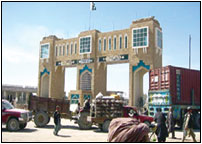
But the government does not allow import of cotton via Wagah border. It has to come via Karachi port. However an exception has been made in the case of Nishat Textile Mills and Riaz Mills in respect of 50,000 bales of cotton which they have booked via Wagah border. But the consignments are dumped at the border for at least three months for custom clearance..
During the period of increasing competition for Pakistani textiles around the world, the mill owners are looking for cost-saving measures, but the government is not very helpful. .
Our textile industry prefers Indian cotton as only 50 per cent of the cotton produced here is clean. Official efforts to provide dust–free and pest–free cotton to the textile industry has not been a total success so far.
In fact the textile industry here wants to import lot of things from India, including textile machinery, spare parts and chemicals, instead of importing them from western countries which will cost them a lot. But the government is not ready to accept these demands for political reasons.
Hence these items are not imported but smuggled to Pakistan through third countries like Dubai and Singapore.
With the steel prices soaring, Pakistan is expected to import 20,000 tons of corrugated iron sheets from India for exclusive use in the earthquake-affected areas. Last year around 12,000 tons of sheets were imported for the same purpose.
India is also interested in exporting tea to Pakistan via Wagah border. Indian Foreign Minister Pranab Mukherjee had discussed the proposition with Foreign Minister Khurshid Kasuri during his recent visit to Islamabad.
Islamabad prefers import of tea via seaport which makes it costlier. With an import of around 140,000 million pounds of tea annually, Pakistan is the second largest consumer of tea in the world.
Meanwhile, the two countries are to evolve a joint strategy for marketing rice, mainly basmati, the common product of the two countries. Rice exporters here believe that international traders of rice are benefiting a lot due to a competition between India and Pakistan and are exploiting the situation.
They want both the countries to coordinate their policies and conduct the DNA test of basmati to satisfy its European Union importers.
Discussion between rice exporters of the two countries had started as early as May 2004, when a rice delegation from here visited India, but the cooperation sought has made little headway so far.
Indian pharmaceutical products are being smuggled to Pakistan in large quantities as they are comparatively cheap. Prices of such drugs in India are far below than those produced in Pakistan despite the fact the same foreign company is manufacturing them.
The World Bank has cautioned that pharmaceutical products made in Pakistan are so highly priced that they would not be able to compete in the export market, and Chinese and Indian products would have big sale in the region, even in Pakistan. The government does not seem to have taken any notice of the bank’s cautionary note.
Pakistan’s balance of trade with India will improve with the expected export of around a quarter million tons of wheat to India this year. Pakistan has half a million tons surplus wheat and India has fallen short of the same quantity.
Negotiations are on between the two sides.. If the deal is finalised it will be for the first time that India will import wheat from Pakistan.
The two neighbours have agreed to extend visa facilities to businessman on both sides and issuance of multiple visas is expected.. How the change of policy takes place remains to be seen.
While trade is increasing between the two countries and the two–way trade has crossed the billion dollar mark, India has not been able to get the most-favoured-nation status from Pakistan which reduces tariff all around. India was expecting that the problem will be circumvented by Safta of the seven-member Saarc nations coming into force.
Safta became effective from January 1, 2006 and was operational from July 1, 2006, but Commerce Minister Humayun Akhtar says MFN is a matter for the WTO and not for Safta.
At a recent meeting of Saarc council of ministers, India, which tried to raise the issue, was told that tariff and trade issues should be dealt with at the Safta council of ministers meeting.
The Safta council of ministers is to meet in Kathmandu on March 26, in which Pakistan, may argue, as before that trade between India and Pakistan should take place on the basis of a mutually-agreed positive list. Pakistan’s positive list has now over 1,000 items. But India wants the issue of tariff reduction to be solved on the basis of Safta accord. While India has given the MFN status to Pakistan, it has too many non-tariff barriers which bar trade between the two countries. These barriers have to be removed if normal trade is to commence between India and Pakistan.
But an improvement in political situation, particularly with respect to Kashmir, can improve the MFN prospects of India, says Humayun Akhtar, and that is too slow in coming, he adds.
The Bangladesh Consul-General in Karachi, Saqib Ali says that for his country the smooth and successful working of Safta is far more important than free trade area accords with India or Pakistan.
He said Bangladesh was interested in signing a direct shipping service protocol with Pakistan, but Pakistan was more interested in signing the FTA.
Pakistan and India have signed a shipping protocol for the resumption of services between Mumbai and Karachi. But a shipping service and the carrying of cargo from Karachi to Mumbai and Mumbai to Karachi has not yet started. When it starts, the volume of trade between the two countries can increase substantially.