0
0

Inmates learn skills in jail
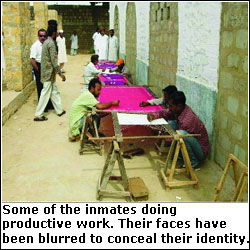 KARACHI: Determination reinforced by dedication can change one’s life. This is what is happening in Karachi Central Prison.
The central prison is now in the heart of Karachi. A 65-acre complex, it was far from the city when built in 1898. It has also incarcerated the famous Maulana Mohammad Ali Johar and Maulana Zafar Ali Khan who were tried in Karachi in 1919 for organising the Khilafat Movement.
The prison when built was meant to accommodate 1,000 prisoners and staff. Today it houses at least 6,000 inmates, 125 of whom are condemned while another 50 are high profile detainees from all over Pakistan.
A person sentenced to prison becomes an outcast from society, carrying a stigma for the rest of his or her life. A prison inmate is not expected to be a productive member of society. Citizens paying taxes bear the expense of imprisoning the offender. One Sindh government official has shown that prisoners in jail can be productive members of society.
Superintendent Prisons Nusrat Mangan is a soft-spoken person with a demeanour one would expect in a university professor. He was completing his final year thesis as an architecture student when he sat in the public service examination to select prison officials.
He was appointed and switched careers. He joined the prisons service in 1987. While in service he decided to do a masters in sociology. This unique combination has made him an amazing prison department official.
He strongly feels that most of the 6,000 prisoners in central prison can become useful members of society. To prove his point, he has initiated some projects and revived some others, after being posted.
He is trying to salvage and make operational ten shuttleless Sulzer looms that knit yarn. These looms were given to the jail and were gathering dust for the last seven years. A few of them are not operational. He now wants textile industries to give the prison orders to knit fabric.
The idea is to train the inmates in a technical skill that will help them earn a livelihood once they leave prison. The jail expects to earn around Rs200,000 a month. A small portion of this is to be set aside for the inmates working on the looms to support their families. Beside they will get a small sum in hand when they leave prison.
There are another 50 prisoners engaged in producing embroidery for women’s clothes. These clothes command good prices.
A display centre has been set up just inside the boundary wall of the prison which will sell handicrafts, embroidered clothes and other goods made by the prison’s inmates. Tailoring classes and running a laundry are plans that he hopes will materialise in the near future.
Acquiring an education is also encouraged. Prisoners who want to register for various programmes of Allama Iqbal Open University are facilitated, while a computer training centre is functioning with 24 PCs. These are five prisoners teaching 150 others different courses from networking to hardware.
There are two programmes for 25 prisoners each to improve their English. These tutors have designed the course themselves and have got the computers institute affiliated with a training facility.
The SP is keen to acquire the services of a visual art instructor. The idea is to hold an art exhibition. He has already applied this idea successfully when he was posted in Nara jail.
A very talented but pennyless artist asked him to purchase a painting. He agreed and asked the painter to teach the inmates, many of whom were willing students, completing a week’s assignment in two days and demanding more work.
He hopes to build a couple of multi-storey prison blocks to house the prisoners in better conditions. The present barracks are single story structures.
The modern blocks will free space which can be used for a kitchen garden growing vegetables for the prison’s use. There are a couple of small plots earmarked that grow vegetables but these are not enough.
The prison official is modest and says he is a government servant doing his job and ably assisted in his task by an efficient staff.—Text by M.M. Alam, Photo by Dr. Behrouz Hashim
Exam controversy and students
Composite or separate exams for class IX and X is an issue which has been hanging on the heads of students for the last couple of years. The federal, provincial and local authorities have failed to reach consensus on the issue. Ironically, students are the ultimate sufferers for whom the controversy has been created.
The regime that claims devolution of key matters of governance to the lower level has created a centralised edifice of decision making for the procedural issue of schools exams. There are no two opinions that education is a provincial issue according to Pakistan’s constitution.
The federal government’s role is limited to advice on policy, planning and promotion of educational facilities to allow the federating units to meet the need and aspirations of their people. The entire institutional infrastructure of the education sector is based on this premise. Even the Local Government Ordinance 2001 has devolved the responsibilities of managing educational matters to the district governments. However, what one finds in practice is completely in contrast to these provisions.
Zeeshan is among the thousands of students, affected by the controversy created by ‘elders’ of this country. “How I can start exam preparations when I am still confused,” he says. Not only students, but teachers are also finding it hard to cope with the authorities ever changing decisions.
Obstinacy in support of a matter such as combined examination is likely to cause harm. There are other pressing issues in education which beg the government attention like mismanagement of funds, recruiting qualified teachers and improving their salaries, modernising teaching methods, ensuring availability of textbooks, repairing dilapidated buildings, the list is endless. Perhaps the government would be better put addressing these issues.
Hazardous amplifications
Teenaged Arsalan has abandoned his passion of listening to music on his favourite walkman and tiny Chinese-made FM radio. A doctor has recently informed him that his noisy beloved devices have affected his outer ear cell and he could lose the hearing ability permanently if music continues to hammer his eardrums.
Arsalan, a resident of Gulshan-i-Iqbal and college student, was referred to an ENT specialist after his parents found him sluggish in response to conversations, sometimes not responding at all.
“The walkman or walkman-like FM radio had just become parts of my body and I was sensing some difficulty in comprehending what others talk for the last few weeks,” says the boy.
He was a chronic user of such electronic devices but luckily saved the permanent hearing loss for his habit to listen to soft music in soft volume. But, there are many youngsters who are in the habit of dancing to music played on their sets at such high volumes audible even to the bystanders. They might be not as lucky as Arsalan.
“Many youngsters have visited me for the treatment of hearing impairment they were facing due to the use of walkman and FM radios with loud volume,” an ENT specialist says. “Unfortunately,” he says, “some of them have suffered the high sensory neural loss, which is a permanent disability and untreatable.”
Experts say the parents and teachers should get the youngsters informed of the hazards of carrying such deadly devices.
“Or at least the elders should tell the boys not to amplify the volumes to dangerous pitches while listening to their favourite music or songs,” says another specialist.
Teachers at colleges say they could not force their students to do something. “Our youngsters even don’t like advice by their teachers in schools so how can we ask them (pupils) to do away with such devices in college,” a lecturer says.But, the parents don’t play their part in general terms. That can be seen from the ever-increasing sale of walkman and FM radios in Karachi’s electronics markets.
“I usually sell over a dozen of walkman sets,” was the reply of a salesman of a common shop of the Saddar Electronics Market. He says usually teenagers come with their parents to buy these sets.
The walkman-like made-in-China FM radio sets are selling in the city like a hot cake. It is available in all markets, shops and even without roadside vendors. They are favourite because they are the latest, cheapest and serve their holders by receiving all local FM channels, which mainly broadcast the latest music and songs and justify their popularity among the young audience.
“I usually sell around a dozen radios a day and earn good money,” Tahir, a vendor in Boulton Market, says. A vast majority of purchasers, inarguably, are teenagers.
Ghosts!
Most urban people believe that there exist ghostwriters, ghost schools, ghost teachers and other employees in thousands. But they do not believe in the existence of ghosts.
Some people, however, have recently begun having creepy feelings since the publication of news stories about a haunted tree near the mortuary of the Jinnah Hospital (JPMC). Some other people have, of course, dismissed these reports in the Urdu press as 'ghost stories’. Some doctors and staffers admit that the tree is haunted and many of them have heard certain un-describable voices.
I have met both sets of people who claim that they have sought, sometimes visiting desolate places and graveyards, and found no such things. They believe people who spread such rumours have ulterior motives and vested interest.
The other set of people swear that they have experienced the existence of invisible beings, ghosts, fairies, witches, etc. And in such experience they have whole families and even communities to testify.
I met an old man, Khan-i-Zaman, who bared his back to show me quite visible red marks of five fingers. He said it was the imprint of a witch’s hand who later fell in love with him for his being such a bold man and appeared in his bedroom every night.
Well, you can say that the hand could be that of a woman as well. Some women could slap as lethally as to leave their stamp on someone’s body.
Those who claim that there is always a man behind a successful ghost have got their opportunity to investigate and unmask the creature hiding behind the JPMC tree.
An expression of love
Valentine’s Day is celebrated across the globe on February 14 with different explanations about its origin. Some associate it with the martyrdom of St Valentine in Rome on February 14, 269AD. Others say Cupid — the Greek god of love — was the one who laid its foundation. However, all who celebrate it agree that it is all about love.
In Karachi, the young particularly students keenly await the day to express their love. Most schools, colleges and universities wear a festive look. Colourful gifts, cards and flowers are to be seen in the hands of boys and girls on the day. The greatest beneficiary are those who sell greeting cards, flowers, chocolates and gifts besides restaurants who promote Valentine’s Day.
— Karachian
| © DAWN Group of Newspapers, 2007 |