0
0

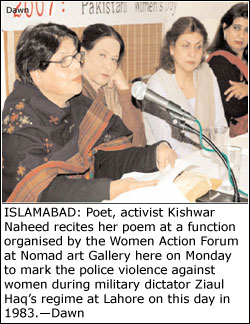 ISLAMABAD, Feb 12: A representative gathering of women and human right activists, legal experts and intellectuals on Monday called for merging the struggle for women’s emancipation with the overall democratic struggle against the outdated socio-economic and exploitative feudal and military bureaucratic system.
They were speaking at a meeting organised by the Women Action Forum (WAF) to mark the anniversary of the brutal police action against women in front of the Lahore High Court on Feb 12, 1983 for protesting the Law of Evidence and the Zina Ordinance issued by the military dictator of the day, Gen Ziaul Haq.
They rejected the latest laws on women protection and honour killings as cosmetic and ineffective and demanded that all laws discriminatory to women should be repealed.
They expressed concern over the rise in violence against women and the continuing denial of rights to women in particular and basic human rights and civil liberties in general.
In a statement read out at the conference by Ms Nageen Hayat, the WAF said “violence against women, especially rape and so-called honour killing, is on the rise”.
She said two recent cases shocked the nation once again. In the first a 16-year-old girl was gang-raped and paraded naked in Habib Lebano village of Ghotki, and in the second, a divorced woman in her forties was stoned and clubbed to death with her male companion in Donga Bonga district of Bahawalnagar.
“This was just tip of the ice-berg as many such cases go unreported. In spite of the government’s assurances that the safety and dignity of women will be safeguarded, violence against women continues unabated and perpetrators continue to go unpunished.”
Ms Hayat said the WAF demanded the immediate repeal of all retrogressive legislation, including Hudood ordinances, Law of Evidence, Qisas and Diyat provisions, the blasphemy law and the Shariat Act which “mitigate the struggle for gender equality, social justice, human rights and peace”.
She invited all progressive and committed individuals and groups to jointly struggle for riding the society of bad laws, religious, ethnic and political prejudices, intolerance and strife, economic deprivation, oppressive socio-cultural norms and patriarchal customs.
She called upon the government to curb growing intolerance, extremist politico-religious elements and traditional power elites who attempt to hold Pakistan hostage.
Naeem Mirza, Director Legislative Watch Programme, Aurat Foundation Publication and Information Service, said the concerns of women were becoming mainstream concerns. He wanted substantive criminal justice reforms and alleged that the lower judiciary was corrupt “though not as much as the police was”.
He said “creating an island of women’s protection in the sea of dictatorship” would be meaningless.
All struggles for rights should be conducted in unison, not in isolation, he said. Mr mirza urged the women rights activists and all progressive forces to link their struggle with the movements of Hari (peasant) and bonded labour of Sindh and Okara farms.
He criticised the hypocrisy of the military rulers.
A student of Khaldunia High School recited her English poem on the occasion.
Along side the conference, the WAF had also organised a painting exhibition by renowned artist Qudsia Nisar. The abstract reality in Qudsia Nisar’s art becomes more intense than the physical reality, enhancing deeper aesthetic sensitivities, full of newness and universal appeal.
The participants praised Qudsia Nisar’s work as a foremost painter of abstraction in the medium of water colour and said she had given a new horizon to art in Pakistan.
Qudsia Nisar is acknowledged as the country’s most high profiled artist in abstract art, with more than three decades of art achievement and experience to draw upon.
A mushaira was the last item on the agenda for the day. Poets including Kishwar Naheed, Shabnam Shakeel, Sarwat Mohiuddin, Abida Taqi and Rakhshanda Parveen enthralled the audience depicting the miseries, injustices of society and struggle of the women.