0
0

ISLAMABAD, Feb 6: Two parties boycotted the start of a National Assembly session on Tuesday in a glaring rift in the six-party Muttahida Majlis-i-Amal over whether the grouping should honour or revoke a vow to quit the lower house.
Both the Jamaat-i-Islami and the Jamiat Ulema-i-Pakistan, which want all 64 MMA members to resign from the 342-seat lower house in protest against a women’s right bill passed by parliament in November, indicated they would continue their boycott until a contrary direction was given at an alliance leadership meeting in Lahore on Wednesday.
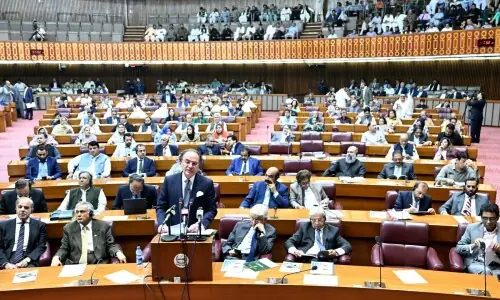
While nearly 30 members of the JI and JUP stayed away, those of the Jamiat Ulema-i-Islam, the other main MMA component, came to a poorly attended brief sitting before the house was adjourned until 10am on Wednesday without conducting any business to mourn the recent death of a JUI MNA from the North West Frontier Province, Nasib Ali Shah, for whom a prayer was offered.
But JUI chief and opposition leader Maulana Fazlur Rehman, still fresh from a much-publicised angioplasty operation for a heart ailment last week in Lahore, was missing from the house.
The MMA originally issued a threat in October to resign if the National Assembly passed the Protection of Women (Criminal Laws Amendment) Bill, which sought to protect women from the widely complained misuse of two controversial Hudood ordinances forming an Islamic rape law enforced in 1979 by then military ruler Gen Ziaul Haq.
But the alliance, which described the bill as un-Islamic, failed to carry out its threat mainly because of JUI foot-dragging after the draft was approved by both houses of parliament in November and became an Act after a presidential assent, sparking an internal controversy and frequent taunts from rivals for not keeping a promise.
While the JUI dithered, apparently to avoid a political turmoil that could endanger the MMA government in the NWFP that the party leads, and its major partnership in the PML-led government in Balochistan province, members of both the JI and JUP sent their resignations to their party leaders to be handed to the house speaker whenever a date was fixed for that.
Tuesday’s boycott by of the house by the JI, whose chief Qazi Hussain Ahmad is also the alliance president, and the JUP was the most open display of differences in the grouping formed before the October 2002 general election that it swept in the NWFP and Balochistan mainly because of an anti-American sentiment after the US-led invasion of Afghanistan and a government policy to sideline liberal mainstream parties.
JI Naib Amir Liaqat Baloch said his party’s parliamentary group had informed the JUI about its move and still favoured resignations after considering the current situation on Tuesday at a meeting in Islamabad chaired by the party chief.
“In principle, it was the view of all (parliamentary group) members that the Supreme Council’s earlier decision should be honoured,” he told Dawn.
But he said the party would abide by any decision that might be taken by alliance leaders at Wednesday’s meeting in Lahore.
Sahibzada Abul Khair Mohammad Zubair, leader of the two-member JUP group in the National Assembly, said his party would also boycott the house until the alliance took another decision.
Tuesday’s sitting, which marked a belated start of the present assembly’s fifth and last parliamentary year after a 75-day recess, lasted only a few minutes consumed in remarks about the dead MNA and a prayer for him before Speaker Chaudhry Amir Hussain concurred with Parliamentary Affairs Minister Sher Afgan Khan Niazi’s request to adjourn the house without taking up any item of a comprehensive agenda set for what was a private members’ day.