



 0
0

Don’t let small projects linger
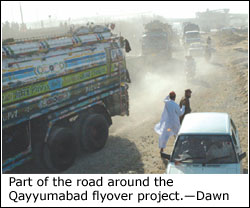 RESIDENTS of Gulistan-i-Jauhar have been bracing themselves for a long period of suffering since the announcement on January 11 by the city nazim that a flyover would be built at the Jauhar Mor to ease traffic congestion on Rashid Minhas Road. President General Pervez Musharraf is expected to inaugurate it soon.
The cause of concern, of course, is not the building of a flyover at that point. When built, it would benefit both residents and motorists. But residents know how long will be the trouble they are set to face. And their scepticism is not unfounded.
"Oh, no!" exclaimed a young motorist living in Gulistan-i-Jauhar when he was told that a flyover would be built at the place. "It was an 'azab' (affliction) when a road was being expanded there. A flyover will mean many, many months of suffering."
People who pass through what used to be called Hino Chowk, near Qayyumabad, where a flyover project has been under construction for more than a year, know how indifferent the relevant authorities have been to their sufferings. The roads around the project are in tatters. With sharp gravel pieces protruding and potholes widening into big craters, the roads are a motorist's nightmare. Admitted, work on the project has been going on day and night. Indeed, the flyover has begun to take shape now. But why can't they repair the roads damaged because of the project? The government can surely get bind the building firm to keep the roads along the project in order.
The stretch between Korangi Crossing and the PAF's Korangi Creek base has been repeatedly ruined by the oil tankers filling at the Pakistan Refinery and PARCO. In many countries heavy vehicles are not allowed to run on roads other than the ones designated for them. They may be strong enough for light vehicles but heavy vehicles may create bumps in them. There are many educational institutions and industrial units along the PAF road. PAF Korangi Creek base officials, including the base commander, use the same road. But they all seem to be either indifferent to the problem or cannot have it repaired. The poor quality material used in its patchwork washes away even with a moderate rainfall or vanishes under the load of the juggernauts. A road built with proper material is needed there that could withstand the load of the heavy oil tankers, rumbling day and night on this two-and-a-half-kilometre stretch.
The dug-up roads have turned Landhi and Korangi into a no-go-area - once again! Forking into Korangi at the flyover project at Qayyumabad, both the main Korangi Road and the Industrial Road have places dug up either for laying sewerage lines or road expansion. Work on the road between Korangi Crossing and Daud Chowrangi was begun about two years ago when Niamatullah Khan was at the city's helm of affairs. Not even half of it has been completed yet. So, frequent traffic jams occur at several places on the road.
Take the road through the Korangi Industrial Area to Daud Chowrangi in Landhi and you will see how badly this road is damaged and how torturous the travel on it is. There is no smooth sailing beyond the Daud Chowrangi as a flyover has been under way on the other side of the Quaidabad bridge, making it the worst trouble stop for motorists passing through it.
There are many more examples which show that the city government does want to take strides to improve the city's infrastructure. But it is reluctant to take small steps to mitigate the citizens' inconvenience and suffering.
There never were so many flyovers, underpasses and durable roads before. Striped with white and yellow paints and lined with reflectors. They are sparkling, flashy during the day and bright, shiny at night, ineffably fantastic. They have to be cleared of the occasional blemishes - the short spans of damaged, dug-up, troublesome roads.
Malir losing its meaning
In Sindhi Malir means a lush green area and it is favourite metaphor of the great mystic poet Shah Abdul Latif Bhitai who employed it to depict prosperity and happiness in his poetry.
The Malir area was a green belt adjacent to Karachi, a source of fruit and vegetables to Karachians. And it used to be a favourite picnic point of those bored with urban living.
All this is history now. The Malir of today is a Karachi suburb adversely affected by unplanned and unbridled urbanisation.
The people of Malir are facing an ecological disaster mainly due to water scarcity. The oasis has paid a huge price for the city's haphazard growth. Karachi skyscrapers are built with the sand and gravel taken from the Malir riverbed and the river's tributaries. The excavation caused underground water level to drop to as deep as 500 feet. Some three decades ago, its water table was not more than 30-foot deep and the fertile land would supply fruit and vegetables to half of Karachi. Five rain-fed rivers of the valley are now dead. Thanks to the sand and gravel mafia.
The older generation recalls with nostalgia how beautiful and fertile their valley was.
"We would grow potatoes, good quality guavas, mangoes and other fruit and vegetables then. Today, you won't find a single potato in the entire valley," says Haji Ali Bux, an elderly farmer.
Water scarcity has dealt a crippling blow to the agricultural economy of the area. The historical wells have gone dry.
Every well requires side borings as they provide water to the main well from where it is supplied to the land for irrigation. "It has become too expensive to cultivate our lands," another farmer of Memon Goth says.
Agriculture and agro-based economy are the main sources of income of around 75 per cent population of the Goth.
Locals have been forced to switch over from farming to petty jobs in government departments, driving of vehicles, mining of sand and gravel, doing small business and migration to Middle Eastern countries.
In the past, the farmers were self-sufficient in grain production but land degradation has forced many to purchase essential commodities from the market.
A few years ago, farmers opted to cultivate betel leaves (paan) that usually fetch good money in the market and hundreds of shades were established.
It is a capital-intensive crop requiring peculiar irrigation arrangements, a typical shade and an expense of some Rs400,000 per acre.
The crop got popularity among the farmers because of high profits but vanished due to viral diseases. The absence of water spawned diseases and fungus, says Zameer Ali, an expert. After that most of paan shades have been shifted to Thatta's Garho town.
The destruction of ecology and agriculture of Malir is a sad example of unrestrained development that is taking its toll on natural resources, causing them to deplete rapidly.
Chinese mania
It doesn't matter if a cat is black or white as long as it catches mice, says the modern architect of China, Deng Xiaoping.
One wonders how Chinese products have captured the world market and strengthened this notion. This makes sense when one visits the bazaars of Karachi. Being cheap, Chinese needles, nail clippers, balloons, handkerchiefs, automobiles, tooth brushes, garments, shoes and any such commodities one can think of have flooded the markets.
Boultan Market, Light House, Zainab Market, Saddar, Tariq Road and even at roundabouts and roadside stalls, Chinese products are sold and purchased. Now buses and minibuses too are used for business of such products.
A colleague is surprised by the variety of items on sale and says: "A couple of days back, my mother asked me to bring her a 'tasbeeh' and a shawl. To my utter surprise, Chinese made 'tasbeeh' and shawls were being sold at a number of shops.
"No doubt, cheap products are more attractive to the middle-income and labour classes and they have outclassed local products. This may seem counter productive to the weak economy of a country like ours, but not the millions of people living below the poverty line."
— Karachian
Email: naseer.awan@dawn.comM
Encroachments: the bane of our cities
NO city in our country is spared from encroachments and thus anti-encroachment drives, not even our planned and relatively tidier capital city.
The fact that authorities recently had to resort to the drastic action of demolishing illegal constructions (permanent encroachments) in both Islamabad and Rawalpindi makes many wonder if our present anti-encroachment departments are capable of dealing with a problem which is only expected to grow in our fast expanding cities.
In Rawalpindi, five under-construction commercial plazas —three on the main Murree Road and two others in Sadiqabad — said to have been built in violation of the city’s building rules were demolished over the last weekend by the Rawal Town Municipal Administration. The three two-storey plazas on Murree Road were razed because parking lots were not provided for.
About a fortnight ago, six mosques were reportedly demolished in Islamabad as part of the city authorities’ anti-encroachment drive against some 84 mosques which are said to have been illegally constructed, a move which prompted female students of a madressah to forcibly occupy a children’s library in protest.
CDA’s Anti-Encroachment Department had started the demolition campaign against illegal structures in urban areas several months ago. In September 2006 it razed a camp said to have been established illegally near a mosque in sector G-8/1, some 23 makeshift cottages in sector G-11/4, various cattle huts in sector I-11/1 as well as three boundary walls.
Last Friday, some huts in Saidpur Village were reportedly razed to make way for the alignment of a nullah (drain) — part of CDA’s plan to establish a ‘model tourist village’ — prompting the villagers to stage a demonstration seeking compensation in the form of alternative plots in the village.
In the ICT, the encroachment problem is particularly extensive in the non-developed rural areas, especially Tarnol, Sihala, Bhara Kahu and Saidpur. In 2005 CDA had carried out a survey of encroachments in these areas before launching an anti- encroachment operation.
In 2006, CDA set up anti-encroachment checkposts in the rural areas to prevent recurrence of illegal constructions. For this, CDA’s enforcement directorate was strengthened by personnel from the capital police who were supposed to provide guards to man these checkposts.
But while anti-encroachment drives against makeshift temporary structures and movable stalls in the markets and on the roadside can be carried out relatively easily, similar campaigns against permanent structures like mosques or commercial plazas can prove to be quite a daunting task, politically as well as economically.
The operation to remove permanent encroachments is usually a massive one, requiring not only dozens of vehicles, trucks, dumpers and tractors to be used in the bulldozing but also the presence of tens if not hundreds of law enforcers. All this money of the taxpayers is wasted when these encroachments resurface, which is very often the case where slums or katchi abadis are concerned, whether at the same site or elsewhere.
Moreover, razing these illegal structures is also wastage of resources, however, wrong the encroachers may have been in raising these structures where they are not supposed to in the first place. Then there is also further wastage of resources in subsequent long-drawn litigations between the owners and the authorities.
All this wastage of the precious resources of the people and the nation could have been avoided if we had more efficient government agencies, not least of all more authoritative but corruption-free anti-encroachment establishments, to pre-empt the mushrooming of illegal structures in the first place.
No person has the right to encroach but the fact that encroachments often occur and very often are allowed to continue mean that the government agencies have only themselves to blame for the existence of these illegal structures.
This is because illegal structures are usually the result of officials turning a blind eye to encroachments and not taking stern action from the very beginning before the first brick was laid. And the longer the encroachments are allowed to continue to exist, the harder it is to get rid of them.
In the case of the recently demolished plazas in Rawalpindi, their building plans must have been approved by the relevant government departments. In the case of the demolished mosques, electricity, water and even drainage connections must have been approved by the relevant government departments.
In both instances, officials from the anti-encroachment departments should have been there to prevent the first brick of these structures being laid. Thus, unless officials in the various government agencies have the will and courage to act whenever necessary and at the same time these officials are made accountable for their lapses when encroachments come up, illegal structures will continue to be raised in our cities.
Anti-encroachment checkposts would also need to be set up in the capital’s urban areas, where encroachments outside the shops and along the roadside in major markets like Aabpara, Blue Area, etc., are persistent recurring problems. But then these checkposts will only achieve the objective if they do not merely become another opportunity for officials to accept favours and look the other way.
While temporary encroachments like vendors, pushcarts and stalls make the markets crowded and untidy and cause traffic jams on the roads, permanent encroachments like illegal construction foul up urban planning and hamper efficient development.
In many cases, encroachments in our country are also a reflection of not only influence, nepotism and corruption, but the inability or failure of governments to provide the population with the necessary facilities like low cost housing, employment opportunities, etc., thus driving them to resort to encroaching to build a shelter over their heads or to earn a living.
Controlling the growth of encroachments permanently thus requires much more than alert and efficient anti-encroachment departments. It requires a long term multi-pronged approach, the character of each depending on the nature of the encroachment.
Finally, not only are illegal encroachments the bane of urban planning, their presence also reflects the lack of civic sense and respect for the law among the general population. Until and unless we can inculcate the sense of law abidance in people, the lack of which is also responsible for a host of other problems like unruly traffic and rising crimes, encroachments will continue to blight our cities and remain a challenge for the authorities.
| © DAWN Group of Newspapers, 2007 |



























