0
0

 ISLAMABAD, Jan 26: Be it natural or man-made, people of the twin cities have experienced all sorts of crises. From the Ojhri camp disaster to the Leh floods, they have seen it all. But, unfortunately, these events have not made them good crisis managers.
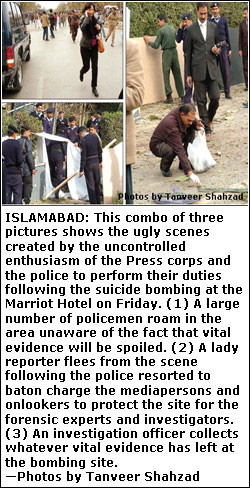
And this weakness of theirs again became evident on Friday when a suicide bomber blew himself up near Marriott Hotel, killing himself and a security guard and injuring five others. The events that followed brought to the fore the police inability to handle such a situation, and people’s uncooperative attitude.
Soon after the incident, police rushed to the area and tried to keep it clear for ambulances and prevent the evidence from getting lost. They cordoned off the site with wooden sheets, presumably to prevent photojournalists from taking shots of the bodies.
Stretching their arms over their heads and adopting all postures to capture their target, the photographers pushed one another and in the process lost their balance and fell on the policemen.
Some who tried to get through the barrier were repeatedly warned to keep off. But no matter how hard the police tried to keep the area clear for ambulances and the bomb disposal squad, they could not succeed.
They even pleaded with those present there not to enter the evidence-rich area. “Allow us to do our job. Do not cross the yellow tape or the barrier,” a police official was heard as saying.
“Not only will the evidence be destroyed but there is also possibility of a second explosion like the one that took place in Karachi last year when two explosions went off one after another,” he said.
However, when their soft words fell on deaf ears, the police were left with no choice but to resort to baton charge. The police action left three times more people injured than in the blast. What ensued was nothing less than mayhem. One could see the police, journalists and by-standers running all over the place, destroying the evidence.
Agreed that both the police and journalists were out there to perform their respective duties, but in such situations both should cooperate with each other so that they could execute their professional matters in a more amicable way.
Instead, police ended up baton-charging the journalists, and diverting the attention from the main event.
Later, the journalists protested against the police action. “We were just doing our job,” said a newsman who was hit in the head by a policeman. “The baton-charge is not justified,” quipped another.
All journalists present there raised slogans against the police and demanded immediate suspension of the additional ASP for ordering the baton-charge.
On the whole, these events made the tragic incident even more tragic. The area that should have been sealed off remained crowded with onlookers. And most of the evidence that could have come handy for the investigators was lost in the police- journalist skirmish.