



 0
0

 EUROPE is worried over its growing demand for energy and as well the extremely adverse impact of the increasing use of fossil fuels on the climate to satisfy this demand.
These worries are understandable as the EU energy imports are expected to rise from 50 per cent of consumption to 65 per cent by 2030. This would entail for Europe a high environmental cost as well as a political cost of enormous proportion as the fossil fuel exporting countries have been known to be unpredictable and often given to using the commodity as a political weapon. These worries have been further deepened by Russia's recent oil row with Belarus, which has hit EU states Germany and Poland, Iran’s nuclear ambitions and Venezuela’s confrontationist policies to name a few.
To meet this challenge, the European Commission has announced a wide-ranging set of proposals on both the issues---energy and climate change. The Commission aims at ushering in a new ‘industrial revolution’ by implementing these proposals.
The proposals of the commission set out in a report demand increased investment in renewable energy projects with the aim that at least 20 per cent of energy would come from renewable sources by 2020. The commission has also called for a 20 per cent reduction in gas emissions by 2020.
The report is also due to include measures to open up the EU's energy market, enabling the bloc's 500m citizens to buy their gas or electricity from anywhere in Europe. The package of measures will have to be approved by European governments before it can come into force.
In recent years, the EU has been the most powerful political voice urging targets on reducing greenhouse gas emissions beyond the current Kyoto period, which expires in 2012.
But at the latest UN climate meeting, its attempts to get new targets debated met with failure. The commission is now likely to urge that all developed countries across the world adopt a goal of cuts in the order of 30 per cent by 2020.
Critics say that demand is unfair because people in India and China pollute a fraction as much as individuals as those in the West. The EU's principle tool for achieving cuts within the union itself would be an enhanced Emissions Trading Scheme (EU ETS). But that only affects businesses, leaving emissions from road transport and domestic heat and power unaffected.
A voluntary agreement under which car manufacturers promised to increase the efficiency of their products has not produced the results which the commission wanted, and it may now propose a mandatory regime.
On the business side, the commission is likely to propose an enhanced "unbundling" of energy supply across the continent in a bid to increase competition.
In the last three years it has raided the offices of energy firms it believed were deviating from required competitive practices and warned 17 member states for failing to implement competition legislation; but it is poised now to go further.
New measures could also include breaking up the ownership of energy businesses to avoid conflicts of interest. It may propose that companies generating electricity and distributing it would not be permitted to have owners in common; gas production companies would be divorced from pipeline operators. Ministers are likely to debate the Commission's proposals in March.
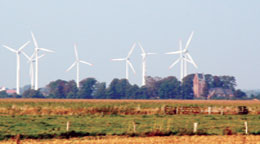
While the EC is making its plans to meet its energy and climate worries, the UK has already started paper work for investing in a big way in renewable energy. The government has already approved plans to build the world's largest offshore wind farm off the coast of south-east England, a move that could eventually bring 341 turbines to the Thames estuary.
The £1.5 billion scheme, called London Array, could generate 1,000 megawatts of power, enough to meet about one per cent of the UK's electricity needs.The consortium behind the scheme, which includes Shell and E.on, says the wind farm between Margate and Clacton could cut UK emissions of the chief greenhouse gas, carbon dioxide, by 1.9m tones a year. But the project is dependent on local planning officials giving permission for an onshore electricity sub-station to channel the power generated about 12 miles offshore into the national grid.
The estuary wind farm scheme was earlier altered to protect a little-known bird called the red-throated diver. Ministers will approve the 90 square mile (230 sq km) development only if a first phase of 175 turbines does not damage a 7,000-strong colony of the birds which spend the winter on waters nearby. The birds, which were thought to number only about 5,000 in the UK, were discovered in an environmental survey of the region by the power companies.
The government has also granted a license for Warwick Energy to build a second wind farm nearby. The £500 million. Thanet project, seven miles from North Foreland on the Kent coast, will consist of 100 turbines over 13.5 square miles. It is expected to be completed by 2008 and will supply electricity to about 240,000 homes. Alistair Darling, the trade and industry secretary was quoted by media as saying, the two wind farms were a significant step towards the UK meeting its target to generate 20 per cent of its electricity from renewable sources by 2020, up from about four per cent now.
"Britain is second only to Denmark in the offshore wind sector and projects such as the London Array and Thanet underline the real progress that is being made."
Maria McCaffery, chief executive of the British Wind Energy Association, said: "The significance of these decisions is far greater than the projects themselves. Far more important is the clear signal from the UK to the rest of the world that this country is open for business for offshore wind."
Another company Npower Renewables wants to build a giant 1,200MW offshore wind farm in the Greater Wash, off the east coast of England. When completed, it would claim the London Array project's title of the world's biggest offshore wind farm.
Developers want to build up to 500 onshore wind turbines in three separate farms on the remote Hebridean island. The local council has encouraged investment in the renewable energy but local communities are bitterly opposed. The Royal Society for Protection of Birds (RSPB) is concerned that the wind farms would affect golden eagles and other birds, and damage sensitive peat land.
Permission for Scottish Power's massive onshore wind farm at Whitelee, near Glasgow, was finally granted this summer after the company agreed to erect a new radar tower for Glasgow airport. The 322MW facility, the largest of its type in Europe, will produce enough electricity to power 200,000 homes when it enters full operation in 2009.
Another power offshore scheme, this time about eight miles off the north coast of Wales, and further out than the existing North Hoyle offshore site has submitted plans to government and the latter and Welsh national assembly officials are weighing up the plans, which would see some 200 turbines put in place to produce 750MW of energy.
Godfrey Boyle, the director of the Open University energy and environment research unit, was quoted by media as saying: "This should just be the beginning. Offshore wind could be providing nearly a quarter of Britain's electricity in 20 years, given a bit more encouragement from government."






























