



 0
0

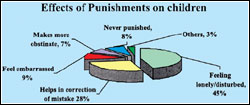 ISLAMABAD, Jan 19: It is still considered important by the Pakistani society to make children respect elders, differentiate between right and wrong, obey rules and work hard. But a research has found that punishment - physical and emotional-badly affects the development of children and make them feel revenge.
Punishment is not a healthy mean of disciplining a child because threatening a youngster or imposing any punishment on him/her may force compliance but never commitment.
Sahil, a non-governmental organisation working against child sexual abuse, has conducted a research in 11 cities of Pakistan on a random sample of 1,000 male and female students of 12-17 years of age and found that punishment was counterproductive and relatively ineffective.
“Contrary to this, appreciation gives encouragement to children and recognition to their works, serves as a source of motivation and above all makes children happy,” said the research conducted in Rawalpindi, Peshawar, D. I. Khan, Multan, Faisalabad, Hyderabad, Sukkur, Karachi, Lahore, Abbotabad and Quetta.
A majority of Pakistanis still believe that different forms of punishments are important to show children the right path. Punishment is considered a family business where the state has no role to play. “I do with my children the same as my parents did with me. They punished me and nothing bad happened to me,” most of the people in Pakistan buy this idea.
But according to the research, punishment is not a cultural issue. It happens all over the world. It is related to how adults manage the power and the violence within their own personal relationships, and how much they respect children as equal human rights holders.
The research has found that most of the children disliked emotional punishment, because apparently it may not be causing any pain or injury to the child but it has long-lasting negative effects on the personality of the child.
Whereas different forms of physical punishments remind children of pain and anger accompanies with it which causes the feelings of revenge.
Only a small number of children said punishment helped them in correcting their mistakes, which implied that these children were brain-washed in such a way that they internalised that punishment was good for them and would make them disciplined.
Punishment, or the threat of it, do not help youngsters learn how to modify the behaviour involved rather it affect them negatively by making them more obstinate, spoiled and embarrassed.
“One important thing that we all should keep in mind is that it should be the action of the child which should be questioned and not the child. Instead of punishing a child physically or emotionally, we should try alternative ways to help the child learn lesson from the bad behaviour,” the researchers said.
The children were asked what kinds of appreciation were offered to them for their successes. They mentioned appreciation in words, gifts, being loved, being spoken nicely, being blessed and wished and their wishes and wants being fulfilled.
However, half of the children showed preference for the expression of love and affection from people around them for their good work.


























