



 0
0

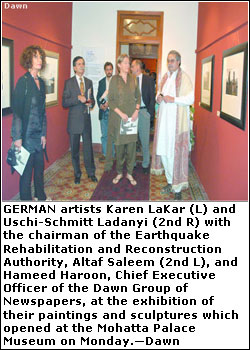 KARACHI, Jan 15: The Chairman of the Earthquake Rehabilitation and Reconstruction Authority (Erra), Altaf Saleem, said on Monday that only 32,000 of the 3.5 million people rendered homeless in the October 8, 2005 earthquake were still housed in tents and efforts were being made to provide them homes.
“Last year we had 3.5 million people from Kashmir and the northern parts of Pakistan living in tents but through the massive efforts by the government and NGOs we have achieved a gigantic task to resolve the problem of homelessness of most of the earthquake victims,” the Erra chief said. He made these remarks at the inauguration ceremony of an exhibition, ‘Art for Charity’ at the Mohatta Palace Museum yesterday evening.
The exhibition which was later inaugurated by Mr Saleem features artists with global recognition for their work in various fields of art from across the world have put their works on display. The exhibition will continue till January 20 and all sale proceeds would go towards the relief fund for earthquake victims.
H.H. Sheikha Latifa bint Mohammed bin Rashid Al Maktoum, daughter of H.H Sheikh Mohammad bin Rashid Al Maktoum, UAE Vice President, Prime Minister and Ruler of Dubai, graphic designer and photographer Uschi Schmitt-Ladanyi and sculptor Karen LaKar from Germany are the known artists who contributed their works at the event to generate funds to improve life of earthquake victims.
The Erra chief said there was a huge task in front of him and the individuals and organisations involved in the rehabilitation effort but what had given him immense relief was that people were not only being rehabilitated but the new infrastructure and facilities were far superior in quality and functionality than those that existed before the disaster.
“It is satisfying to see that we are not alone in doing this gigantic task as many organisations and devoted individuals are keenly working along and doing an excellent job in different areas,” he said.
He said the tremors claimed thousands of lives, snatched shelter from 3.5 million people and destroyed schools, houses and infrastructure on thousands of kilometers. Besides, some 900 health facilities from major hospitals to basic health units and private properties became history, he said.
He said Erra and other partner organisations had provided transition homes to most of the shelterless people but some 32,000 were still in tents, but these were far superior in quality and safety requirements. These families would also be shifted to transition homes.
He said 52 percent of the houses, destroyed in the earthquake, were single-room and most made of mud, now the people were getting proper houses with sheet roofs. All the 6,500 schools, destroyed had become functional and most of the buildings completed. Work on the rest was in progress. Similarly, all health facilities were functional and their quality improved.
He referred to a school at Chakothi, which was originally of three rooms with 250 students, now it had 24 rooms. Similarly, a 12-bed hospital at Garhi Habibullah had become a 60-bed hospital with state-of-the-art facilities.
The Erra chief said most of the works would be completed in three years while major projects would take five years.
He said half of the seven billion dollars pledged by the donors had been given and the rest in the pipeline. Projects worth two billion dollars had been completed by the donors themselves.
He said Erra was undertaking programmes to provide livelihood, rehabilitating the injured, widows and orphans. Besides, there were many programmes for development schemes. “We cannot do it alone, we need help from people from every sphere of life living here or abroad,” he concluded.
Earlier, Chief Executive Officer Dawn Group of Newspapers, Hameed Haroon, said Dawn Relief was making efforts to restore life in the earthquake hit areas for which it was operating in different sectors. He said Dawn Relief had adopted four villages Kucha-e-Sayedan, Jiggal Bala, Karthama and Lamnian-Reshian located in Hattian Tehsil Bala on the right and left banks of the Jhelum Valley in Azad Kashmir. Tent villages were set up by Dawn Relief in each of its adopted villages and more than 8,000 homeless men, women and children provided housing in the form of tents and fibre glass porta cabins as well as drinking water, food, clothes and blankets on a sustainable basis. He also talked about the establishment of community kitchens, bathing, washroom facilities and temporary schools etc. set up by Dawn Relief. He thanked the three artists for becoming a part of the massive campaign to rehabilitate humanity in the country’s north.
German graphic designer and photographer Uschi Schmitt-Ladanyi said she along with other artists were in Pakistan to help the people. She hoped the effort she was part of generates ample funds to help the earthquake victims.
Artist Karen LaKar from Germany said art was part of social work foreseeing new way of life and giving a new way of feeling. She said all efforts being made to help the earthquake-hit people were aimed at restoring their normal life.
Fahim Zaman Khan representing Dawn Relief said his organisation had rebuilt and handed over five schools complete with furniture, books and computer section to the authorities and taken seven more, which would be rebuilt this year. He said Dawn Relief planned to eventually rebuild all the 19 schools destroyed in the earthquake.
He said earlier this year, his organisation entered the second phase by initiating the task of setting up permanent prefabricated, earthquake resistant homes and schools for its tent villages inhabitants.
“Dawn relief has already provided 70 families residing in Kucha-e-Sayedan with prefabricated houses manufactured with earthquake resistant materials and is currently setting up more for the remaining members of its adopted villages,” he said
Mr Khan said Dawn Relief would establish water supply networks, medical care centres and vocational training centres for women who had lost male members of their families and so that the people of its adopted villages can attain security and the ability to move on from the tragedy that altered their lives forever.





























