



 0
0

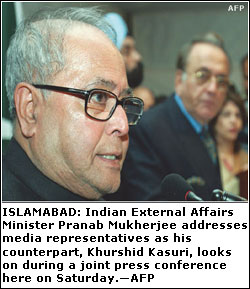 ISLAMABAD, Jan 13: In a bid to move the peace process forward Pakistan and India on Saturday agreed to launch the fourth round of Composite Dialogue on March 13-14 in Islamabad and hold the Joint Commission meeting next month in New Delhi.
This was announced by visiting Indian External Affairs Minister Pranab Mukherjee at a joint press conference with Foreign Minister Khurshid Kasuri after their lengthy discussions that focused largely on Kashmir, Siachen issue and terrorism.
Reading out a number of other important decisions taken at the meeting, Mr Mukherjee announced that the first meeting of the joint anti-terrorism mechanism would take place before the end of March.
Mr Mukherjee said Mr. Kasuri had accepted his invitation to attend the meeting of the Joint Commission in Delhi next month, and added that several agreements which were near or close to finalization would be concluded then.
The agreements include: (a) The Agreement on Reducing the Risk from Accidents relating to Nuclear Weapons etc.; (b) Speedy return of inadvertent Line Crossers; and (c) Prevention of Incidents at Sea.
They also agreed to expedite the Liberalisation of Visa Regime and complete the work by next month. It was also agreed to work out procedures to facilitate movement of diplomats to Noida and Gurgaon in India and to Taxila and Hasanabdal in Pakistan. An agreement was also reached to establish a Committee on Prisoners comprising retired judges of the superior judiciary to visit jails in the two countries and propose steps to ensure humane treatment and expeditious release of the prisoners who have completed their prison terms.
Both the foreign minister described their discusssions in very positive terms. In a clear indication that some headway had been made on the issue of Siachen, they said that officials concerned on both sides would be directed to meet at an early date to expedite the process of addressing the issue.
Mr. Kasuri, in response to a question, reiterated that given the political will the Siachen issue could be resolved within days.
Indicating that “lot of work had already been done” he disclosed that foreign secretary Riaz Mohammad Khan had, during the foreign secretary-level talks held in New Delhi in November, handed over a “detailed plan” to his counterpart.
He referred to the plan as a “package” that meets concerns of both the sides. Mr Kasuri refused to go into the “battle of words” when asked if Pakistan had agreed to India’s condition of authentication of troop positions.
On Sir Creek it was also decided to instruct officials concerned to expedite their work. The joint survey for Sir Creek will begin on Jan 15.
To a question if without the resolution of the Kashmir dispute enduring peace and friendship between Pakistan and India was possible, Mr. Mukherjee acknowledged that there were issues that ought to be resolved and underlined that “serious efforts” were under way to settle these issues. His view was that these ideas were not contradictory but complementary to each other and he emphasised: “Problem resolution and institutional arrangement of ensuring peace are the two sides of the same coin and we are trying to attempt that.”
He said it was not possible for him to set a timeframe for resolving the differences over Kashmir.
He, however, declared: “To have enduring peace and friendship between Pakistan and India is absolutely necessary.”Mr Kasuri intervened to say that never before in the past 60 years the two countries had such sustained discussions on the Jammu and Kashmir issue as they were having now.
On President Musharraf’s proposals on Kashmir, Mr Mukherjee did not go into the specifics but referred to the response given by the Indian prime minister that all these issues should be discussed, and added: “We are prepared to consider each and every idea to find a solution.”
Mr Mukherjee was evasive when specifically asked about India’s view on President Musharraf’s proposal of joint management and joint control of divided Kashmir, and merely said: “Any idea of resolving the issue could be considered, examined and attempt would be made to find a solution.”
When he was asked if India, in a concrete expression to its sentiment for lasting friendship with Pakistan, would hand over the Jinnah House in Mumbai to Pakistan, his response was: “I am fully aware of the sentiments of the people of Pakistan in regard to the Jinnah House and I respect this sentiment. We are fully aware of the issue and we will try to resolve the issue as expeditiously as possible.”
The Indian foreign minister did not give a direct response to a question if it was the view of the Indian government that the ISI was still sponsoring the insurgency in Kashmir or whether it was now taking active steps to prevent it.
“So far as involvement of certain agencies are concerned, we are aware of it and we have brought it to the notice of appropriate authorities.” He evaded a question on whether infiltration was continuing.
Responding to a question, Mr Kasuri said that overall there was very strong support for the peace process on both sides and it was evidenced by the fact that it was continuing.
He said the Composite Dialogue and the joint anti-terrorism mechanism were in the interest of both the countries.
On the issue of terrorism, he said: “Suffice it is to say we recognise India’s sensitivities and hopefully India recognises our sensitivities.”
Mr Mukherjee expressed the hope that the anti-terrorism mechanism would become an effective instrument to combat terrorism, saying: “Terrorism is no friend to anybody.”
In his opening statement, Mr Kasuri said: “Mr. Parnab Mukherjee’s visit has provided a good opportunity to review the status of our bilateral relations and it is a matter of satisfaction to note the overall improvement in relations between the two countries.”
He said the two sides reviewed progress on all issues on the Composite Dialogue framework comprising peace and security, Jammu and Kashmir, Siachen, Sir Creek, terrorism, drug trafficking, Wullar Barrage/Tulbal navigation project and promotion of friendly exchange and Trade and Economic Cooperation.





























