0
0

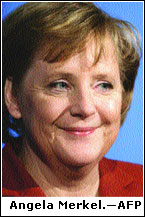 LONDON: When Condoleezza Rice leaves the Middle East in the next few days after sizing up the chances of re-launching an Israeli-Palestinian peace process, her first port of call will not be Downing Street. And it certainly won’t be Paris.
Rather, the US secretary of state will head to the gleaming palace of steel, glass and concrete that is the German chancellery at the heart of the new Berlin to swap notes with Angela Merkel.
It’s a measure of the German chancellor’s sudden emergence as the pivotal politician in Europe and the west that Rice should take her Middle East ideas to Berlin. But it’s small wonder. In London the Blair decade has entered its final months. In Paris, the Chirac era is fading and no one knows who will be running France in a few months’ time.
In Berlin, by contrast, 2007 is the year of the pastor’s daughter and physicist from eastern Germany.
Hers is a remarkable and improbable career trajectory. Fewer than 20 years ago, Merkel was a stranger to politics, an unknown and apparently conventional academic in communist eastern Germany. By late 2005, having traded in the gauche pudding-bowl hairstyle and dowdy clothing for smart dark trouser suits and turquoise jewellery, she became the eighth chancellor of modern Germany, breaking every rule in the German political book: the first woman, the first easterner, a Protestant in a Christian democratic party traditionally run by Rhineland Catholics.
Fourteen months into her rule, Merkel could be forgiven if her characteristic enigmatic smile widened to a broad grin. A robust German economic recovery is in full swing after years of stagnation, persistently high unemployment is tumbling, German exports, the highest in the world, are putting in their best performance since 2000. And the year begins with Merkel both chairing the G8 and occupying the presidency of the European Union.
Are the burdens of power and responsibility causing her a few sleepless nights?
“Not because of that,” she says. “Fear is not a good political adviser.”
Merkel and Rice-- both former academics and perhaps now the two most powerful women in the world-- are likely, at Merkel’s prodding, to outline a plan on Thursday to revive what is known as the quartet, bringing together the Americans, the Russians, the UN and the EU on the Israeli-Palestinian conflict.
“We want to take on responsibility in the Middle East process even if we’re aware that it is an extremely difficult political area,” the chancellor told the Guardian in an interview at the chancellery in Berlin. “We know that the issue of the two-states solution is of the greatest importance for many other conflicts in the region.
“We’ve agreed (with Rice) that we will both discuss her description of the situation and then consider what the next steps might be ... Condoleezza Rice’s report will be a basis for seeing how the quartet can play a sensible and important role.”
Merkel pushed the quartet revival with George Bush in the White House last week. Next week she is in the Kremlin with Vladimir Putin where she is likely to have a few choice words to say about Russia’s latest shenanigans with its oil and gas supplies to Europe, not least as Germany is Russia’s most important energy customer.
Her predecessor, Gerhard Schröder, in his recent memoirs, described the Russian leader as “an impeccable democrat”. Merkel grew up under Soviet communism and has a more detailed and nuanced understanding of where the ex-KGB Russian leader is coming from. Does she share Schröder’s view?
“I have not said that yet and I am not going to say it now,” she states pointedly. “With Russia, I use the words strategic partnership.”
Merkel has a disarming knack of being very firm while not sounding at all stern. Diffident, modest, seemingly shy and displaying a formidable grasp of detail, she also possesses a ruthless streak.
Her early political career in post-reunification Germany in the 1990s she owed to Helmut Kohl, who brought her into his cabinet in junior positions after the fall of the Berlin Wall. He also patronised her, calling her his “mädchen” (girl). She was loyal. But when Kohl was disgraced in a party funding scandal after he left office in 1998, Merkel turned on him mercilessly.
The 52-year-old has shown similar stamina in getting to the top of her Christian Democratic Union party despite the condescension and frequent hostility from the middle-aged, west-German male party barons that traditionally control the CDU.
It has been an uphill struggle. Now at the peak of her powers, the agenda she has set herself also looks like a tall order. Energy security, the Middle East, a looming crisis in Kosovo, which is expected to have its independence from Serbia imposed within months, better transatlantic relations, and a new relationship between Russia and Europe are all crowding her in-tray. If there is a risk in all this preoccupation with international affairs, of neglecting pressing business at home, then it is a risk that, for the moment, Merkel is prepared to take.
Then there is Europe. It is the EU and her determination to salvage a European constitution that many have already written off as dead that is one of the central aims for her chancellorship. Poignantly, she ascribes her fascination with and commitment to Europe to her sheltered and deprived upbringing on the other side of the Iron Curtain.
“For me this (Europe) issue has a different perspective because until I was 35 years old, I only knew the countries of eastern and central Europe ... I never knew Great Britain or France, something that schoolchildren today experience at the age of 14 or 15. Because of that, of course, I developed a great curiosity at an age when others had known all this for a long time. But a passion for Europe is so much in the German interest that any chancellor should have it.” Passion apart, there is also the politics. Merkel has just launched an ambitious, if discreet, campaign to rescue the constitution. She is already highly rated as a very good listener and a skilful fixer. On the constitution, though, she wants to get her way and intends to bang heads for the next six months of her EU presidency to that end.
Her team has drafted a detailed timetable for what looks like a make-or-break attempt to reshape the way Europe is run. In an unusual move, she has just asked all EU leaders to appoint a senior figure to resume negotiations on the constitution behind closed doors over the next few months. There is to be minimal public disclosure. She hopes to avoid any further popular votes or referendums on the constitution.
In June Merkel will table an EU “roadmap”, outlining how to enact the constitution within two years. The aim is to have the deal in the bag before the next European parliament elections in 2009. —Dawn/The Guardian News Service