



 0
0

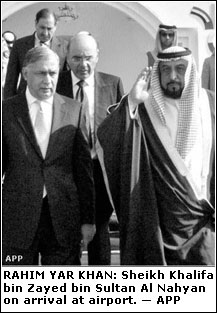 RAHIM YAR KHAN, Jan 11: Pakistan and United Arab Emirates (UAE) on Thursday held wide-ranging discussions on regional and international issues and agreed to expand cooperation, specially in energy, investment, trade, manpower, defence and security sectors.
Prime Minister Shaukat Aziz, who especially arrived here to meet United Arab Emirates President Shaikh Khalifa bin Zayed bin Sultan Al Nahyan, who was here on a private visit, discussed political, diplomatic and bilateral relations.
The prime minister said the UAE was the single largest foreign investor in Pakistan’s public and private sector.
He said Pakistan greatly appreciated the continuing interest of the UAE’s private sector in Pakistan’s banking, telecom and infrastructure sectors and wanted to expand it to the areas, including tourism, agri-business and food packaging.
The UAE president said his country was desirous of joint projects with Pakistan and would be conducting feasibility studies in this regard.
Prime Minister Aziz said many areas, including petro-chemicals, real estate, major infrastructural development projects like roads and industrial units were open to investment and Pakistan was becoming a destination of choice for foreign investors.
He said the development of the Gwadar Port was a major opportunity for economic collaboration between the two countries and the UAE investors would welcome to develop shipping linkages with the other regional countries besides opening warehouses and oil storage facilities in Gwadar.
He said Pakistan and the United Arab Emirates enjoyed close brotherly and historic ties that had passed the test of time.
“Pakistan greatly values its bonds with the United Arab Emirates ... our relations are historic and we want to strengthen and make these a model for others,” he said.
The two leaders expressed similarity of views on important regional and international issues, including Palestine, Iraq and Kashmir.
Prime Minister Shaukat Aziz said Pakistan was committed to the ongoing composite dialogue with India and wanted it to move from dispute management to dispute resolution.
He said President Musharraf had advanced several proposals on Kashmir, including de-militarisation, self-governance, autonomy and softening of borders, which, he added, could serve as a basis for a discussion between the two countries.
He said Pakistan was a peaceful country and wanted to resolve all outstanding issues with India, including the Kashmir dispute, in a peaceful manner.
He said Pakistan was not engaged in arms race and believed in the doctrine of minimum credible deterrence to ensure peace in the region.
Mr Aziz said Pakistan believed that without a just and early settlement of Kashmir dispute in line with the wishes and aspirations of the Kashmiri people, sustainable peace could not be achieved.
The UAE president supported President Musharraf’s proposal on Kashmir and said his country believed that the solution should take into account the aspirations of the people of Kashmir.
Regarding the developments in the Middle East, Mr Aziz said Pakistan believed that peace in the region hinged on an honourable and just solution to the Palestinian issue.
Pakistan will continue supporting the just struggle of Palestinian people for the establishment of an independent state, he added.
Pakistan also supports Iraq’s sovereignty, territorial integrity and unity and is concerned over the worsening security and sufferings of the Iraqi people, he said.
About Afghanistan, Prime Minister Shaukat Aziz said Pakistan was also committed to the stability and security of Afghanistan and wanted it to emerge as a strong and vibrant country.
He said Pakistan was weighing various options, including fencing and mining of its border with Afghanistan, to prevent the movement of extremists’ elements.
He said both Pakistan and Afghanistan recently agreed on the return of Afghan refugees in an organized and phased manner.
He said the international community needed to expedite the ongoing process of reconstruction in Afghanistan and the well-being of its people was vital to counter extremism. He said Pakistan had also raised financial assistance to Afghanistan from $250 to 300 million for its health and education sectors.
Prime Minister Aziz said Pakistan would also hold a regional donors conference in Islamabad to arrange additional funds to boost economic activity in Afghanistan.
He apprised the UAE president of Pakistan’s relations with Iran and China. He said the current visit of the UAE president would further consolidate and expand bilateral ties.
He lauded the sagacity and far-sightedness of the late Sheikh Zayed bin Sultan Al Nahyan who, he said, had played a key role in bringing the two countries closer.
“Pakistan has enormously benefited from his wisdom, sagacity and farsightedness,” he added.
Mr Aziz said Pakistan had developed a strong base of trained, educated and professional manpower and could meet the growing requirements of the UAE.
He hoped that the recent MoU signed between the two countries in the field of manpower would enable Pakistan to increase manpower export to the UAE.
The meeting was attended by Punjab Governor Khalid Maqbool, Chief Minister Pervaiz Elahi, Minister of State for Information and Broadcasting Tariq Azeem and Minister of State for Defence Zahid Hamid.
During the talks the UAE side was supported by Finance Minister Shaikh Mohammad bin Khalifa al Nahyan, Minister for President Affairs Shaikh Mansour bin Zayed al Nahyan, Deputy Minister for President Affairs Ahmed Juma al Zaki.
Prime Minister Shaukat Aziz later bid farewell to President Shaikh Khalifa bin Zayed bin Sultan Al Nahyan at the end of his private visit to Pakistan.—APP




























