



 0
0

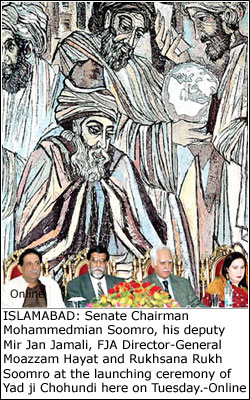 ISLAMABAD, Jan 9: Senate Chairman Mohammedmian Soomro handsomely praised Rukhsana Rukh Soomro’s poetry collection Yad Ji Chohundi launched at the Federal Judicial Academy (FJA) auditorium on Tuesday.
At the same time the chairman came out strongly in favour of learning languages, and for promoting the values of reading, research and writing.
In saying this, perhaps he may have hinted to quiet the present controversy raging in newspapers in his province about the efficacy of primary education in the mother tongue.
All languages serve as vehicle for communication of one’s tender feelings, and they unlock the treasures of the sages of the past, Mr Soomro said.
He also mentioned the wisdom contained in the writing of Shaikh Abdul Latif, Bulleh Shah, Sachal Sarmast, Ghulam Fareed and Rahman, the great masters whose work yield wisdom for the benefit of posterity. Mr Soomro said Rukhsana successfully composed poetry in this classic tradition.
There was one more reference to the benefit of learning the Sindhi language this time from FJA Director-General Muazzam Haidar, who said he was born and educated in Sahiwal, but was first posted at Sehwan Sharif and learnt Sindhi which he now considered as a language in which he could express with ease and felicity. Mr Haidar said he also had spiritual attachment to the problems of the Sindhi people.
“Sindhi is an exceedingly sweet language. And, besides all languages promote national harmony,” he told the FJA trainees.
Ms Rukhsana’s poetry book also received attention from Ghulam Haidar Sindhi, a director at the National Historical and Culture Research Institute, who spoke of the book as one that had been produced and published well, without containing a single mistake.
He said in the introduction of the book, Imdad Husaini, a profound Sindhi scholar, had discussed the ingenuity with which Rukhsana had composed her poetry. Dr Ghulam Haidar entirely agreed with this evaluation.
He said Rukhsana’s knowledge of Sindhi was excellent even though she had lived abroad, and she had written poetry using a simple daily-used words which made her verses descend in the reader’s heart. Rukhsana conveyed the inner feelings and the pathos of Sindhi daily life, he said.
Hashim Abro said Rukhsana’s poetry was firmly anchored in the locales in which she lived to such an extent that her reader may feel she was in love with Sindhi language that was her mother tongue.



























