0
0

Four issues remained primary concerns for the over 15 million citizens of Karachi in the year we bade farewell a few hours ago. Traffic; electricity; rainwater drainage and road (dis)repair. Metropolitan takes a look at these issues, which affected citizens’ daily, and reviews what will again shape their destiny each day, posing a question to the city officials, ‘will 2007 be any different?’
Traffic headed for gridlock
By Arman Sabir
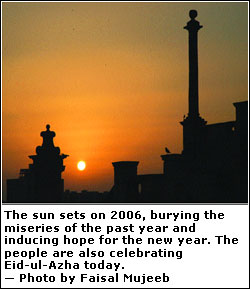 Traffic jams made headlines almost daily in 2006. And as chaos on the roads continues to wreak havoc on Karchiites’ daily movements, it is feared the traffic crisis will intensify in 2007, with no one taking responsibility.
An enormous increase in the number of vehicles on the roads is said to be the main reason for the present crisis. In the past five years, more than 500,000 vehicles have been added to the previous fleet of 1.1 million, resulting in hours-long (at times, day-long) congestions on almost all major roads and thoroughfares.
The sudden increase in vehicles is the direct result of the growth of leasing companies and the easy installments loans offered by all the banks. But while banks were given a free hand to create a debt-ridden consumer market, the national policy makers never bothered to realise the wider impact, especially in Karachi.
Most importantly, no policy makers gave a thought to the logistic issues of 15 million citizens and the necessity of reviving and extending the circular railway network.
The delay in introducing the circular railway services has hugely multiplied problems. Every citizen, who can now afford it, now wants to buy a car or motorcycle to cover the distance from his home to workplace because of the pathetic and less than efficient road transport service.
The prime responsibility for the management of traffic flow the roads, is that of the traffic police. But they blame the crisis on dug up roads, roadside encroachments, scarcity of parking places, whereas these is also a shortage of manpower in their department albeit these shortcomings also serve as excuses to cover up for their inefficiency.
As far as dug up roads are concerned, there is no road dug up downtown of Saddar but the traffic jams are a routine throughout the day. And while removal of roadside encroachment is the responsibility of the city government, no one can encroach upon the roadside area without the blessings of the area police.
Besides, the major violators of traffic rules are drivers of commercial vehicles like buses, minibuses, coaches, trucks and trailers. Known as the ‘yellow devils’, the minibus drivers apparently are above the law, following no traffic rule. According to statistics, the share of public transport is mere 3.4 per cent in the vehicle population but their involvement in fatal accidents is more than 72 per cent.
Despite efforts of successive governments to rein in the transport mafia and launch various campaigns against traffic rule violations, the transporters (owners and operators) have managed to safeguard their collective interests, giving strike calls in retaliation. The government is always forced to succumb to their demands each time and abandon all traffic management campaigns. As a result, jumping red lights and stopping in the middle of the road is now a modus operendi of all public vehicles, with no thought given to the resultant traffic chaos. Such violations continue mainly because, insiders say, public transport and commercial vehicle drivers are never fined since their protection has allegedly been bought trough a weekly amount forwarded to the traffic police.
The traffic network can hardly improve until these irregularities are checked and the culture within the traffic police is changed. With the internal police set up in disarray due to insufficient resources there is no motivation or means available even for the dedicated policemen to work efficiently, another reason for traffic disorder. An SP of each traffic zone is responsible for repairing and managing the logistics of his force but shifting responsibility to his deputy superintendents, the issue gets side-lined as these officers are reluctant to impose fines, on ‘valuable clients’ who are beneficial to the officers’ financial needs.
However, if there is even the slightest will, a small difference can be seen in traffic management provided if all roadside encroachments are immediately removed and proper bus stops are designated for public transporters and the operators of buses, mini-buses and coaches are made to stop on the designated stops. Transfers and postings within the traffic police department should be strictly on merit with punishment issued in case of dereliction of duty.
Rules concerning prohibited parking in double and triple rows on roads in and around business and shopping centres need first to be strictly implemented. Above all, plans for the circular railway or light rail project as alternative transport options must immediately get underway to avert the growing traffic crisis. But the kind of commitment needed for such stringent steps to be executed still seems elusive, and the plaguing question that remains; will traffic management be any better in 2007?