0
0

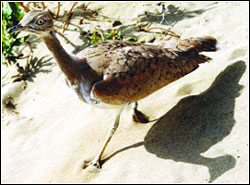 KARACHI, Dec 29: As the chilly winds start to blow announcing the arrival of winter two types of guests descend on the country – one a bird species, the houbara bustard, comes here to avoid the hostile weather conditions in their Central Asian habitat and the other, arrive as special guests of the Pakistan government from the Middle East to hunt the houbara bustard.
Hundreds of thousands of migratory birds of numerous species, the most important being the very rare and internationally protected houbara bustard, leave their habitat to avoid the harsh Central Asian winter for a warmer environment every year but end up as prey for hunters. A major reason for the hunters’ interest in houbara is a myth, not supported by scientific evidence, that its meat has aphrodisiac qualities.
The houbara during its winter migration used to go to the Arabian Peninsula but the inhabitants who have a tradition of falconry, hunted it to extinction. When the bird disappeared from the skies of the Arabian Peninsula, the hunters started coming to Pakistan, as this land is also visited by the houbara bustard.
Pakistan is not only a signatory to various international wildlife conservation agreements — like the Convention on International Trade in Endangered Species of Wild Flora and Fauna (CITES), the Bonn Convention; etc — but hunting the houbara is banned under the Pakistan’s wildlife protections laws, and Pakistanis are not allowed to hunt this rare bird. Trapping or poaching the bird, its eggs or chicks is also banned under the country’s wildlife.
However, the government issues special houbara hunting permits to these foreign hunters who have special access and facilities, mentioning specific areas and dates on which hunting can be done and the number of birds that can be hunted. Though wildlife officials accompany the hunting parties, keeping in view the hunters status and clout, the wildlife officials are helpless bystanders.
The hunt becomes a massacre when radar and radio equipped scouts riding high-tech desert range vehicles are let loose to spot the bird. Once spotted and pitted against some of the most pampered, well fed and healthy falcons of the world the frightened and exhausted houbara has to fight for survival — which it always loses.
After the falcons are let loose to chase the houbaras, the hunters riding in their four-wheel drive vehicles chase the houbara and falcon and watch the fight of death of the houbara which soon ends with birds landing on ground. The hunting assistants immediately rush to the falcons to get the half-eaten and profusely bleeding houbara from the clutches of the predator and bring it to the foreign hunters.
Conservationists want the government to stop issuing special houbara hunting permits so this endangered species does not become extinct.