



 0
0

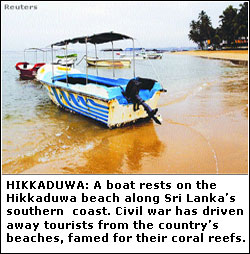 HIKKADUWA: Glass bottom boats tethered to the shore, candlelit shacks serving seafood empty of patrons, a solitary bar open: Not the signs of a vibrant beach resort at the height of the holiday season.
Thousands of travellers normally flock to this sun-kissed, palm-fringed spot on Sri Lanka’s southwest coast, renowned for its coral reefs and ochre beaches.
But most tourists have stayed away this year, deterred by renewed civil war between the state and Tamil Tiger rebels that has killed 3,000 people this year alone amid a rash of land battles, air raids and suicide bombings.
A backpacker haven since the 1970s, Hikkaduwa has sprouted luxury hotels with pop bands, internet cafes, and diving schools catering to mostly middle-aged Germans and Britons looking for tropical sunshine in the middle of their winter.
“This is the worst it’s been in 30 years,” said W. M. Bandaranayake, manager of the Coral Sands Hotel on Hikkaduwa’s main strip.
“We had more guests after the tsunami.”
The war has prompted foreign governments to issue travel advisories discouraging their citizens from visiting the island this year, causing a dramatic drop in tourist arrivals.
Not even the bargain basement travel deals on offer have lured many tourists to the island’s south coast.
“Every day there are more cancellations,” said Bandaranayake, whose hotel is running less than 20 per cent full at a time of year when it is usually overbooked.
Unsurprisingly, the Coral Sands Hotel’s regular calypso band has not been asked to report to work.
Tourist arrivals fell 22.4 per cent in November compared to a year ago, on the back of a 12 per cent drop in October -- not an encouraging sign for a country dependent on tourist dollars and still recovering from the 2004 tsunami.
With a 2002 ceasefire agreement in tatters and many expecting a conflict that has killed over 67,000 people since 1983 to escalate, the drop in tourist numbers is expected to continue this month and into 2007.
“We’re very concerned about the numbers, and incidents like the assassination attempt against the Pakistani high commissioner and the president’s brother have really hurt us,” said Prathap Ramanujam, Secretary to the Ministry of Tourism, referring to two suspected rebel attacks in the capital.
“The LTTE have gained a lot of media exposure recently, and the perception is that Sri Lanka is synonymous with them,” he added, referring to the Tamil Tigers rebel group.
Tourism brought $450 million into Sri Lanka’s $23 billion economy last year, and is one of the main foreign currency earners for the country along with tea, textiles and remittances from abroad.
The industry directly employs 150,000 workers and affects the livelihoods of half a million people -- from shopkeepers selling batik sarongs and incense sticks at tourist strips, to coconut water vendors on the beach.
“Tourism is a key sector, and this year’s drop in revenues will affect disposable incomes, which in turn will hurt the economy as a whole,” said Dushyanth Wijayasinghe, research head at Asia Securities.
Yet for the two years after the ceasefire agreement was signed, Sri Lanka was viewed as one of world’s hottest tourist destinations, receiving gushing endorsements from the likes of Conde Nast Traveller magazine.
Tourists thronged the island in record numbers, peaking at 66,159 in the month of December 2004.
Luxury resorts and boutique hotels, some charging as much as $3,000 a night, were feverishly constructed along the southern coast, and several five-star hotels in Colombo were upgraded to meet the surge in affluent overseas guests.
“There were positive signs all around us, and the entire tourist industry was investing heavily,” said Roshan Gurusinghe, business development head of the upscale Cinnamon Group, whose occupancy is down 40 per cent this December.
Even the impact of the tsunami that battered the south, east and north coasts, was cushioned by the arrival of foreign aid workers.
“Strange as it may sound, you couldn’t get a room in Colombo after the tsunami,” said Gurusinghe. “That business is long gone.”
Despite Sri Lanka’s deepening conflict, 37,059 tourists arrived in November, with most enjoying an unexpectedly high level of attention from hotel staff.—Reuters




























