0
0

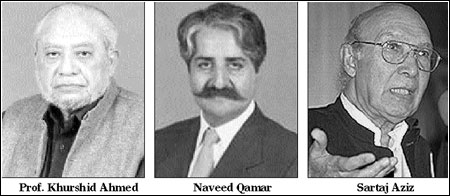 KARACHI: Leading political parties support market reforms but were critical of their management by President Musharraf’s government. They
feel that trade liberalisation, deregulation and privatisation policies are being pursued without first putting in place a strong regulatory system.
While talking to Dawn Naveed Qamar, leader of the economic team of Pakistan Peoples Party and a former chairman of privatisation commission said that the results of the liberalisation policies over the last two decades had been mixed. “Some of the success stories can be found in the openness of the currency regime, enhanced profitability and growth of certain privatised units, expansion in the IT, telecommunication and power sectors. ”About major imbalances and the issue of sustainable development, he observed that the present economic package had some weaknesses as it has increased inter-provincial, inter-class and rural-urban inequalities.
In response to a query about smooth functioning of free market mechanism, he said regulations needed to be enhanced and done at an arms length distance from the government. “All the regulatory bodies set up are still seen as an extension of the bureaucracy rather than as independent arbiters and guardians of public interest.
On savings and tax ratio, Mr Qamar was of the view that the GDP growth needed to be in the areas which were productive for the economy as it would result in actual investment, employment and enrichment of people at large.
He said that the PPP would continue to follow the liberalisation and privatisation policies but with a much better regulated regime with emphasis on employment generation in urban and rural areas.
Sartaj Aziz, a leader of Pakistan Muslim League (N) and former finance minister said that trade liberalisation and privatisation policy could only be successful when pursued under strong regulatory framework.
He identified government interference in several key sectors where large scale privatisation had taken place. “The government does not allow sufficient autonomy to new owners and deprives them of the freedom to determine output prices or make investment decisions, which should be done away with.”
Bringing efficiency in service delivery and producing quality goods
coupled with competitive prices in the market is the prime objective of privatisation and if the outcome is different the fault lies with the regulatory system, he said.
In 1991 he said the PML (N) government had initiated comprehensive economic reform programme to achieve better growth rates with sustainable development by re-allocating resources for more profitable and efficient use.
Sartaj pointed out two major weaknesses in privatisation carried out during the last seven years. First, the sell-offs were made without following procedures. Second, the pre-requisite conditions for prequalification were not appropriate.
He was also of the view that privatisation of monopolies in utility services sector like water, electricity, railways, would not bring any positive results in the absence of competition. He also opposed the privatisation of strategic assets like railways, oil and gas etc., they were too capital-intensive.
Senator Prof Khurshid Ahmed of Jamaat-e-Islami told Dawn that he was disappointed with the policy and the manner in which it had been implemented over the last 20 years in general and the last seven years in particular.
Pakistan adopted the policies of privatisation and deregulation under pressure from outside.
“We implemented what is known as Washington Consensus. The United States and financial institutions like World Bank and IMF etc. have been pushing this agenda,” Prof Khurshid Ahmed added.
While over 120 units had been privatised, he said almost one fourth of them had disappeared, their buyers had made money by closing them down and selling the real estate and hardly one fourth had become profitable.
“The objective should be selective privatisation that leads to genuine growth and promotion of justice and equity in society,” he added.
Muttahida Qaumi Movement (MQM) Deputy Convenor Dr Farooq Sattar was sent emails and contacted on phone to give his comments on the economic policy thrust but despite many calls and reminders he did not seem to be interested to offer viewpoint of his party.