0
0

 The people of Pakistan endured the pains of privatisation, liberalisation and deregulation on the promise that gains were to follow. While GDP grew from $31 bn in 1985 to $130 bn in 2006, gross capital formation as percentage of GDP fell from 18.3 to
16.8 per cent. Pakistan stood at 110th position on the index of economic freedom, 91st on the index of global competitiveness and 134th on human development index. It missed MDG targets for 2005 and, at the current pace of progress, Pakistan will not be able to realise at least six of the eight goals by 2015. Despite the tall claims by the government about a 6.5 per cent GDP growth rate, gains never materialized for the majority. Must the country still follow the same path or
In this special report a team of Dawn’s economic reporters tries to gauge the impact of donors-prescribed policies on the economy. An attempt has also been made to solicit the views of stakeholders about the opted path.
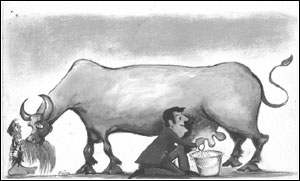
KARACHI: The current aphorism that explains our economic situation is: To each, according to his economic muscle. Ability, quantity or quality of work done and needs were not considered attributes worthy enough to guarantee a decent living in the system.
Since mid-1980s thousands of employees were retrenched from big bloated public sector entities to put these units on the auction bloc for privatisation. The aim was said to be removal of inefficiencies in the economy through an open competition and creation of more space for the private sector.
Rate of indirect taxes were increased and new levies were introduced in utility bills for revenue generation. Public subsidies were curtailed and development budget was chopped to control the expenditure side of public finance. This was done to improve country’s balance sheet that was in red in 1980s.
As a policy the government decided not to interfere with the market. Forces of demand and supply were considered efficient on their own to warrant any supervision or regulation. Business, it was proclaimed, was not the business of the government. As private sector entered education, health, energy, and communications sector with new zeal the state deemed it fit to withdraw.
Twenty years later, in 2006, Pakistan stood at 110th position on the index of economic freedom amongst 155 countries surveyed. It was ranked 91st on an index of global competitiveness amongst 125 nations. The situation was hardly any better on Human Development Index released in 2006. Pakistan clinched 134th position amongst 177 countries evaluated by the prestigious UNDP.
As far as the progress on the millennium development goals (MDGs) is concerned the situation is grimmer as the country has missed targets for 2005 and according to its own report will not be able to realise at least six of the eight targets at the current pace of progress by 2015.
Why the high GDP growth rate has failed to lift the country on some of the key indices? Why the economic managers embraced the policy package of privatisation, deregulation, and liberalisation? Who bore the brunt of these policies? How much credit of the current high GDP growth goes to the three-pronged strategy? Who benefited most from dividends of these policies? A judicious answer to these can help people in formulating their opinion over the question if it is fair and appropriate to carry on with the current economic policy mix or would it be more apt to reconsider and redesign policies after a thorough informed public debate.
We never had a dull moment in our history. Twenty years is not that long a period but in Pakistan in between uniformed president Gen. Zia-ul-Haq and President Gen. Pervez Musharraf eight different setups were installed. They differed in shape and form, falling on either side of the political divide, but there seems to be an astonishing unanimity in their views on the economy. The economic management with symbolic gestures for popular consumption (Nai Roshni, Khushal Pakistan, Tameer-e-Watan, and poverty reduction strategy, etc.) on the whole, led to economic exclusion of the poorest of the poor in the country.
All past governments religiously followed policies of market based restructuring. Political parties PPP(P), PML(N), PML(Q), JI and MQM have times and again reiterated their commitment to the said policy mix. Democratically elected governments, which came under fire from their own rank and file for implementing what are referred to as structural adjustment policies against popular sentiments, sometimes blamed donors but their own economic programme did not offer any clear alternative to the economic path being followed.
The collapse of the Soviet bloc and moral defeat of Socialism as a workable economic model came later in 1989. Pakistan harped on the West sponsored market based model in early 1980s. Besides, political considerations, Pakistan’s failed experience at nationalisation, its dependence on donors and the failure of the indigenous political scientists to offer solutions for economic woes led the country to accept what was demanded of it by donors. In fact most economic wizards, including respected Dr Mehboobul Haq were confident that this was the right path to achieve growth, which would automatically promote development.
According to US State department brief available on their site on internet, it has been actively advocating implementation of the policies of privatisation, deregulation and liberalisation in Pakistan since 1985.
The reason for advocating these policies was clear. The West found poor countries drowned deep in debt, too messed up, and suspected default on money it was lending. The developing countries needed new debt to clear the old ones. So the prime concern of the West was to improve Third World’s credit worthiness. Key donors IMF and World Bank made their lending conditional. Client states were advised to implement economic prescription or face the music after default. Donors, at that point, did not see the flaws of one size fit all strategy.Pakistan, a nation mired deep in debt, signed on the dotted line in 1988 the structural adjustment programme of the IMF. The full list of conditions was printed in these pages back then. The programme carried a timeframe to implement proposals that were to be monitored by the donors. Pakistan initiated retrenchment and called it right-sizing in nationalised financial institutions and units such as Pakistan Steel Mills, Pakistan Railways, and Pakistan International Airlines. Put a ban on recruitment in different tiers of administration and departments, closed down organisations such as Rice Export Corporation of Pakistan, and imposed new indirect taxes, etc.
No one can defend employing more than required strength of labour in any concern or maintaining a department that has outlived its utility. But throwing people out of job to fend for themselves in an economy, where unemployment is high cannot be justified. Had the human resources been treated as an asset and not a liability the planners would have done it differently. Excess labour with on-job-training could have been relocated. Unfortunately, all through the past two decades economy was restructured without a human resource management policy.
You need not be an economist to make out that pains of restructuring were borne primarily and mostly by ordinary lower and the middle class people but gains were gobbled up by the privileged class. Be it high electricity rates, dearer consumer items, user charges at government hospitals or termination of any other subsidy it were people with limited budgets who were put under pressure. When people had to be laid off the vulnerable contract worker was the first one to go. When increased competition forced owners to shut a factory down they incurred financial loss but workers locked out of factory gate lost livelihood. The adversity of restructuring measures was more acute for the under privileged.
It was probably for political reasons that vocal influential propertied classes were spared and the government after government chose to beat the beaten ones. For resource generation it never occurred to planners to change the taxation regime to make it progressive by taxing people who can afford to pay more. To control expenditure the axe fell on development expenditure while the government continues to spend liberally on fleet of VIPs and VVIPs. The cabinets sometimes were so big that even the PM could not recall names of his team.
As for privatisation, yes it has been rewarding in the services sector. Twenty years back telephone was a privilege accessible to few. Today, thanks to competition, one sixth of the population has connectivity. The success story of banking sector is little doubtful but they have come a long way. There is, however, not a single manufacturing unit out of several dozen sold out at throw away prices to be performing well. It would be good if before going ahead with privatisation programme a performance evaluation is carried out of all units privatised so far.
In the countries that top relevant indices, Norway, Sweden, Singapore or even the champion of free market-US, market operations are strictly supervised. Be it commodity, stocks, real estate or financial institutions, market manipulation is checked very strictly and the system does not spare wrong doers. Taxation regimes are progressive and state play the role of a referee reconciling interests of all multiple segments in the best interest of the country. For those who are left behind for whatever reason state assumes the responsibility of their care.
Unfortunately, our experience at market-oriented policies is infested with scams where free market was manipulated to amass unearned incomes. Dadabhoy, Alliance, Taj Company, cooperative societies, manipulated cement, sugar, flour scarcities, capital market crashes, real estate speculations, car premiums, negative returns on household savings, etc., etc., etc., the list is long. The government failed to guard the interests of people effectively as regulatory institutions were not ship shaped to face the challenge that open market throws up.One hopes that when political parties chart out their manifestoes for the upcoming elections they consider re-evaluation of the economic policies of privatisation, deregulation and liberalisation.
As for post-2003 high growth rates, there is little to suggest direct link between the neo liberal policy package of privatisation, deregulation and liberalisation launched in 1985 and turn around some 17 years later. Whereas there are many indicators to link Pakistan’s economic boom over the last three years to lifting of sanctions by the West, rescheduling of debt by Paris Club, soft loans and grants in recent past and most of all inflow of massive amount of money of Muslim account holders parked in West through formal and informal channels. There must be many factors but the single most important event that changed country’s fortunes was 9/11 and not the callous privatisation, un-mindful liberalisation or irresponsible deregulation.