



 0
0

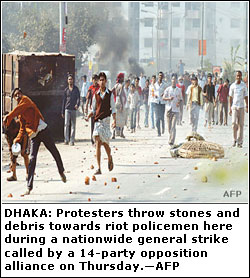 DHAKA, Dec 21: Bangladesh was brought to a standstill again on Thursday as opposition parties staged a nationwide strike to demand sweeping reforms ahead of next month's general elections, police said.
Chanting slogans including “no reform, no elections”, supporters of the Awami League and its allies marched through the capital Dhaka and other major cities, while security forces stepped up their presence.
Police said the strike had halted transport and disrupted business operations. In Dhaka, offices, schools and colleges were closed.
“At least 9,400 police and paramilitaries have been deployed in the capital to prevent violence,” police inspector Mahbubur Rashid said. Roads around the presidential palace were sealed off.
The Awami League and its allies were holding rallies and marches at 36 points in the city, but there were no reports of violence, police assistant commissioner Anisur Rahman said.
The strike came despite the interim government's agreement to push through two key electoral reforms demanded by the opposition ahead of the Jan 22 polls.
The interim government, led by President Iajuddin Ahmed, said it would ask a top election official accused of bias to go on leave, and decided to use an updated voter list based on one drawn up for the 2001 elections, not a list the opposition said contained millions of “ghost voters”.
But the Awami League said the reforms did not go far enough to ensure the vote would not be biased in favour of the outgoing Bangladesh Nationalist Party (BNP)-led government.
“We are not satisfied with these latest steps. It's piecemeal and it came too late. And also it did not have everything that we have been demanding for months,” opposition spokesman Abdul Jalil said.
“The president still could not prove that he is neutral. He is still being dictated by the BNP,” Mr Jalil added.
The Awami League and its allies have threatened to boycott the polls unless the interim government carried out a string of other reforms and set a new date for the vote.
Pre-poll political violence has already claimed at least 35 lives and injured thousands, and the interim government has called out the army to keep order.
Repeated strikes, blockades and protests have disrupted business life, costing the impoverished country millions each day.
Chittagong, the country's main port, had again been cut off from the rest of the country, senior police officer Farid Uddin said.
Chittagong port handles more than 90 per cent of Bangladesh's 24-billion-dollar foreign trade. The business bodies have repeatedly urged the political parties to spare the port from their protests.—AFP





























