



 0
0

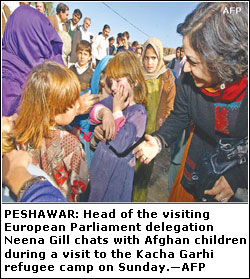 PESHAWAR, Dec 17: No proposal to integrate Afghan refugees with the local population is under consideration, said a senior official.
“The government of Pakistan will not forcibly repatriate Afghan refugees, nor will it offer them citizenship,” said Sahibzada Mohammed Anees, head of the Commissionerate for Afghan Refugees (CAR), while briefing members of a European Parliamentary delegation at the Kacha Garhi refugee camp here on Sunday.
Neena Gill, Chairperson for South Asia, is leading the delegation which earlier visited Darul Uloom Haqqania near Nowshera.
At the Kacha Garhi camp, the delegation members witnessed the process of registration of the refugees at an office of the National Database Registration Authority (Nadra).
The delegation members also spoke to the refugees at the camp.
Haji Mohammed, an elderly Afghan national, told the delegation that the refugees could not go back to Afghanistan, primarily because of a worsening law and order situation there. Lack of basic amenities of life in the country was also hampering their repatriation, he added.
"I led a four-member family to Pakistan in 1980, but now my family has grown to 54 members," he said.
He also complained that about 55,000 inhabitants of the camp were facing problems concerning basic needs.
Briefing the delegation, Mr Anees said even though Pakistan was not a signatory to the Geneva Convention or any other protocol to shelter and feed such a large number of immigrants, it would not opt for forced repatriation of the refugees.
“Pakistan is providing shelter to more than 2.5 million Afghans on humanitarian grounds and it will help them to go back to their homeland under the United Nations voluntary repatriation programme,” he said.
The government, he said, never imposed a ban on the movement and activities of the refugees in any part of the country. It had given certain incentives to them to earn their livelihood and exempted them from several taxes, he added.
However, the CAR chief clarified that Afghan children, born in Pakistan, were not eligible for citizenship nor could they be given jobs in the public sector.
He said under a tripartite agreement signed by Pakistan, Afghanistan and the United Nations High Commissioner for Refugees (UNHCR), about 400,000 refugees were to be helped to go back to their homeland. However, the target could not be achieved this year due to the security situation in Afghanistan, he said.
Mr Anees said that under a new strategy, being devised to enable more and more refugees to return to their country, the Afghan government would recommend the number of people to be returned from time to time.
He deplored that since 1995 there had been no international assistance for the refugees.
He said the UNHCR was providing assistance for a primary education project while the CAR was running secondary schools in refugee camps out of its own resources.
Quoting a report, he said that 40 per cent of the refugees were getting treatment at government hospitals.





























