



 0
0

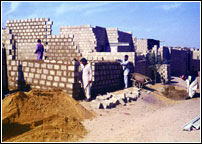 AS the real estate market tumbled and land prices nosedived in the major urban areas of Punjab – especially in Lahore and Rawalpindi, since the second half of 2005, most people linked to the construction industry assumed that the house-building boom would be over sooner than later. It didn’t. In fact, the dip in the land prices proved a boon for the housing sector.
“I had more work come my way this year (2006) than last year in spite of the slump in the real estate market,” Abdur Rauf, a labour contractor says. “Initially, the dip in the market and the reports that investors were pulling themselves out of the real estate sector, and genuine buyers were waiting the land prices to fall further gave rise to speculations that the construction boom in the housing industry may be over, at least partially if not completely for the time being. The situation nevertheless changed rapidly within a few months as more and more people began constructing houses,” he says. Like several others in the housing industry, Rauf feels that the “temporary or brief slowdown” in the housing sector was caused by the exorbitantly high cement rates.
Bankers contend that the number of individuals seeking housing finance during the last one year or more has increased considerably in spite of the fact that the cost of credit has gone up substantially. The banks have jacked up their interest rates on housing finance to 11.5-12.5 per cent since the central bank began tightening its monetary policy for controlling inflationary pressures . It is pertinent to recall that housing finance was available for as low as seven per cent before the State Bank reversed its earlier monetary policy and started to reduce money supply in the economy.
“The volume of our housing finance portfolio and the number of clients applying and seeking funds for constructing their houses has definitely increased over the last one year despite higher cost of credit,” says Rana Umair, an executive at Bank Alfalah Limited. “The growth in demand for housing finance is mainly generated by the reduction in the land prices,” he says. “Now that the residential plots are available (in the well developed housing schemes) at almost half their price a year or so ago, people interested in constructing their own houses and don’t mind obtaining a bit expensive credit,” he contends.
That the construction activity in the housing sector is picking up is evident from a record, highest cement production and sales last month. The cement production and sale shot up 46 per cent in November as compared to the same period last year on a year-on-year basis.
“The record cement consumption last month reflects the fact that the so-called construction boom is not over in the country,” says Shahid Jamal, a practicing architect who also teaches at the University of Engineering & Technology (UET). “Since there is no new mega project underway,, it can safely be assumed that a major portion of cement sold in November or before must have been consumed by the housing sector,” he maintains.
He says more people, especially those who were in possession of a plot and did not sell it even when the land rates were at their peak as well as those who had purchased plots at quite a high price with the intention of building their houses, were fast building houses for themselves. He did not agree with a suggestion that the recent drop in the cement price had boosted construction in the housing sector. “The reduction in the cement prices is nothing but just a temporary phenomenon. The day the manufacturers decide to form cartel, the rates will again go up. The reduced cement price has though helped bring the construction cost slightly down for the time being, it has failed to impact upon the overall activity in a big way,” he says, adding the overall construction cost remains at the same level or gone up because of the rising costs of finishing materials like tiles, marble, paints, wood, etc as well as wages of the skilled and semi -skilled labour due to growing construction activity.
While the housing sector is showing healthy growth in urban Punjab, the “built houses” market has suffered a setback in the recent months. “We’re selling fewer houses these days than a few months or a year back despite the fact that the prices have been reduced by Rs250000-500000 per unit depending upon the size of the plot,” says Muhammad Sarwar, a builder. Even most reputed developers, he says, are facing problems in finding customers for the apartments, town houses, etc in their new schemes. “The slump in the sales of built houses can be attributed to the temporary absence of the investor from the market,” he says. He says the overseas Pakistanis who formed a big portion of the buyers of built houses had apparently also lost interest in the purchase of the built houses. Further, he says, “it always costs you less to build your own house if you have a plot of land rather than purchasing a built unit.”
With the land prices and construction costs (ranging between Rs850/sq.ft and Rs1600/sq.ft for a modest construction and finishing) is still too high for an average middle class salaried person to afford, the construction activity is primarily confined to upscale market and developed schemes with good infrastructure – DHA, Valancia, Wapda Town, etc – and to some extent in old, LDA sponsored schemes like Johar Town in the provincial capital of Punjab.
Can the current boom in the housing sector in the urban areas bridge the widening nationwide housing gap which is projected at 6.19 million in the Economic Survey of Pakistan 2006? No. The housing production has to be increased to 500,000 units per annum for the next 20 years to fill the current gap, according to the government’s own estimates. And in spite of the current boom only 250,000 units are being constructed annually around the country, widening the gap further by as many numbers each year.
“Those who are building their houses mainly comprise overseas Pakistanis, or those who already have plots and enough income to obtain a bank loan for this purpose, or those who have substantial savings or income to afford to purchase a plot and undertake construction. For others it is near impossible to build a house because the land prices are still too high for them and construction cost too big for them to afford,” says Rauf.
Akber Sheikh, a leading builder and developer, says the people with a monthly income of Rs25000-50000 can have a roof of their own provided they decide to move away from the main city to suburbs where the land is comparatively cheaper or adopt the culture of living in flats. “But the problem (with our middle class) is that everyone wants to own an independent house, bungalow in one of the main city localities. Many of them still can have a roof for themselves and their families provided they are ready to compromise on their ambitions.”
That may be a solution to the housing problem for many people with a limited but reasonable monthly income, but it entails many other problems that the government has to resolve before they actually start thinking of moving out of the cities to suburbs. The major problems include the lack of quality physical and social infrastructure like roads, hospitals and educational institutions, and cheap public transport to move to and from workplace that could be as far away as 20-30km. On top of this, the ever worsening law and order situation in the urban as well as rural areas of the province is scary enough to prevent people from moving to the city’s suburbs.






























