



 0
0

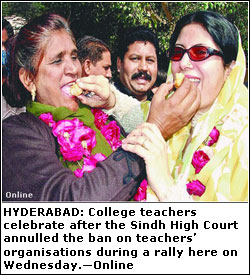 KARACHI, Dec 13: The Sindh High Court on Wednesday voided the ban imposed on the Sindh Professors and Lecturers Association and the Government Secondary Teachers Association and quashed the consequential actions taken against their members.
By a detailed judgment reserved in October, a division bench -- comprising Chief Justice Sabihuddin Ahmed and Justice Yasmin Abbasi -- held that the impugned notification of July 21 was violative of the fundamental right of freedom of association and expression guaranteed by Articles 17 (1) and 19 of the Constitution.
The proceedings against the petitioner teachers in pursuance of the ban, including termination of services and notices under the Removal from Service (Special Powers) Ordinance, are, therefore, ‘mala fide and of no legal effect’, declared the bench.
Akhtar Hussain, Abdul Mujib Pirzada and Rasheed A. Razvi, appeared before the court as lawyers for the petitioners while Khalid Anwar acted as the legal counsel for the respondent provincial education department.
The provisions of the Government Servants (Conduct) Rules, 1966, placing unreasonable fetters on the functioning of service associations formed by government employees could also not withstand the test of constitutional validity, the bench said. Parting with the judgment, authored by the chief justice, it observed that the withholding of salaries of the petitioner teachers despite the ‘undisputed legal position’ that a civil servant is entitled to full salary even during the period of his suspension ‘only augments the allegation of mala fides’. It also expressed its surprise over registration of a criminal case for rioting against a petitioner teacher and the chief secretary making it a ground for taking action against him.
Rejecting the respondent’s plea that the right to form unions and associations should not be available to government servants, the bench pointed out that, in the first place, whenever the constitution makers thought that a particular right should not be conferred on government servants as a class, they did so through a specific intendment. For instance, the right to form a political party under Article 17 (2) was made available to every ‘not in the service of Pakistan’. No such exclusion has been made in respect of the right to form unions and association under Article 17 (1).
Referring to a 1997 Supreme Court judgment in the Civil Aviation Authority case, the bench noted that a provision mandating prior permission of the CAA director-general for membership of an employees’ association was held repugnant to Article 17 (1) as it bore no nexus with the sovereignty or integrity of Pakistan, public order or morality in the interest of which reasonable restrictions on the right could be imposed by law. The right to associate did not include the right to strike but the exclusion was no bar on the right to form unions and undertake collective bargaining.
The bench also referred to an Indian Supreme Court judgment to the effect that while the right to strike was not a fundamental right, the right to participate in a protest demonstration could not be denied under the Indian constitution.
It pointed out that there is no provision in the Societies Registration Act prohibiting registration of associations of civil servants. In any case, even an unregistered union or association can function and engage itself in collective bargaining under the right guaranteed by the Constitution.
EMERGENCY: Dealing with a ‘more formidable’ contention raised by Khalid Anwar that the state of siege proclaimed on May 28, 1998, was still in force, the bench felt sorry that despite radical changes in the international situation over the last eight years, the holding of a general election in 2002, and the induction of a democratically-elected government, the proclamation could not be revoked. In view of the 1999 Supreme Court verdict in Farooq Ahmed Khan Leghari’s case, the superior court can always review continuance of emergency. In a 1980 Malaysian case, the Privy Council held that the failure to revoke emergency when it was no longer necessary amount to abuse of discretion and a writ can be issued to the cabinet to rescind the proclamation.
“We are, therefore, of the view that this court is not denuded of the jurisdiction to examine the validity of the continuance of 1998 proclamation of emergency”, the bench said but hastened to add that since the petitions could be decided on narrower grounds, “we did not feel it necessary to issue a notice to the attorney-general for examining the justification for continuance of the 1998 proclamation”. Apparently, denial of a right to form associations and unions to a particular class of persons in one province had nothing to do with the situation of a country being threatened by external aggression.
“Even otherwise”, the bench observed, “it appears wholly incongruous that all the citizens should stand deprived of their basic rights of movement, association, business, expression and property in their ordinary evocation of life having nothing to do with a national emergency or that the parliament and the federal government should assume complete control over all affairs of the provinces on the pretext of a proclamation of emergency issued eight years ago”.




























