0
0

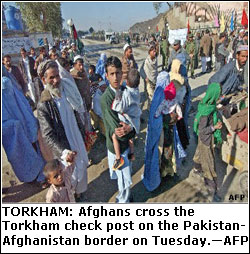 WASHINGTON, Dec 12: Insurgents continue to cross the Pakistan-Afghanistan border to carry out attacks inside Afghanistan, says the US State Department while urging Islamabad and Kabul to work together to beat the insurgency.
"Clearly, you still do have cross-border infiltration and I know that that is a concern for the Pakistanis and the Afghans," State Department spokesman Sean McCormack told a briefing in Washington on Tuesday.
For the first time in an official US briefing, the spokesman also indicated that insurgents had safe havens along the Pakistan-Afghanistan border and they were using them for attacking Afghan and US-led coalition forces.
"Having safe havens and areas where these extremists can operate from is a real concern for us," he said.
The spokesman, however, refrained from blaming Pakistan for the increase in insurgency and instead urged greater cooperation among Afghan, Pakistani and coalition authorities to defeat insurgents.
“The key is to have cooperative working relationships among the Afghans, the Pakistanis, as well as coalition forces and that includes us,” he said.
Pakistan has deployed more than 80,000 troops along the border with Afghanistan for tackling the problem and hundreds of Pakistani soldiers have been killed while battling the insurgents.
The US concerns stemmed from media reports on Monday that Pakistan's peace deals with militants in tribal areas are allowing the Taliban to regroup.
A 10,000-word report in the New York Times claimed that the militants are now consolidating their hold in the tribal zone, vastly expanding their training of suicide bombers and other recruits. They also have intensified their relationship with al-Qaeda and foreign fighters, the report said.
Their new strength has led to "virtually a Taliban mini-state" and portends an "even bloodier year for Afghanistan in 2007," the report warned, quoting diplomats and intelligence officials from several nations.
Many Taliban guerrillas fled to Pakistan's tribal zone after the US-led invasion of Afghanistan in the wake of the September 11, 2001 attacks. The Taliban's subsequent insurgency has spiked in 2006 with almost 4,000 deaths.
The report blamed the peace deals that Pakistan signed with the tribal elders of North Waziristan in September 2006 and neighbouring South Waziristan in April 2004 for this increase.
Spokesman McCormack, however, refused to back this claim, saying that it was "too early to tell" whether the peace programmes were succeeding.
When a reporter asked him to say if the peace deals had failed, the State Department spokesman said: “I do know it's relatively new so they're still working through it.”
He said that Pakistan had briefed the United States on the peace programmes before implementing it “and certainly it seemed as though it was a workable model.”
He said that as with most things, “the true effectiveness” of this programme also comes down to its implementation and in exactly what manner it’s implemented. The spokesman also rejected the suggestion in the New York Times and other media reports that the Pakistanis had willingly allowed the Taliban to operate from their territory.
“I think that everybody is aware of the problem of ceding territory to extremists, to terrorists, and you don't want to do that,” he said.
The peace deals with the tribal elders, he said, also reflected Pakistan’s desire to prevent the insurgents from gaining a foot-hold inside the Pakistani territory.
The insurgency, he said, was becoming a problem not only for the Pakistanis but also for Afghan and coalition forces because the insurgents were attacking them as well. “So the Pakistan government came up with this programme as a way to integrate economic, political, civil, military programmes to try to address that,” he said.