



 0
0

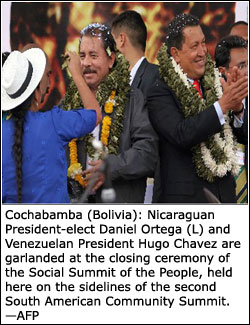 COCHABAMBA (Bolivia): Bolivia's president closed a two-day regional summit on Saturday by saying a South American community of nations modelled on the European Union could become a reality in five years.
“We don't want it to take as long as with the European Union -- 50 years to create. I hope it can take us less. Three, four, five years,” President Evo Morales told seven of the region's 12 presidents in the Bolivian city of Cochabamba.
The leaders, including Venezuelan President Hugo Chavez, signed a statement agreeing to “lay the cornerstone of the South American integration process.”
Chavez, Washington's leading US foe in Latin America, expressed concern that the summit group, known as the South American Community of Nations, lacked clout and said there had not been enough dialogue between the presidents.
“Let's admit it, we take decisions but we do not have the power to implement them,” he said.
Morales, a leftist ally of Chavez, told reporters the future of the grouping of nations would be a social, economic and cultural union based on “solidarity and cooperation.”
Brazilian President Luiz Inacio Lula da Silva said the leaders had “a lot setting them apart and a lot bringing them together.”
“I'm certain South American countries cannot move forward individually. ... Either we sit down and we carry out the integration (process) ... or we won't have a chance,” he said.
Morales, Bolivia's first indigenous leader, advocates a merging of the two trade blocs vying to be the leading voice and consolidate economic growth in South America -- the Andean Community of Nations and Mercosur.
Bolivia, Colombia, Ecuador and Peru belong to the Andean bloc, which lost ground this year when oil-rich Venezuela withdrew, claiming the group was dead after Peru and Colombia signed free trade deals with the United States.
Venezuela then joined Mercosur, which also includes Argentina, Brazil, Paraguay and Uruguay. But it has been riddled by spats between its members and has not progressed as far as expected when it was launched 12 years ago. Chile, one of the largest and most stable South American economies, does not belong to either group.
Chavez said both blocs were dead and that scrapping them both was the only way to achieve the goal of unity. “Those instruments were born to benefit trade, the elites,” he said. The presidents agreed to meet in Venezuela next year to discuss energy integration and to create an office in the Brazilian city of Rio de Janeiro to promote regional unity.
Following sometimes violent pro-autonomy demonstrations in the wealthy region of Santa Cruz this week, local leaders have renewed their demands for more regional independence from the national government in La Paz.
They have called a public meeting for Friday at which they will decide their next step. Leaders of the regions of Pando, Tarija and Beni are organizing similar meetings next week.
Both Morales and Chavez have accused Washington of conspiring with the opposition.
“The struggle continues against North American imperialism ... the people together with the armed forces and its government will never allow them to boycott this process of change,” said Morales, the country's first Indian president.—Reuters




























