



 0
0

India is doing quite well without Sharia courts
THE Bhopal gas tragedy occurred on Dec 2, 1984. More than 20,000 were killed and many more maimed by the poisonous fumes that leaked from the Union Carbide factory. The 16th century Babri Masjid was razed on Dec 6, 1992, by a religious mob. Thousands were killed in the ensuing communal carnage, mostly in Mumbai. And finally, the Indian parliament was attacked on Dec 13, 2001, in which eight or nine Indian security personnel died along with five mysterious militants who were shot or blew themselves up. This led to a military build-up against Pakistan, with fears of a nuclear war looming high. The diplomatic enclave was deserted out of sheer fright. Hundreds of soldiers died without a bullet being fired, as they stepped on landmines their colleagues had planted.
We have graphic details of the politicians who presided over the Babri demolition exhorting the crowds in Ayodhya into a froth. We have every kind of evidence needed to punish the guilty. Its perpetrators call the destruction an essential core of their patriotism. Nothing has happened to catch anyone. Later Justice Srikrishna investigated the murder of Muslims by state police and religious mobs in Mumbai in the wake of the Babri tragedy. He named everyone who was involved. The Shiv Sena, the police. Nothing happened. The report is gathering dust. What is being investigated is the act of terrorism that followed when in apparent revenge for the massacres, the Muslim underworld allegedly planted bombs across the city, killing 300 in March 1993. Dozens have been convicted of that crime after a long-drawn trial. Those convicted include movie star Sanjay Dutt, ostensibly for keeping a gun linked to the underworld.
Every year since the horrible mass murder in Bhopal, the survivors still coping with the effects of the poison converge in the Indian capital and elsewhere to demand justice. They are still trying. The American CEO of Union Carbide was arrested for a few hours and let off on bail. He has refused to return to face trial. This was several years ago. The Indian government is too busy wangling a deal on nuclear fuel to seek justice for Bhopal’s helpless citizens from the United States. In fact it is getting ready to invite the corporate heirs of Union Carbide to set up more killing factories in other parts of the country. This is part of the package called economic reforms. What are the courts doing?
Indian media mock Sharia courts in Pakistan and elsewhere because of their perceived bias against women. Fair enough. Even within the Indian context, mainstream newspapers and TV channels daily pounce on a steady supply of obscure judgments on rape and divorce handed down by self-styled judges in small towns that double up as Muslim ghettoes. Shariat courts are supposed to derive their clout from the will of God. Last week as they discussed the three December tragedies under the caption, “Impunity for some, witch-hunt for others,” a leading activist working with the Bhopal victims dropped a bombshell. She quoted a Supreme Court judgment that could have belonged to any theological school. According to teacher and human rights activist Suroopa Mukherjee, a 1996 judgment by the court dropped serious charges against the Indian collaborators of Union Carbide because it believed the tragedy was “an act of God, for which no human being was responsible”. On that basis the charges were reduced from “culpable homicide” to “death due to negligence”. So Bhopal was an act of God. What about Ayodhya and the parliament attack cases? The Supreme Court has not punished anyone for the Babri crime but it has concluded that Hindutva is not a communal ideology, but a nationalist worldview. More recently, delivering the death sentence on Mohammed Afzal Guru, the court did not talk about meeting the ends of justice, the standard catch phrase accompanying a decision, but it quoted instead the “collective conscience of society” to support its judgment.
What about the “collective conscience” of those whose views are represented by Arundhati Roy, for example? They are not with the Supreme Court. Whatever the claim of any court to its ultimate wisdom, it should not be allowed to shake off its core responsibility of addressing questions that defy its beliefs. Afzal Guru’s case is one such example. Penguin India has assembled a collection of writings by lawyers and rights workers that throws fresh light on the case. Arundhati and Nirmalangshu Mukherjee, who has written a book on the case, have for long tried to see traces of the notorious Reichstag fire in the attack on the Indian parliament.
Ms Roy’s 13 questions contained in the book, to be released on Dec 12 -- a day before the notorious anniversary, are good enough to overturn any verdict because it punches so many holes in the prosecution theory. Here are the questions. For the rest of her arguments you read the book.
Question 1: For months before the attack on the parliament, both the government and the police had been saying that parliament could be attacked. On Dec 12, 2001, at an informal meeting Prime Minister Atal Behari Vajpayee warned of an imminent attack on parliament. On Dec 13 the parliament was attacked. Given that there was an 'improved security drill’, how did a car bomb packed with explosives enter the parliament complex?
Question 2: Within days of the attack, the special cell of Delhi police said it was a meticulously planned joint operation of Jaish-i-Mohammad and Lashkar-i-Taiba. They said the attack was led by a man called 'Mohammad’ who was also involved in the hijacking of IC-814 in 1998. (This was later refuted by the CBI). None of this was ever proved in court. What evidence did the special cell have for its claim?
Question 3: The entire attack was recorded live on close circuit TV (CCTV). Congress Party MP Kapil Sibal demanded in parliament that the CCTV recording be shown to the members. He was supported by the Deputy Chairman of the Rajya Sabha, Najma Heptullah, who said that there was confusion about the details of the event. The chief whip of the Congress Party, Priyaranjan Dasmunshi, said: "I counted six men getting out of the car. But only five were killed. The close circuit TV camera recording clearly showed the six men.” If Dasmunshi was right, why did the police say that there were only five people in the car? Who was the sixth person? Where is he now? Why was the CCTV recording not produced by the prosecution as evidence in the trial? Why was it not released for public viewing?
Question 4: Why was parliament adjourned after some of these questions were raised?
Question 5: A few days after Dec 13, the Indian government declared that it had 'incontrovertible evidence’ of Pakistan’s involvement in the attack, and announced a massive mobilisation of almost 500,000 soldiers to the border. The subcontinent was pushed to the brink of a nuclear war. Apart from Afzal’s 'confession', extracted under torture (and later set aside by the Supreme Court), what was the 'incontrovertible evidence’?
Question 6: Is it true that the military mobilisation on the Pakistan border had begun long before the Dec 13 attack?
Question 7: How much did this military standoff, which lasted nearly a year, cost? How many soldiers died in the process? How many soldiers and civilians died because of mishandled landmines, and how many peasants lost their homes and land because trucks and tanks were rolling through their villages, and landmines were being planted in their fields?
Question 8: In a criminal investigation it is vital for the police to show how the evidence gathered at the scene of the attack led them to the accused. How did the police reach Mohammad Afzal? The special cell says S. A. R. Geelani led them to Afzal. But the message to look out for Afzal was actually flashed to the Srinagar police before Geelani was arrested. So how did the cell connect Afzal to the attack?
Question 9: The courts acknowledge that Afzal was a surrendered militant who was in regular contact with Indian forces, particularly the Special Task Force (STF) of occupied Kashmir’s police. How do the forces explain the fact that a person under their surveillance was able to conspire in a major militant operation?
Question 10: Is it plausible that organisations like Lashkar-i-Taiba or Jaish-i-Mohammed would rely on a person who had been in and out of STF torture chambers, and was under constant police surveillance, as the principal link for a major operation?
Question 11: In his statement before the court, Afzal says that he was introduced to 'Mohammed' and instructed to take him to Delhi by a man called Tariq, who was working with the STF. Tariq was named in the police charge-sheet. Who is Tariq and where is he now?
Question 12: On Dec 19, six days after the parliament attack, the police commissioner of Thane (Maharashtra), S. M. Shangari, identified one of the attackers killed in the parliament attack as Mohammad Yasin Fateh Mohammed (alias Abu Hamza) of the Lashkar-i-Taiba, who had been arrested in Mumbai in Nov 2000, and immediately handed over to the J&K Police. He gave detailed descriptions to support his statement. If Police Commissioner Shangari was right, how did Mohammad Yasin, a man in the custody of the J&K Police, end up participating in the attack? If he was wrong, where is Mohammad Yasin now?
Question 13: Why is it that we still don’t know who the five dead 'terrorists' killed in the parliament attack are?—jawednaqvi@gmail.com
Hopes for KCR revival
 Hopes for the revival of the Karachi Circular Railway have again been raised. A meeting in the Governor’s House last Monday approved the revival of the Karachi Circular Railway. The meeting was told that Japan would provide $872 million of the total estimated cost of $1 billion. The presence of Railways Minister Sheikh Rashid Ahmed, in this case, lends weight to the perception that the government is finally considering the KCR’s revival as a serious matter.
Although the project needs the go-ahead from the Executive Committee of the National Economic Council and the Planning Commission, the governor directed the local authorities to launch the project early next year and ensure that it was completed within three years.
Sceptics may, however, cite the earlier inauguration of what was dubbed as Phase-I of the project by none other than Prime Minister Shaukat Aziz on March 8, 2005. That project was not even semi-circular as the train was supposed to go from the city station straight to the Landhi station and back. That too hit a snag sometime in between and is heard of no more.
The city traffic is growing at an alarming rate. There are so many flyovers and underpasses in the works. But it seems that these projects too will fall behind in the race with the traffic growth.
Once the KCR used to be a popular mode of transport. As it chugged through Lyari, Shershah, Site, Nazimabad, Liaquatabad and Gulshan-e-Iqbal to Malir and Landhi, the faces of the working people waiting for it on the small railway stations would brighten up. And when it tooted its horns, commuters having their breakfast in the nearby houses would rush to the station to the catch the train.
The few buses that plied in those days charged too much, took too long to move from one place to another and offered little comfort as they kept no schedule. Even when you waited at the KCR station, you could rest on the cement benches installed along the platform and in the verandah attached to the ticketing room. But over the years, the KCR lost its utility as it ran at times when there were fewer passengers to pick. Actually its timings were tuned to the schedule of the express trains rather than people’s arrival at and departure from their workplaces — offices and factories. Now the platforms are used to hold daily or weekly bazaars and the offices and verandahs serve a few drug addicts.
The new KCR project envisages 22 underpasses and overhead bridges besides other related infrastructure. Much of the old infrastructure can also be utilized. That this project will be linked to the city government’s mass transit system will make it more efficient. The city desperately needs it as well as the light rail, etc. All these projects are vital for Karachi’s future if it is not to bog down under ever-growing traffic load.
Snake in the grass
My wife immediately notices when there is a flicker of smile on my face and demands to know the reason behind it. Her attention is never attracted by my crazy gesticulations, frowning, grimacing and other manifestations of an agitated state of mind. Obviously, all these signs have become the hallmark of a disgruntled man with many perceived causes to be so.
The cause of the momentary pleasantness was a couplet of mine that came to mind in another context:
Bethna, uthna, thaherna, ya keh jana chahiyey
Unko tau hum per bigarnay ka bahana chahiyey
(Whether I should sit down, stand up, move off or stay on, I cannot decide. Because I know he — or she? — is hunting for a pretext to scold me.)
Though it describes my own erstwhile predicament, the couplet also reflects the situation Chaudhry Shujaat Hussain and his colleagues are in vis-à-vis the Muttahida Qaumi Movement. After the MQM’s agitation launched against him for his entertaining a group of religious scholars, imagine what would be his response when another group comes knocking and wants to see him. Chaudhry Sahib is already groaning that the language used at the MQM protest rallies against him was not particularly decent. It was really harsh when the senior politician was called 'Aasteen ka saanp’, or a snake in the grass.
The PML-Q chief has also been threatened that his plane would not be allowed to land at Karachi airport, reminiscent of Pervez Musharraf’s own plane when it circled over the airport before it was finally allowed to come in to land on October 12, 1999. So, passengers better take care that they do not share a flight with Chaudhry Sahib.
Earlier, Punjab assembly members had been incensed by the MQM’s activities in that province and they constantly criticized the party in the provincial assembly. Outside it, the MQM retaliated with vehemence. When a Punjab minister assured his audience that MQM men involved in crimes would be punished, immediately came the MQM rebuke: 'PML-Q men found involved in crimes will be punished.’
But Chaudhry Shujaat is not pestered by one party alone. Dr Sher Afgan Niazi, a partner in the coalition government, had also echoed the MQM’s criticism of the Chaudry. His predicament knows no end as even the MMA chose Gujrat, his ancestral town, to lead its protest 'rally’ to.
When nature turns harsh
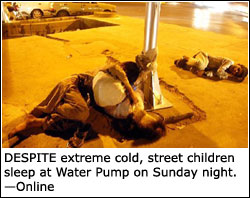
Mustafa has no different life than thousands of street children in Karachi who have no shelter and remain under the sky round-the-clock.
Life becomes too difficult for them when it rains and it becomes too harsh when he and his little companions find little shelter to pass the wet season under.
Mustafa is one of the many car washers in Saddar. Like his companions, he works the whole day, washing luxurious cars but the money he gets in return is not so hefty. Most of his earnings go to the contractor who manages the business but that does not annoy him, rather he feels content.
Mustafa is no exception among street children who hate rain because it does not allow them to get sleep on a footpath outside the Tibet Centre on M.A. Jinnah Road. It gets even more difficult for them to have forty winks in daytime.
Mustafa says, “Normally, rain does not obstruct car washing — it helps you. But people avoid having their cars washed as frequently as they normally do because rainwater gathers in the area and cars become filthy again before long,” says the boy.
“We cannot sleep in the open because of rains. And it is too difficult to get a nap under any shelter of a building because most people do not permit us.”
Like Mustafa, most of the street children of Karachi are facing similar hardships during heavy rains in the city and are praying for the downpour to stop. “I don’t like rain because when it falls we cannot sleep, we cannot earn as much as we normally do,” says Karim, another street child who works as a waiter at a roadside teashop.
He points to the tea stall and says: “It is too small to get any shelter for a proper sleep in the night. And I could not sleep on the footpath because of rain.”
— Karachian
Email: naseer.awan@dawn.com



























