0
0

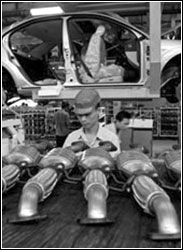 MEGA investment proposals, which promise to generate thousands of jobs, raise billions of rupees in taxes, and contribute to rapid economic growth, are generally welcomed by politicians, trade unions, other businesses and the general public.
But in India, such proposals bring out the worst in politicians, many of who abandon whatever little principles they have, and do everything possible to drive away the investments.
Last week saw Rajnath Singh, President Bharatiya Janata Party (BJP) – which when in power at the centre struggled to attract investments from all over the world – behave like a petty, whining, low-level operator of a regional grouping, rather than the head of a national party.
Singh dashed off to West Bengal and joined a bunch of professional protestors opposed to virtually every development project, and raised his voice against the multi-billion-rupee small car project of the Tata Motors in Singur on the outskirts of Kolkata.
West Bengal, which has been ruled continuously by the leftists, led by the Communist Party of India (Marxist) for nearly 30 years, has over the past few decades lost its position as one of the leading industrial states of the country. But the present Chief Minister, Buddhadeb Bhattacharya, a pragmatic Marxist, has been wooing both Indian and international investors to the state.
The Tatas, who have been planning to launch a small car priced below Rs100,000, selected Singur as the site of the proposed plant. They have plans to invest about Rs2.5 billion initially; later, with other manufacturers also investing in Singur, it could see total investments of up to Rs10 billion. The West Bengal government offered the Tatas a thousand acres of land at Singur, which is about 50km from the state capital, Kollkata.
But the CPM – which ironically opposes similar major projects in states that are not ruled by it – has been facing stiff opposition from other parties following the clearance given to the Tatas. The most vocal opponent has been Mamata Banerjee, a former Congress activist, who set up the Trinamool Congress with the sole intention of dislodging the CPM from West Bengal.
However, her party was routed in state elections held early this year. The mercurial Banerjee, who has a love-hate relationship with the two major national parties – the Congress and the BJP – has been an ally of the BJP in the National Democratic Alliance government.
But her visceral hatred of the Marxists has blinded her and Banerjee has launched a major battle against the Singur auto project. Earlier in the month, her party legislators went on the rampage in the state assembly, ransacking it after she had been detained by the police and prevented from visiting Singur.
Opponents of the Tata project include celebrity protestors like Medha Patkar and Booker-prize winning novelist Arundhati Roy, besides of course Naxalites and other extremists. Last week, some Naxalites attacked the Tata Motors showroom in the heart of Kolkata.
While most of the other protestors are consistent in their opposition to mega projects, Rajnath Singh’s bid to exploit the issue has shocked the Indian industry. The BJP is in power in states like Gujarat, Rajasthan, Madhya Pradesh and Chhattisgarh, and chief ministers from these states travel abroad to lure investments.
Gujarat has been at the forefront of attracting capital, both Indian and foreign, and the state government has been acquiring hundreds of acres of land from farmers for 18 special economic zones (SEZs) that will come up in the state. In fact, the concept of the SEZs was launched in India when the BJP was in power.
When the West Bengal government acquired land in Singur from farmers for the auto project, it offered them compensation which has been seen as transparent and also the best so far by a state government. According to Sitaram Yechury, the CPM member of Parliament, while farmers on the outskirts of Mumbai were paid Rs24,000 an acre by a state government agency, in Singur, the West Bengal government paid them Rs840,000 for an acre of single-crop land, and Rs1.2 million for an acre of multi-crop land.
Nearly 10,000 farmers have accepted the cheques from the government. The Tata Motors project at Singur is one of the most important investment proposals in West Bengal; if it succeeds, the state expects the floodgates to open. The state has seen the closure of thousands of industrial units over the past few decades, both in the public and private sectors, resulting in growing joblessness, and economic stagnation.
Chief Minister Bhattacharya has been trying to revive the state’s economy by attracting investors from around the globe. In fact, Bhattacharya will be the first Communist politician from India to officially visit the US next year, to attract investments. Last week, the US Ambassador to India, David Mulford, met the West Bengal Chief Minister in Kolkata, to discuss his trip to the US.
The West Bengal government has also been negotiating with other international and domestic automobile and auto-component majors, urging them to invest in Singur. It is in talks with Japan’s Sumitomo, European majors Lumax and the RBH Automobiles, and the Indian auto giants Mahindra & Mahindra, Ashok Leyland and the engineering leader Bharat Forge.
But other states are monitoring developments in West Bengal with interest. In case the opponents of the Singur project succeed, and the Tatas are forced to pull out of the state, they are waiting in the wings with equally lucrative offers.
The neighbouring state of Orissa – which has attracted billions of dollars in investment in the steel sector – has suggested to the Tatas that they might consider setting up the small car project in the state.
B.B. Harichandan, the state’s industry minister, points out that the Tatas had acquired nearly 3,500 acres of land for a steel project about 10 years ago. The project did not take off, but the Tatas still own the land, and are eager to promote an SEZ. However, the federal government, which has approved nearly 400 SEZs in the country, has still to give its clearance for the Tata SEZ in Orissa.
According to Harichandan, the state offers a lot of opportunities for automakers. It has huge steel manufacturing capacity – South Korean steel giant Posco is putting up a $12 billion, steel plant in the state, Mittal Steel is planning another plant, and Tatas themselves are investing $3.5 billion in a steel unit – and the government is also eager to provide incentives for auto units. Land is also being allocated for a 500-acre auto component hub in the state.
Other Indian states are also trying to lure auto manufacturers. They include Tamil Nadu, Haryana, Maharashtra and Gujarat. Earlier this month, Europe’s largest carmaker, Volkswagen, announced a $530 million investment in an automobile plant near Pune in Maharashtra.
The Tata Motors already has a sprawling facility in Pune. The American giant General Motors announced plans to set up another plant outside Pune, while the Fiat of Italy has a manufacturing unit near the city, which is rapidly emerging as an automobile hub. France’s Renault has tied up with Mahindra & Mahindra, and is planning a manufacturing unit in Maharashtra.
Other international manufacturers, including Toyota and Honda, are also planning to set up small-car units in India, and most of these states are hoping to attract them. India’s automobile market is booming, and the country has emerged as the second biggest compact car producer in the world after Japan, overtaking even Europe.
Compact car sales in India shot up by 23 per cent during the April-November period, crossing the half a million mark. The Society of Indian Automobile Manufacturers (SIAM), estimates that the auto market in the country will triple to three million units by 2015.