



 0
0

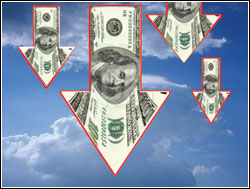 THE dollar has more or less stabilised over the week-end. But most currency watchers have stopped betting on the greenback. They predict further battering of what has, so far remained one of the strongest currencies in the world. And they advise the governments, especially those in the developing countries like Pakistan who have parked most of their foreign exchange reserves in Fort Knox to look for safer currencies like the euro and pound sterling.
Fears of a slowing US economy and speculation that central banks across the world may be moving their reserves away from the weakening dollar are also said to have contributed to a steady decline of the currency.
And there have been strong indications from the Chinese monetary authorities and others that diversification of currency reserves is becoming a more active policy. Russia is said to have already diversified into euro.
A simple decision to place fewer new reserves in dollar-denominated assets may avert the woes that would befall developing countries if they continue to keep all their reserve eggs in the not-so-strong-any-more dollar-basket.
The dollar fell against all major currencies during the week, losing well over a cent against the euro to end the week at $1.33 and against the pound, it plunged to almost $2. The turbulence on foreign exchanges spread to equity markets as well, where shares in both, London and Wall Street were under pressure.
Following the pathetic plunge of the dollar against pound, the attention this week here had focused on shopping bargains on offer to British consumers visiting the US. But some analysts warned that the strength of the pound might have a detrimental impact on the UK exports across the Atlantic. By the close of trading in Europe last week, sterling was at a 14-year high against the dollar and at six-year against the basket of global currencies.
About 10 per cent of the British trade is with the United States, so exporters will suffer from the stronger pound but importers of the US goods will see costs fall. Petrol prices at the pump could fall as the world's oil and its products are priced in dollars.
The US currency has by now shed 11 per cent of its value against the euro this year and 12 per cent against the pound. On a trade-weighted basis against a basket of other currencies, it has lost nearly 31 per cent of its value amidst fears over the America’s galloping current account deficit.
A big deficit, caused by the Americans consuming more goods from abroad than they export, is said to theoretically push a currency down until imports become more expensive and exports cheaper, at which point the deficit is reduced. But experts said that the dollar has held up so far mainly because big exporters to the US, such as China, have used their current account surpluses to reinvest in American assets, thus keeping the demand for dollars high.
The Paris-based Organisation for Economic Cooperation and Development (OECD) has said in its latest outlook that the US economy was slowing and would only grow by 2.4 per cent next year after a downwardly revised prediction of 3.3 per cent for this year. This is also said to have contributed in a small way in the fall of the dollar.
The OECD has blamed the housing market slowdown for the lacklustre US performance but added that the rest of the world would march on. Jean-Philippe Cotis, the OECD's Chief Economist has said, “rather than a major slowdown, what the world may be facing is a rebalancing of growth across the OECD regions."
The US current balance of payments deficit, recently running at some seven per cent of gross domestic product is said to be one of the major factors triggering the free fall of the dollar.
But being by far the world's biggest and the most developed market economy, the dollar is still more than acceptable all over the world. Nevertheless, experts said there comes a time when enough is enough. Although, there has been a gentle decline in dollar, most serious economists argue that a major adjustment (estimates circulate of up to 20 per cent or more) was necessary to put right a situation where the US imports 50 per cent more than it exports.
Some experts have listed three major causative factors for the present plight of the dollar. First, the colossal current account deficit, which the US funds by borrowing money from the rest of the world. Second, the clear signs of slow down in the economy following the steady increase in interest rates from one per cent to 5.25 per cent since 2004. The boom in the housing market that artificially inflated growth a year ago has tapered off.
Third, the differential between US interest rates and those in the rest of the world is narrowing. Despite all its tough anti-inflationary rhetoric, the Federal Reserve is not expected to raise rates again. The same could not be said of the European Central Bank, the Bank of England or the Bank of Japan; indeed, for the first time since the euro was launched in 1999 the foreign exchange markets are faced with a situation where the two big European banks are tightening but the next move in the US rates will be downwards.
The question now being asked is whether lower long-term rates would give overseas investors enough confidence to keep supporting the dollar by buying the US assets. One study in the US has shown that foreign capital flows have helped keep long-term interest rates in America a percentage point lower than they would otherwise have been.
Many believe that the global growth would slow down if the US economy slows down and in tandem the dollar’s buying power starts declining. For example not only China's exports to the US, accounting for 21 per cent of its total exports over the past five years are expected to be adversely affected by the US slowdown but economies such as Japan, Korea and Taiwan, would also suffer because, besides exporting directly to the US they also sell components to China that are assembled before being sent on to the US.
Some others, however, argue that a more balanced global economy, with strong growth in Asia and Europe, would neutralize the impact of a US slowdown or limit it to an acceptable level.






























