



 0
0

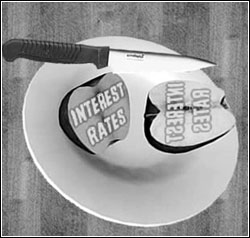 PAKISTAN has, more under the influence of international financial institutions rather than by its own choice, espoused the philosophy of market economy. Accordingly, market forces are to decide production, consumption and allocation of resources among various users and purposes.
In the process, market price plays a crucial role as a vital signal for economic activity. This will reflect the true market condition if there is no undue interference with demand and supply of goods and services, including financial assets, and there is fair and free competition.
The resultant market price must clear the market in the sense that there is no excess supply or unsatisfied demand at the prevailing price. Therefore, for efficient working of the market mechanism, there are essential pre-requisites, of which information and mobility of resources for free and easy choice are outstanding. Interest, or any other name given to it, is a price of loan-able funds and must comply with the basic requirements of market economy.There are frequent official announcements that government controlled interest rate will be related to the market interest rate as the benchmark. Recently, the director general of government sponsored and managed small saving schemes also hinted at that.
However, the central bank’s actual strategy of interest rate management is summed up in the State Bank’s Second Quarterly Report on the state of the economy, FY 06. It says: “SBP increased its intervention during this period to ensure that short-term inter-bank rates remain close to the discount rate.”
The fundamental question is: is there such a thing as really market determined interest rate which may serve as a bench mark for government controlled interest rates? For an answer, one must look at the nature of demand for and sources of loan-able funds.
On the demand side of loan-able funds, government looms large. This is obvious from the fact that as of end-June 06, domestic debt of the federal government stood at Rs2.3 trillion, or 67.6 per cent of money supply on that date. Public sector enterprises are also privileged borrowers, along with advances for commodity operations and individual government departments, Bank advances to them, were Rs205.4 billion and this raises the ratio of public sector debt to 73.5 per cent. If external debt is added, the ratio goes up significantly. External debt of the federal government had stood at Rs1.8 trillion at the end of December 5, or 51.3 per cent of money supply on that date.
The demand by the private sector is indicated by outstanding bank advances to private sector enterprises (Rs1.4 trillion), personal (Rs343.7 billion), and trust funds and non-profit organisations (Rs13.7 billion). At Rs1.8 trillion, this was 52.9 per cent of money supply on June 30, 2006.
The supply of loan-able funds ( apart from external debt governed by external factors, especially the policy of international financial institutions), emanates from households, corporate bodies and the public sector. Savings of corporate bodies and the public sector being quite small, it is for households to supply the bulk of loan-able funds, mostly through bank deposits and investment in the NSS.
Total deposits of domestic constituents with scheduled banks, inclusive of government (Rs270 million) and PSEs (Rs262 million) were Rs1.8 trillion. Personal bank deposits in June 06 were Rs1.2 billion as compared with the investment of Rs934.2 billion in NSS. They accounted for 35.3 and 26.7 per cent respectively of the money supply.
The traditional function of the central bank is to serve as the lender of last resort so as to ease the temporary liquidity difficulties of banks. This means minimum injection of money by the central bank into the economy. However, in Pakistan, the central bank has assumed an unorthodox developmental role and has been serving as an important primary source of capital to the economy. This could be, to some extent justified in the 1950s, when the economy was in a primitive stage, but not its present state of development more than half a century later.
The central bank’s injection of money into the economy, as of end-June 6, through loans and advances to scheduled banks, (Rs194.6 billion) loans and advances to non-bank financial institutions, (Rs14.2 billion), investment in scheduled banks (Rs25.8 billion), in non-bank financial institutions (Rs1.7 billion), in government securities (Rs493.3 billion), and “Others” (Rs.0.9 billion), was Rs730.5 billion representing 26.8 per cent of domestic assets (net) and 21.4 per cent of money supply on that date. Interestingly enough, the currency in circulation on that date was Rs740.4 billion.
As has been explained by this scribe in an earlier article, monetary policy is subordinated to fiscal policy and debt management by the State Bank aims at keeping the cost of servicing of government debt as low as possible. This is evident in the rate of interest but also in maturity of the debt, by not issuing long-dated securities. This is obvious from the composition of Federal debt; permanent debt at Rs500 billion, floating debt at Rs940 billion and unfunded debt at Rs856 billion.
Within permanent debt, Pakistan Investment Bands (FIBs) claimed Rs304 billion. Maturity structure of outstanding FIBs of three years was Rs1.6 billion; five years Rs72.1 billion; 10 years Rs200.4 billion; 15 years Rs7 billion; and 20 years Rs6.8 billion. In contrast, Treasury Bills accounted for Rs940.3 billion. New issues of long –dated government securities have been quite limited. During FY05, there was no issue of 15 and 20 years maturities and for shorter maturities, the amount raised was only Rs10.2 billion. Unfunded debt includes NSS, which accounted for Rs934.2 billion. As to the rate of return, the cut off yield on 12-month Treasury Bills was 8.79 per cent up to August 3, 2006 when it was raised to nine per cent and was maintained till October 27, 2006. As for long-dated securities, bids for 10-Year Bonds were rejected in August and November 4 and March, 5.
In May 06, the rate for these bonds was 9.85 per cent, which was raised to 10.39 per cent on October10, 2006. After a gap of more than two years, 20-year bond was issued on that date at 11.17 per cent. The dearth of long-dated bonds is obvious. No wonder, this does not clear the market at the prevailing interest rate and State Bank picks up the debt. As a result, the central bank held government securities worth Rs493. billion as compared with Rs592 billion with scheduled banks.
There are important captive holders of government securities, who have to comply with statutory requirements. These institutions include scheduled banks, insurance companies and pension funds. For want of other `approved trust securities’, they have to rely heavily on government securities. The minimum statutory liquidity requirement for scheduled banks, as of end-June 06, was Rs537.7 billion but the actual liquid assets held were Rs814 billion, of which government securities were Rs593 billion. The latest data for other institutions is not yet available. At the end of Dec. 05, domestic financial institutions other than the State Bank held federal government debt to the tune of Rs120.9 billion as against Rs33.9 billion a year earlier.
With the central bank injecting one fifth of money supply out of thin air, and keeping interest rates low, particularly on government debt, any interest rate to be treated as the market rate of interest is nothing but a myth.
The hard fact that there is no market determined benchmark rate of interest to guide the government, is conceded by the central bank in its Second Quarterly Report . “It is important that the government make fresh PIB issues to lower dependence on SBP borrowings and to provide a market driven benchmark, which is needed for the development of the corporate bond market.”
“At least a part of the government’s rising dependence on borrowing from the banking system is due to the failure to issue long-term bonds (PIBs). The absence of PIB issues probably reflects a reluctance to raise the cost of funding of the deficit, particularly as the yields on these instruments act as a benchmark for returns on the government national schemes.”
The above analysis pertains to the formal market mostly confined to urban areas where elite banking is on the rise. There is a large informal market in rural areas where the bulk of the population lives and which accounts for, if not more, almost equal to the formal market. There, the borrowers are at the mercy of informal sources of credit at atrocious rates, which may be as high as six per cent per month in the hinterland of the country.
Unless the urban and rural economies are fully integrated and banking facilities extended to rural areas so that institutional facilities are available for supply, based on rural saving, and demand for loan-able funds, interest rates in the formal sector would not depict the ground realities.





























