0
0

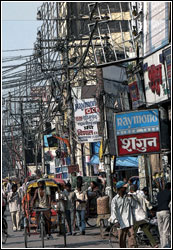 THE US Wal-Mart — the world’s largest retail chain —has tied a knot with Sunil Mittal’s, the Bharti Enterprises to enter into India. If all goes well, it will open its first outlet to Indian consumers by August 2007.
For long, retail chains in the West were jealously watching the booming Indian middle class and its expanding market. Many such giants need new markets to sustain their growth. The Indian legal structure is quite stringent and does not allow foreign firms on its soil, liberally.
For retail business, laws are such that they can not sell their goods directly to Indian consumers. Therefore, the foreigners have found a side door: starting the wholesale and sourcing companies which supply a local retail partner.
Last month Australia’s Woolworth entered into an agreement with the Tata, India’s second largest firm. The Tesco from Britain and the Carefour from France are reported to be exploring their options, too.
Earlier, the Reliance Industries, India’s largest industrial group has disclosed that it was planning to spend $5.5 billion in the next five years on a retail store chain, staring this year only.
In a desperate attempt to get a toe-space in the Indian market before it was too late, now the Wal-Mart has entered into a franchise agreement with the Bharti Enterprises. As for its impact on the local player, it will drive petty retailers out but it is good news for Indian consumers who would fetch a better bargain as the chain is reputed for squeezing consumer goods companies around the world down to the last dime and passes the benefit on to the customer.
It is a God-sent opportunity for the Indian manufacturers who will be lead suppliers as the company is bound to make 80 per cent purchases locally. This would certainly change the fortune of local manufacturers dealing in hundreds and thousands of consumer items in India.
Pakistan is comparatively small but is the sixth most populated country in the world with 52 per cent people under the age of 21 years. People of Pakistan spend liberally, and with passion. They spare no excuse to take a plunge. Be it a festival such as Eid or any occasion such as a wedding in the family — they beg, borrow or steel but shop, they must. Even when it is just a day like any other, most shopping areas are busy for a better part of the day.
The domestic demand has proved to be a key driver of the growth and economic expansion. Multinational consumer goods giants are doing roaring business in the country. The financial results of Lever Brothers, Proctor & Gamble, Philips, the LG, Pepsi, Coke, etc., hold testimony to the promise which the domestic market of Pakistan carries.
Most cosmopolitan cities in the world have one or two central market districts. The port city of Karachi alone has at least five huge full-fledged and self-sufficient market centres to serve over 16 million people. The majority belongs to the middle class.
The concept of retail chains is still new in Pakistan. Some local companies such as the Bonanza, the Cambridge, the Chen One, the Labels, the Breeze, etc., have opened some outlets here. The western food chains such as the Mc Donald, the KFC, the Pizza Hut, etc., too have opened their shops in major cities. The government outlets such as the Utility Stores Corporation must be the largest chain boasting some 13,471 stores all over the country. But that is about all.
About 97 per cent of the retail sale is made in more than two million tiny stores, mostly on an area less than 40 square meters. Most of these shops are managed by a family. There is no data available on the actual number of such shops in the country. In India there are said to be 15 million stores. If this number is taken as a reference in Pakistan, the number of stores should be around two and a half million.
The retail and wholesale business accounts for over 25 per cent of the GDP with the share of trading even bigger than the manufacturing sector. According to the latest Pakistan Economic Survey, the sector is growing at the rate of 9.9 per cent.
Some European retail chains have shown interest in Pakistan. A German retail giant, the Macro has entered into Karachi market. A few other retail firms are said to be in the process of entering into Pakistani market. So far the Wal-Mart name has not come up on the list of companies aspiring to enter.
Chaudhry Mohammad Saeed, President of the Federation of Pakistan Chamber of Commerce and Industry, was appreciative of the Indian private sector while commenting on the said Wal-Mart deal. He said that the business class on the other side of the border was more far-sighted.
He said that the Indian government was cautious in letting the foreigners do business there. They make sure that the safeguards are put in place before opening up the floodgates. The retail chains are not allowed to dump their cheap imports in Indian markets as they have a binding to buy merchandise from the local manufacturers, he added.
Majyd Aziz, President, Karachi Chamber of Commerce and Industry when approached said that the current Wal-Mart deal can prove to be a harbinger of more US investments in India.
Majyd Aziz, who has recently returned from India, said that the pace of growth in India was impressive and that Pakistan needs to market the potential of Gwadar port, efficiently.
If we can develop world class warehousing and logistic facilities at the Gwadar port, it has the potential to attract a lot of western business in the retail sector as it offers the shortest trade corridor to reach the Central Asian States.