



 0
0

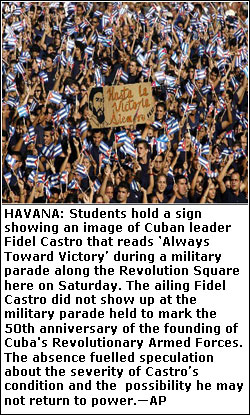 HAVANA: Cuba's mechanics, famed for keeping vintage 1950s US cars on the road, have brought their magic to the military, tweaking, chopping and retooling Soviet-era war machinery, eying a potential US threat.
On Saturday as Cuba rolls out its guns to mark the 50th anniversary of its armed forces, and Fidel Castro's belated 80th birthday, the world will get a rare glimpse at Cuba's first military parade in a decade.
It is not one of the world's biggest armed forces. But in Latin America's only communist-ruled country, so close to traditional enemy the United States, Cuba takes defence seriously.
And the armed forces, led by Raul Castro, consider themselves the backbone of the one-party system that has been in place for more than four decades.
For many years Cuba did not buy new weapons but tried to maintain and repair what it had from before 1989 when the Soviet bloc collapsed. Raul Castro has estimated the value of “donated” East bloc weaponry obtained 1961-1990 at 30 billion dollars.
But as of 2003, as the economy recovered slightly from the economic crash after 1989, Havana started spending a bit more on spare parts and some new items, citing a greater US threat under President George W. Bush.
Among the priorities, artillery and missile units that are all self-propelled, as suggested by a Cuban study, which found that they would be harder for US aviation to locate and destroy, experts say.
Cubans have upgraded old Soviet-made vehicles, tricking them out with cannons, special armour, guns where there once were none, special manoeuvring capacity, and other combat-ready assets to improve their firepower and self-protection abilities.
A BMP armoured troop transport vehicle for example has had an added turret and a gun to boot. BTRs, amphibian transport units, have been outfitted with ZU-23 double anti-aircraft cannon.
Cuba's military since the 1980s has anticipated a massive air war that could be launched by the United States rather than a ground invasion, which would likely cause massive casualties.
Cuban military officials also have said publicly that they have studied recent conflicts in close detail, focusing on those in which the United States is involved -- particularly in Afghanistan and then Iraq.
“During drills carried out this week, on Monday and Wednesday, 80 per cent of the equipment that was on display was anti-air -- anti-aircraft and anti-helicopter -- as helicopters are the preferred US troop transport mode,” a retired military official said privately, among curious onlookers.
Throughout this year, factories that normally turn out sugar cane harvesting equipment and other farm machinery were turned over to the Revolutionary Armed Forces.
And the result will be on parade with a message for the United States: Cuba, though short on funds, is still able to modernize on a shoestring alongside its factories that make weapons and light vehicles.
“We will show the new, moderate techniques, that we ourselves have modernized in military industry, Raul Castro said when he announced the parade which he has organized.
After 1990, amid the gravest of economic crises, Cuba maintained that it did not import weaponry. Since 2003 however, given a green light for some new spending, Raul Castro has had talks with Belarus this year and signed a technical cooperation deal with Russia, technological heirs of the Soviets.—AFP




























