



 0
0

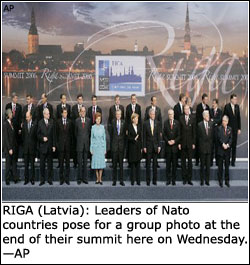 RIGA, Nov 29: French President Jacques Chirac warned his NATO allies on Wednesday against turning the alliance into a sort of United Nations by losing sight of its military vocation, his office said.
At a summit in Latvia, Mr Chirac said NATO was losing its `military nature’ by operating further outside its traditional transatlantic area, conducting relief missions and trying to extend partnerships with countries across the world.
“The alliance's transformation must not modify its military nature but, on the contrary, reinforce the link between North Americans and Europeans that has guaranteed our collective security for more than 50 years,” he said.
The United States is leading nations which want to transform NATO from a Cold War-era military machine set up to counter the Soviets, into a highly mobile organisation capable of dealing with crises wherever they may arise, even outside of Europe.
Mr Chirac also rejected a US proposal to establish a “global partnership” with countries like Australia, New Zealand, Japan and South Korea which have been working closely with NATO in its operations in Afghanistan.
He told the leaders, during the working session on today that it was “better to associate, case by case, with states that are ready to commit themselves on the ground with us,” like in Afghanistan.
“But it is the United Nations which must remain the only political body with a universal vocation,” Chirac said, and rejected any “useless duplication” of tasks better suited to other world bodies.
BLUEPRINT FOR FUTURE: Nato leaders adopted on Wednesday a blueprint for the military alliance’s future, laying the foundation for member countries to develop their forces to deal with security threats over the next decade.
Despite its dreary title, the `Comprehensive Political Guidance’ forms part of Nato’s mission statement and provides a framework for an organisation built for the Cold War-era to adapt to modern-day security threats.
“It's important because putting it into action properly will put more usable military capacity at the disposal of the alliance, in terms of allowing it to complete its new missions,” said a senior NATO diplomat.
“Success depends on transforming our capabilities to do the job we've got to do,” he said.
The North Atlantic Treaty Organisation has shifted from being a largely static machine founded in 1949 to counter the Soviets to a highly mobile coalition keen to make a global response to threats outside its usual transatlantic area of operations.
NATO now leads some 32,000 troops in Afghanistan, has thousands more soldiers in the Balkans, is training the Iraqi military and, in an unusual step, undertook disaster relief operations following the earthquake in Kashmir a year ago.
Together with the Strategic Concept, drawn up in 1999, the five-page text approved on Wednesday reaffirms NATO's commitment to its `core purpose’ -- the collective defence of its 26 member countries.
But it also warns of the need to be prepared for a wide range of operations.
“NATO must retain the ability to conduct the full range of its missions, from high to low intensity, placing special focus on the most likely operations, being responsive to current and future operational requirements, and still able to conduct the most demanding operations.” Those tasks would include dealing with conventional military confrontations but `especially asymmetric threats and risks’ like terrorism and `crisis response’, wherever the problems might arise, the document said.
But some experts argue that this wide range of missions shows the alliance has scattered ambitions and has lost focus, and that now is not the moment to be drawing up such a far-reaching document.
“It’s too early,” warned Ronald Asmus, analyst for the German Marshall Fund think-tank and an official in the administration of former US president Bill Clinton.
“Let's write the theory after we've figured out what we're going to do, as opposed to having the big theoretical dispute about what Nato’s going to do, which ties us in knots for two or three years,” Asmus said.
“We're still too scattered all over the place here as an alliance to be able to shepherd it together into a new consensus that would last a decade,” he added.
The text also builds on a key “ministerial guidance” adopted in June that is meant to prepare NATO to simultaneously conduct two large missions, involving some 60,000 troops, and six smaller ones, comprising up to 30,000 soldiers each.
That document also steers the allies in their relations with the United Nations, European Union and non-governmental organisations.—AFP




























