The jirga method of peace-making
IN pursuance of the agreement between President Musharraf and President Karzai in Washington in Sept, Pakistan and Afghanistan have at long last begun to address the issue of terrorism in their border areas on a bilateral plane and to involve the local leadership in the dialogue. The format of this consultation —termed a jirga, but not in its traditional form — is yet to be finalised. Both countries have been discussing the issue and it is not clear how the two sides will link up which is essential if the on-going dispute between Kabul and Islamabad on cross-border attacks is to be amicably settled. Traditionally the local elders are the members of a jirga because of their social standing in the community, their views carry weight. Since terrorism has come to acquire national and international dimensions it cannot be resolved at a purely local level. Therefore, the need has been felt to induct representatives of the nationally and provincially elected government bodies as well, as Afghanistan is considering. They also act as intermediaries between the people and the officialdoms in Kabul and Islamabad.
Since Pakistan and Afghanistan have yet to evolve a common format, one cannot assess the chances of success or otherwise of their move. Some ground rules and a framework for discussions and the composition and powers of the body formed need to be evolved prior to the meeting. The idea is to formulate a joint policy on terrorism, especially the violence unleashed by the resurgent Taliban. Both countries have accused each other of providing sanctuary to the Taliban and allowing them to mount attacks on the other side. This has caused a lot of heart burning between Pakistan and Afghanistan which are also said to have agreed on the applicability of the doctrine of hot pursuit that led to the Bajaur incident in October. This shows how important procedural questions, such as the composition and competence of the jirga, are for the peace of the areas bordering the two countries that are in turmoil. For instance, the truce accord that Pakistan claims to have signed at the Bajaur jirga in September could have served as a model but for the fact that it has been signed between the Pakistan army and the Taliban and not the local elders, as is being claimed.
When Pakistan’s foreign minister goes to Kabul in December these issues will come up for discussion. But the two sides will not find an easy way out because of the complexities of the situation. The fact that many tribes straddle the Durand Line and enjoy a right to cross the border make it difficult for one government alone to exercise control over them. Any kind of dual arrangement would require the de jure recognition of the Durand Line as an international boundary by both sides, when Afghanistan challenges the legality of the border. Any arrangement with the Taliban of a military nature will not be possible without a nod of approval from Nato and the ISAF, which may not be as tolerant towards the Taliban as the local leaders may be inclined to be. In any case, Pakistan will hopefully learn from this experience in jirga making. It can employ its knowledge and understanding of how the peace jirgas work in the case of Balochistan too where it has failed to make peace. The continuing violence in the province indicates that no conciliation and pacification move has been undertaken. And if it has been, it has not succeeded.
Hope for under-trials
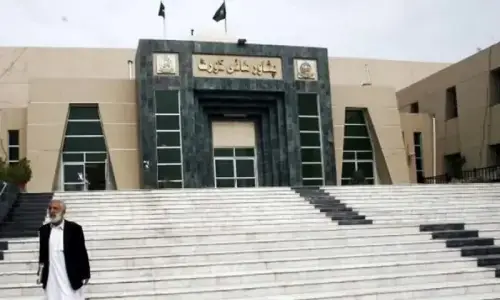
THE Sindh High Court’s ruling that the detention of under-trial prisoners who are not produced before the court on the date of their hearing would be considered illegal after March 31, 2007, should come as a big relief to thousands of inmates in jails across the province. At the same time, the possibility of facing disciplinary action for keeping a detainee in illegal confinement should prod jail officials into ensuring that the prisoners are produced before courts on the relevant dates. The predicament of under-trial prisoners is such that many spend more time behind bars than they would if found guilty and sentenced. The lack of prison space means that many — including accused juvenile offenders — find themselves sharing barracks with hardened criminals, thus being exposed to the latter’s corrupting influence. Besides, they also suffer from health complications associated with congested living. So bad is the problem of overcrowding that figures for 2005 show that more than 86,000 prisoners across the country were housed in 81 jails against a combined capacity of less than 37,000. With the conviction rate as low as 11 per cent, it stands to reason that the majority of the under-trials are not guilty of the charges against them.
In Sindh, the ruling, if taken seriously by the jail officials and the law enforcement authorities, should expedite the judicial process and give substantial relief to those who otherwise would have to be in captivity for several years. At the same time, the factors responsible for the absence of prisoners from court must be investigated and dealt with. These range from the dearth of vehicles and police escorts to take the prisoners to court to torture of the detainees that jail officials want to conceal from the judges. Quite often, in return for taking the detainee to court, jailers demand large sums of money from the prisoner’s family which they cannot afford. These lapses should be removed and the prisoners provided with legal counsel so that justice can take its course and reduce the agony of the prison inmates.
Hazardous waste disposal
IT IS reassuring to know that the Karachi city government is joining hands with the Sindh Environmental Protection Agency to ensure that hospitals properly dispose of their waste. It is tragic that standards of hygiene are dismally poor at most hospitals and that instead of trying to improve the disposal system, hospital administrations violate laws and end up contributing to hazardous situations. This is especially true of the careless manner of used syringe disposal. According to the findings of a survey conducted in April this year, out of 2,800 medical units in Karachi, only 130 were following proper guidelines for waste disposal. As things stand, the CDGK runs two incinerators that can take 10 tons of waste per day but few hospitals avail of this facility, presumably because they do not want to pay for the service. But many of the hospitals do not have their own incinerators so hospital waste is dumped at various land-filled sites where it is often picked up and then sold by scavengers. This is a major health hazard, especially since a lot of the disposed waste has infectious material in it. The CDGK says it has sent several warning notices to hospitals in this regard but because it has no powers to penalise hospitals, their warnings are often ignored. It has called in SEPA to assist them in enforcing their instructions.
Hospitals will now have to inform SEPA of how they are disposing of their waste and if it is not up to mark, one hopes that SEPA will take action in accordance with relevant laws. The recycling of used syringes is one of the reasons behind the increase in blood-borne diseases. Hospital staff must be made aware of their proper disposal. Those who do not follow guidelines must be taken to task for their irresponsible conduct that puts peoples’ lives at risk.
Nato summit: hard times ahead
THESE are not happy times for Nato, the western military alliance. The war against insurgents in Afghanistan is becoming increasingly difficult, with allied troops facing a rising number of casualties in the volatile south of the country. In addition, France is lukewarm about US plans to forge global peace-keeping alliances with countries like Australia and Japan.
And despite an open-door policy towards eastern European nations, many in the bloc are cautious about further Nato enlargement.
These and other challenges will dominate a summit of Nato leaders in Riga, Latvia, on November 28-29, The meeting will highlight that although the 26-nation alliance has managed to heal damaging rifts over the US-led war in Iraq, Nato faces a fresh array of challenges which will test the organisation’s solidarity over the coming years.
Leaders meeting in Riga will also review progress in Nato’s military modernisation and transformation amid demands for a fairer share-out of mission costs and an increase in European governments’ defence spending.
Given the daunting — and potentially divisive — issues on the table, Nato policymakers warn against expecting breakthrough decisions at the summit. “Don’t expect miracles,” Germany’s State Secretary for Defence Christian Schmidt cautioned at a recent conference in Brussels. Key Nato policymakers also insist the meeting will focus on “house-keeping tasks” linked to Nato’s switch from a Cold War military organisation to a security actor with an increasingly global reach.
It is unlikely to be that simple, however. With their troops engaged in almost daily combat with Taliban insurgents in southern Afghanistan — Nato’s top officials have an important message for alliance leaders in Riga: Ending violence and winning the peace in Afghanistan will require tough decisions urgently.
The message that Nato’s Afghan operation is a make-or-break venture for the 26-nation alliance is expected to be conveyed to leaders in Riga by Nato Secretary General Jaap de Hoop Scheffer.
Nato’s top military commander, four-star US Marine General James Jones also gave his view last week on the long list of military and other challenges facing the alliance in Afghanistan. With over 30,000 soldiers from 37 nations — including non-Nato countries — deployed in the country, Afghanistan was clearly the alliance’s “number one priority,” Jones told reporters.
But Nato’s increasingly violent battles with insurgents in Afghanistan’s volatile south were being hampered by a long list of restrictions on the use of troops imposed by governments, said Jones. The general’s comments are a strong signal that Nato leaders in Riga will come under increasing pressure to be more flexible on how and where their soldiers are deployed in Afghanistan.
Repeating Scheffer’s criticism of such conditions, Jones insisted that Nato’s current troop shortfalls in southern Afghanistan — where the UN-mandated International Security Assistance Force (ISAF) is fighting against a Taliban insurgency — could be eased if nations lifted the restrictions. “Removing caveats is tantamount to raising more forces. You have more capability,” Jones said.
The Nato general said governments had the right to attach some conditions on the deployment and use of their soldiers. However, there were some “operationally restrictive” caveats — requiring for example national approval for the movement of troops — which must be lifted. Nato experts say alliance members with troops in ISAF in Afghanistan have imposed over one hundred caveats — covering up to 17 pages — on the use of their soldiers.
Those imposing such limits include Germany which has 2,700 troops working in a provincial reconstruction team in the relatively quiet northern city of Kunduz. Berlin has said repeatedly that it has no intention of changing its Afghan mandate by deploying soldiers in the more volatile southern part of the country.
Reaffirming the policy, German Chancellor Angela Merkel told the Bundestag parliament in Berlin last week that German troops would continue their responsibilities in the north. “I do not visualise any military commitment that goes beyond this mandate,” she said.
But officials in Brussels insist that with Nato troops engaged in increasingly fierce combat with insurgents in the south, Merkel will be under intense pressure in Riga to review her stance. Criticism of Berlin’s policy has been especially fierce in the US and Canada where policymakers say German soldiers should be helping Nato forces in their anti-Taliban operations. Germany has argued, however, that its soldiers are doing valuable reconstruction tasks in northern Afghanistan.
Leaders in Riga will also focus on rebuilding Afghanistan, upgrading the country’s security forces and fighting drug trafficking and crime. Stressing that military solutions alone were not enough, Jones said that the alliance’s goal was to stabilise Afghanistan and to bring about security, stability and reconstruction in the country.”
“We would like to make the Afghans responsible for their future,” said the general. However, “we will not be successful overnight,” he cautioned. Jones said the focus must be on Afghanistan’s “narcotics problem, judicial reform and on developing the quantity and quality of local police.” Efforts must also centre on fighting corruption and imposing the rule of law, he insisted.
While some of the violence was the result of attacks by the Taliban, Nato was also concerned about the rise of crime and narco-trafficking in Afghanistan, Jones said. “We have to reverse the trend,” he underlined, adding: “The influence of narcotics is all encompassing in that society. It affects the functioning of the economy, it affects the corruption of officials, it fuels the engine of violence, it pays salaries of fighters.”
The Nato commander was also unusually forthcoming in countering suggestions that Pakistan was aiding the Taliban, saying that following talks with Ehsan ul Haq, chairman of Pakistan’s joint chiefs of staff, in Brussels recently, he was “very impressed by Pakistan’s willingness to engage with Nato.”
“On a tactical level, we are setting up good, strong links with Pakistani forces on the other side of the border to report and observe what is going on so that we can try to shut down the border activity between Pakistan and Afghanistan from a standpoint of illegal traffic and the flow of fighters,” said Jones.
“It is a good omen that the militaries are working well together,” he said, adding that the relationship with Pakistan was “still a developing one.” The test of Pakistan’s goodwill and intentions would come in the coming winter months, said Jones when “we will see if this good style will really translate into results along the border.”
“Talibanisation is not just an Afghan problem, it is a regional problem,” Jones added.
General Haq’s meeting with Jones was the first visit by a senior Pakistani military official to the Nato headquarters. The Pakistani general addressed Nato’s military committee, the alliance’s top military body, and met the Nato Secretary-General Jaap de Hoop Scheffer and the chairman of the military committee, General Ray Henault.
“Your visit is tangible evidence of the genuine efforts by both Nato and Pakistan to enhance military-to-military cooperation in a number of areas of mutual interest,” General Henault said in his welcoming remarks.
“I know I can speak for all of us here that we appreciate the difficult, challenging and dangerous work you have in monitoring and controlling the border and in identifying and removing the militant forces that stand in the way of peace and prosperity for all peoples in the region,” said Gen Henault, adding: “Nato depends on the support and cooperation of Pakistan respecting cross-border issues to accomplish its mission.”
General Haq also met with the Nato Secretary General Scheffer for discussions on growing military-to-military contacts between Nato and Pakistan.
Pakistan and Nato have been steadily increasing cooperation since October 2005, when Nato launched a large operation to help aid victims of the devastating earthquake that struck the country. The alliance has also opened several courses at Nato education facilities to Pakistani officers, including training in peace support operations, civil-military cooperation and defence against terrorism.
Pakistan is also a key partner in the Tripartite Commission, the trilateral forum of Pakistan, Afghanistan and ISAF where military matters of mutual concern are discussed and information exchanged.
Leaders in Riga will also hear US demands that Nato should seal its global outreach by offering countries like Australia and Japan an expanded relationship. France is expected to question such moves, however. Paris, which is a traditional defender of stronger European Union defence, has long argued against any expansion of Nato’s mission. There is also concern that any Nato alliance with Asian-Pacific nations could offend a rising China.
Officials say the summit will confirm Nato’s open-door policy but take no decisions on expansion until next year. Leaders will offer “measured encouragement” to Croatia, Albania and Macedonia, members of Nato’s Membership Action Plan (MAP) for assisting aspiring partner countries to meet alliance standards, said Germany’s Schmidt. But no formal invitations to join will be issued to Serbia, Montenegro and Bosnia-Herzegovina.