



 0
0

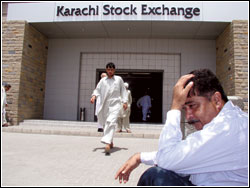 THE Taskforce submitted its report of a broad investigation of the KSE crash in June 2005. Relying on macro-level information, the report described how some participants appeared to benefit from manipulation of the market, identified key causes of volatility, and explained how transactions arranged outside market rules benefited people who arranged those transactions.
It described how managers of public institutions undertook losses for the benefit of market players, arising from pre-arranged transactions using public money, in clear violation of their institutional mandates. It concluded by recommending structural reforms of the stock exchanges and the SECP to check the recurrence of such events. The report called for an immediate more thorough forensic investigation to pinpoint violators of the law.
Nearly eighteen months later, neither has an investigation been made of the persons outside the market who played a role, nor has much progress been made in structural reforms to prevent further manipulation of the market. And the larger forensic investigation of market participants, after a delay of a year during which vital information was allowed to be lost, has failed to do an adequate and satisfactory job.
The Taskforce report raised a number of questions for a more detailed investigation to answer, none of which have been adequately answered as yet. Specifically: During the period mid October 2004- March 2005, government officials, privatisation managers, brokers and analysts participated in an unusual build-up in the media about the prospects of a rise in the KSE index. Did any of these officials and others have any interest in the market and benefited in any way directly or indirectly by such announcements. Not investigated.
Based on rumours of new oil and gas finds, the stock value of OGDC (the most heavily weighted stock in the KSE index) rose from Rs74.95 on December 31, 2004 to Rs189.75 by March 15, 2005 only to fall below Rs100 in the crash. During the long speculative spell in OGDC, neither did the KSE management prevail upon the OGDC management, nor did the management of OGDC provide a clarification. While it was an omission of responsibility on the part of KSE and OGDC, it is not clear whether key individuals at these institutions were aware of the correct position but chose not to inform the market and may or may not have benefited directly or indirectly by withholding this information. Not investigated.
The analysis of stock market data by an expert helped identify a number of potential cases of market abuse where players had undertaken “wash trades”. The new investigation by Diligence claims that the data does not allow definitive proof of existence of wash trades but then claims that the same data allows definitive proof that it did not happen. Not convincing.
After March 4 Badla providers started to pull Badla out. Then, suddenly around March 8, on the occasion of a corporate announcement in PSO, Badla financing for PSO declined overnight by Rs4.1 billion on March 09, while Badla finance for PTCL declined by Rs.3 billion on March 11 to the next trading day. Although some of the decline in Badla can be attributed to the closure of PSO March A and PTCL March A contracts much of it was due to lower lending.
It is possible that the Badla providers who were reducing their lending in specific scrips after March 08, had been selling actively in the ready market and were holding sell positions in the March futures contract in the same scrips at prices well above their ready market prices. The Taskforce asked that this be examined by a detailed forensic investigation and on-site inspection by SECP later.
The Diligence investigation claims that all of the reduction in PSO and PTCL badla finance was related to the corporate announcement, which is factually incorrect. And the forensic investigation does not provide data of specific major players’ multi-channel lending and investment position in this critical 15- day period to examine whether they adopted lending decisions in badla which would benefit their investment position in the future market. Inadequate and incomplete investigation.
Some sellers of the March contract, in clear violation of KSE rules, may not have held the shares that they had sold in the future, but had planned to buy these after the market fell. The latter category of sellers could have played a role in bringing prices down in the ready market by pulling out Badla financing. The forensic investigators agree that violation of the rules did take place on this account, but suggest further investigation to determine manipulation of the market. The investigation is clearly inadequate on this score and raises question about the usefulness of the forensic investigation if yet further work is needed.
The extended COT session of Friday, March 25, 2005 was not in line with established practices of the market and not in consonance with the COT rules that regulate the use of Badla only in the ready market. Through this ingenious arrangement extended COT was designed in violation of normal trading rules, benefiting some large arbitrage players. The regulators acquiesced to this procedure that circumvented the rules to benefit some large brokers who were sellers in the futures market. Not investigated.
The bailout Badla financing at the extended COT session did not cover OGDC, because it had been pumped up so extensively above its true value before the crash that now even Badla providers were unwilling to finance holders of OGDC. Hence a complementary bailout package for OGDC holders was arranged at the expense of public money. A consortium of institutions led by NIT and including SLIC and NIC arranged to buy shares of OGDC at above market price from a whole range of sellers, some of whom had acquired these at the closing of the March contract. The intervention, which was an off-market transaction, in effect saved some private investors using millions of rupees of public funds. Moreover, it is not quite clear how NIC and SLIC were influenced to become part of the consortium. Not investigated.
The Taskforce did not claim at any point that there was an elaborate orchestrated scheme to influence scrip prices which conspired to influence prices as wrongly claimed by the forensic investigators throughout their report. The Taskforce mentioned that because each major broker is large enough in the market, their individual actions can affect the market sentiment. It was only in arranging the bailout package that collusion was obviously witnessed among the large brokers which cannot be denied.
The purpose of the larger forensic investigation was to investigate the issues raised by the initial investigation of the Taskforce by examining the individual accounts of brokers and clients to examine their role in the pumping up of the market, the details of their individual futures investment and badla lending positions to examine their role in manipulation, and to examine their role and gains in the off-market post-crash arrangements.
Unfortunately, the new investigation also relied on aggregate data to draw conclusions in some areas. The same charts, the same list of limitations given by the Taskforce, but little reporting of individual brokers and major client positions and changes in them on critical days, especially when examining badla lending during March 8-15, 2005. In fact this is not a proper forensic investigation.
The forensic investigators have instead been apparently directed to discredit the Taskforce report and absolve everyone. This is obvious from their baseless allegation that the Taskforce had alleged a grand orchestrated scheme by brokers to crash the market, which Diligence repeatedly try to refute in the report. The Taskforce did not say that at all. The Taskforce instead highlighted a number of facts which pointed to possible wrongdoing.
The purpose of the forensic investigation should have been to examine those highlights in greater detail and separate the innocent from the guilty. In absolving all market participants, the forensic investigators write at length of data limitations in conducting the investigation but they do not examine who is responsible for the lack and loss of evidence. Did the SECP ever demand freezing of data, what was the role of KSE, where is the record of all data acquired by SECP, was it all made available to the forensic investigators.
By not examining the role of SECP, KSE and brokers in a possible cover-up of evidence, the new investigation has fallen short of expectations. It is incomplete and inadequate. Unfortunately for Pakistan and the capital markets, the shadow of the March 2005 crash will linger on for some time to come.






























