



 0
0

How to fight a good fight and become friends
Islam urges its adherents to go as far as China to seek knowledge. It is not clear how many of them have followed the prescription dutifully. But those who didn't, may be ignoring the injunction at a cost.
Temporal experience too is replete with examples of nations and people, be they Muslim, Christian, Hindu, Jew, Buddhist or communist, that have benefited from the trove of wisdom that China alone has offered the world.
But there is another country in China's neighbourhood resplendent with a cornucopia of wisdom, innately fresh wisdom shall we say, baked in the clay oven of history. Which other country has given a right royal hiding to not one, not two, but three of the world's towering nuclear powers, and that with bare hands? Vietnam, of course, better still non-nuclear Vietnam. Therefore, for all the cock-and-bull punditry we so relentlessly inflict on each other to justify an insane fetish for nuclear weapons, particularly so the upstarts in the quest like India and Pakistan, there is a stark lesson for us from Ho Chi Minh's people: when ordinary mortals are infused with fellowship and sense of common destiny their resolve to fight and stay together mutates into granite. This cannot be said of either India or Pakistan whatever be their forbidding military hardware.
Try to explain Vietnam's success story any other way. It is today hosting the hugely powerful Apec summit of which the United States and China are key members. Can anyone deny that both these countries had received a bloody nose on their day at the hands of Vietnam's foot soldiers and their legendary generals? Who can forget Vo Nguyen Giap in Dien Bien Phu and later during the fall of Saigon? Of course, the first nuclear-armed country to taste Giap's understated wrath was colonial France.
Therefore, Vietnam exposes the hypocrisy, perhaps even the immaturity of those that seek security in high-falutin weapons systems. No one should be better familiar with this than India. It was a quasi-farcical day for Delhi when Indian Foreign Minister Atal Behari Vajpayee was on a visit to Beijing in February 1979. It was meant to be a first fence-mending mission, after the short border war that dislocated their ties in 1962. Then a disaster struck. It was the media team and not the clueless government of India that gave Vajpayee the first information: Chinese troops, ostensibly on a hot pursuit of their Vietnamese numbers, had entered the neighbour's territory. That the Vietnamese retribution was instant and resounding must have come later as a minor consolation to the Indians who were so wryly snubbed by Beijing. Vietnam after all was India's ally and it was attacked suddenly and rudely by China, with which New Delhi had its own axe to grind.
It's several years since China and Vietnam resolved their border dispute (barring perhaps the one pertaining to Spratley islands which involve complex claims from other South-East Asian Nations too). And the two countries are engaged today in economic cooperation as never before.
Last week's Apec summit was an important milestone in this journey. President Hu Jintao will be in India for four days from Monday, fresh from Vietnam. The usual set of analysts seem divided over what could or should be achieved during this visit. One lesson would suffice, and that is to be learnt from Vietnam: how to do business with China as an equal neighbour, without being seen as a cat's paw of this or that big power, and without the unhealthy pacifier called nuclear weapons. There are several other lessons to learn from China itself which if taken in the right spirit could help New Delhi improve diplomatic ties with its other South Asian neighbours, not the least with Pakistan.
India's approach to Pakistan is predicated on two demands. It wants Pakistan to open up channels of trade and commerce and to check anti-India elements using its soil, chiefly those bearing lethal arms, to launch attacks. The slow progress on these issues reflects their off again on again dialogue. On the other hand, China wants India to keep the volatile Tibetan activists, who have lived here since the Dalai Lama's flight in 1959, on a tight leash. India has assured Beijing that it would not allow anti-Chinese activity by India-based Tibetan refugees. Yet, on several occasions this assurance was breached in a potentially serious way. Tibetan refugees lobbed Molotov cocktails at the Chinese embassy in Delhi to mark their protest against Premier Li Peng's visit during the Narasimha Rao government.
Li did sulk but there was no foolish standoff that followed. In fact the next year or so Rao was in Beijing to sign a landmark agreement on Peace and Tranquillity on the Borders. The pact has kept the borders calm and tranquil, barring one or two mis-judgments.
Similarly, President Hu is coming to New Delhi minus the baggage of an embarrassing Tibetan protest in Bangalore when Premier Wen Jiabao was visiting not too long ago. Did India deliberately allow Tibetan protesters to embarrass Chinese visitors? Clearly not. These things happen despite the state's best efforts. As for the hectoring to Pakistan on poor trade ties, has not India shown the same diffidence in opening trade and commerce, and investments with China?
"Are we schizophrenic when it comes to full-fledged economic ties with China?" The question was raised by business journalist Jairam Ramesh when he had not joined Prime Minister Manmohan Singh's cabinet. There is no political paranoia in India vis a vis South Korea for example as there is in relation to China.
"Perceptions matter," says Ramesh. His collection of insightful essays in the book "Making sense of Chindia" deal squarely with this problem. "Whatever we say, the gnawing feeling in the community that is concerned about such matters is that India is still unable to break out of the shibboleths of the past."
When business visas to China after proper documentation take four to five days, and when business visas to India take two-three weeks, then there is bound to be a feeling that we are not on the same wavelength.
You cannot open a green channel for trade and say that we will go slow on investment because we don't trust you fully. The two are inextricably linked. That's not just Jairam Ramesh's point of view. That's exactly the approach we resent when a country like Pakistan practices it on us.
Bus terminals out of city
 The city government’s bus terminal at Yousuf Goth on the RCD Highway, opened by the Sindh governor on Saturday, has incensed transporters operating between Karachi and towns of Balochistan as it will translate into a curb on their buses’ entry into the city centre.
A Balochistan minister has also criticised this decision and termed it discriminatory against the province, saying that there was no such ban on buses entering Karachi from the other provinces. The criticism seems unjustified as the city government has already announced plans to build two more terminals — at Razzaqabad on the National Highway and at Bhatti Aam Aameri on the Super Highway, 10 kilometres from Sohrab Goth.
The Yousuf Goth terminal is the first of its kind built by the local government. The other 200 or so terminals operating across the city are considered illegal and lack facilities for passengers. The most well-known of them are set up at Sohrab Goth, Cantt Station, Patel Para, Banaras Chowk and North Nazimabad. Scores of inter-city buses use each of the terminals daily.
Passengers coming to the city centre may not like being dropped at the entrance to the city. This will certainly inconvenience them in shifting from one vehicle to another with children and luggage and pay extra either to connecting buses or to taxi drivers. People leaving Karachi for Quetta and similar destinations will also have to bear with the same inconvenience. Probably it will also waste a lot of their time, a commodity in short supply with all of us catapulted into the fast-pace life of the 21st century.
However, the trouble these and other such buses cause to the people of Karachi is far greater than the inconvenience they may endure in having to travel to a terminal located on the outskirts of the city to catch an inter-city bus. These buses cause frequent traffic jams. Just see the mess on Business Recorder Road at Patel Para in the morning. The buses pollute the air already poisoned by the smoke belched by the tens of thousands of vehicles running on city roads. People living around these terminals, mostly set up in heavily populated areas, suffer as these buses pick and set down their passengers.
The Yousuf Goth terminal will be handed over to a contractor who will pay Rs35 million to the city government for two years. The money city officials say will be spent on establishing more such terminals. This one has cost the government Rs39.4 million. The contractor will not only reap profits and divide them with the city government, he will also be responsible for the maintenance of the facility as an agreement between the contractor and the city government suggests. The city government will earn more from the shops and other facilities it plans to auction out.
It is also hoped that this terminal will offer better facilities to the passengers waiting for their buses.
Meanwhile, the pillion riding ban has evoked much criticism from the middle-class commuters. A rumpus over the issue derailed the city council’s session on Friday and a couple of days earlier an NGO had challenged the ban in the Sindh High Court.
Hundreds of people are fined by the traffic police for violation of the ban. In fact, the ban has opened a new avenue for the police to harass motorcyclists and mint money.
Of course, the government authorities have tried to justify the ban. They have their own convincing reasons as most of the street crimes are committed by motorcycle riders, usually travelling in twos and threes. But those who use the wheeler out of necessity are far more than those who use it for street crimes.
In view of Karachi’s chaotic traffic, the two-wheelers are an efficient as well as affordable means of transport for the middle-income people. Depriving them of this means of transport would be an injustice to them. As the ban is imposed for 15 days, apparently for the period when preparations for the defence-related exhibition are afoot, it is hoped that it will not be extended beyond this period. Police authorities, however, deny that this ban has anything to do with the Ideas exhibition. Otherwise, the ban would lend credence to the widely held view that the expensive government machinery is incapable of controlling crime and is creating unnecessary hardships for the people.
Old is solid
When you have the spirit to contribute to the common good, you can do it in several ways. Sometimes you may just be having fun and still contributing to a cause.
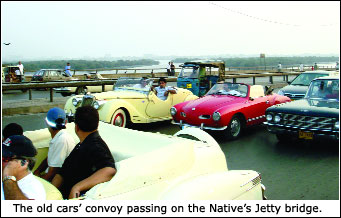
For instance, a group of people in possession of old cars on a recent Sunday got together and tried to raise awareness about old buildings and their condition in the city.
The group called Vinatge & Classic Car Club of Pakistan collected cars old as 1924’s Rolls Royce, Lincoln Continental, 1947; Riley Roadster, 1949, Ford Mustangs, 1966; Volkswagon, 1952; Plymouth Belvadare, 1956; Mini Austin, 1963, two MGAs, 1960, and MGB, 1963. In all 19, the cars rolled in a convoy and attracted the attention of people. They were stopped near old buildings and the onlookers and motorists were allowed to have a glimpse of old buildings and old cars together.
The particular target of the group’s venture were buildings along M.A. Jinnah Road and the rally was appropriately called 'Bundar Road say Keamari’. So on their way were the Native’s Jetty bridge, the Merewether Tower, the Denso Hall, the Khalikdina Hall, etc.
Founder president of the VCCCP Mohsin Ikram told Dawn that the next event would be held in January with more than 30 vinatge and classic cars. That rally will start at the Mohatta Palace and after stopping briefly at 12 important heritage sites will end at the Sind Club.
Let more people come up with such imaginative ideas where they have fun and contribute to a worthy cause at the same time.
Special contribution
If you go to a Western country, you can’t help being impressed by the manner in which special people are treated. Physically or even mentally handicapped people lead fruitful lives. However, in the subcontinent they are marginalised. Which is why it was heart-warming to see young, smiling hearing-and-speech impaired men and women, in their twenties, at the Gulshan-i-Iqbal outlet of KFC last week. They were smiling not only because they were being visited by the trio Anwar Maqsood, Bushra Ansari and Moin Akhtar but because they are independent and confident of themselves.
In all, the outlet has more than 30 such bright young people, who serve their clients - men, women and children — without any problem. But not all of them are posted at the counter as there are some in the kitchen too. They have received training like any person without any handicaps. They know the sign language and can communicate with the clients. To help them menu cards are placed on the counters.
A customer may put his finger on any deal and he or she is served very soon. It’s a good idea to have them in one outlet rather than spread them over to different outlets because they would feel secure in an environment where there are all like themselves. At the outlet there are also three physically normal people to come to their help if there is a communication gap between these special people and their customers.
The experiment has worked so well in Karachi that the management of the franchise in Pakistan has opened one such branch in Lahore and another in Rawalpindi.
— Karachian
Email: naseer.awan@dawn.com
Lara’s disciplined men win on points
This is certainly a transformed West Indian side. Forget whatever loser stats we can throw at them. They have shown a professionalism that has not been seen in the last ten years in teams hailing from the Caribbean.
Sure they pitched up some half volleys but they came mostly from the inexperienced Powell and Dave. Look deeply and the spell that Colleymore bowled to Hafeez and Gayle to Farhat left no clue who was using his brain more.
A Pakistan attack comprising Shoaib Akhtar, Sami, Shabbir and Saqlain Mushtaq withered against the onslaught of Sehwag and Tendulkar two and a half years ago on a similar track as they went for 356/2 on the first day.
Yet the tyro combination of Taylor, Colleymore, Bravo and Dave Mohammad, allied with the clever guile of Gayle, kept in check the Pakistan attack to less than three runs an over on a first day sleepy hollow. At most it can be said that they should have got a couple of wickets in the first session with the cloud cover and the new ball. But it wasn't for lack of the right delivery.
They bowled with McGrathian discipline and like bouncers at a night club, kept out the stumbling thrusts of Farhat and Younis. How long has it been since Farhat had a strike rate of 50% on such a wicket and off such an inexperienced attack?
And till the onset of sunset the Caribbean body language was positive and fronted optimism built on a plan. Lara captained well and backed up his bowlers with astute field placing. He was studious of each batsman's style and for Farhat kept two men at short cover, knowing his penchant to drive.
Likewise he persisted with a short midwicket for Yousuf and sure enough, grasped the chance with both hands, literally, when it came near the close of play.
263-4 off 91 overs with three batsmen having bolted fifty is a disappointing first day total on a pitch like this.
Perhaps the Pakistani batsmen were as cowed down by Collymore and Company as they were with their own preservation. The team selectors kept faith again with the pair of Farhat and Hafeez but Farhat at least was aware that Yasir Hameed was not just breathing down his neck, he was almost breathing for him.
He started slowly, though had his flirtations with the ball leaving him. Gayle especially cornered him and toyed with him to an embarrasing level. He went, however, the predictable way as the ball thudded into Lara at second slip.
It was sad to see Hafeez go the way he did. This boy time and again lines up a big innings but throws it away with a momentary lapse of concentration. It seems he has fuel only for the short trip. Ironically, everything about his style and body language talks a double hundred. I believe it is only a matter of time. He is certainly an improved player than his first year at this level but there is a shortage of self belief once he is into the 30s.
It is Younis, however, who has to do the soul searching. He is too good a player to fall to the ball that is rising away from his body. He is a gutsy street fighter when the chips are down as he proved in India but there has come the time when he has to leave the street strokes behind.
He is the vice captain and has to set the example like his captain. He is bringing in too much ebullience into his stride and has to slow down, has to mature. Ricky Ponting has the same demeanor but you won't find him playing these awkward strikes when his whole body is out of balance.
Younis is a fundamental cog of this Pakistan team but I hope he listened carefully to what Lara had to say at the toss about dropping Sarwan, his vice captain, for this Test.
Yousuf was spookily dropped in the 40s again by Ganga but Lara and Gayle caught him slumbering. It will appear that each of the four gifted their wickets, but it seems the Windies had done their homework on their weaknesses.
A total of 500-plus is what is expected of Pakistan and with the depth in their batting that is a likely possibility. They have played an unchanged eleven though Razzaq's bowling is not suited for this track and they have enough batsmen for such a docile track. If anything it is taking a little spin and Razzaq doesn't gel with that while batting.
A genuine quick who bowls to a good length is what is needed on such tracks and Niazi deserved a place.
With their depth, and Inzamam having got a good start, Pakistan may still get to 500. But if they bat at this rate and if the West Indians show discipline in batting, there may not be enough time to finish this Test.



























