0
0

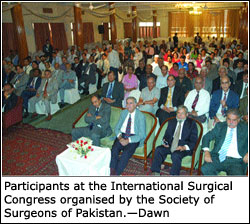 KARACHI, Nov 17: Speakers at an international surgical congress have said that a well-supervised training in surgery and a check and balance system in the healthcare sector can help improve the image of surgeons.
The congress was organised by the Society of Surgeons of Pakistan as part of its silver jubilee celebrations at a hotel on Friday. Sindh Governor Dr Ishratul Ibad had consented to be the chief guest on the occasion, but he could not make it due to some other pressing engagements, said one of the organisers.
The central president of the society, Prof Manzar Salim, in his inaugural address said that amidst celebrations it was also a time to ponder over the status of surgeons and surgery in society. “Despite long hard work we have been failing to maintain any good image, which could be attributed to a couple of reasons, including the bureaucracy which could not ensure any effective system of check and balance in the health sector,” he said.
He said that the society should start a public awareness campaign regarding complications and problems associated with surgery. He expressed the view that surgical problems were growing due to lack of proper guidance, check and balance system for private sector hospitals and sub-standard operation theatres.
Highlighting the significance of medical ethics, Prof Salim urged surgeons not to operate at hospitals where they felt theatre and other facilities were not up to the mark.
Baqai Medical University Chancellor Prof F.U. Baqai, who was chief guest on the occasion, said that doctors and surgeons should give top priority to the welfare of patients and there was always a room for self-accountability and improvement.
Dr Shams Nadeem Alam said that the surgeons’ society had now 13 chapters all over the country, which were working to bring all surgeons together at one forum.
Later, a seminar was held on the “Status of surgeons and surgery in the society”, with Mr Justice (retd) Nasir Aslam Zahid in the chair. There was a consensus among the speakers coming from different walks of life that doctors and surgeons should come up with more concerns towards ailing humanity.
Mr Justice (retd) Nasir Aslam Zahid observed that doctors were not being properly trained owing to the overall failure of education system. Major responsibilities lied with the government to improve the situation, as it was its constitutional responsibility, he added.
Dr F.U. Baqai, who was amongst the panellists, said that local training programme for surgeon had turned weaker but still there was a time that the society could play an effective and significant role in this regard. He also called for launching a continuous medical programme for surgeons.
Prof Bader Siddiqui said that there lacked doctor-patient relations based on trust, which could be developed by focusing on medical ethics in training and more interaction with patients.
Dr Tariq Gondal of the Punjab Medical Teachers’ Association said that surgeons should possess good communication skills besides taking care of medical ethics, which could be ensured by introducing a comprehensive training programme.
Dr Misbahul Aziz, Dr Sher Shah Syed, Prof Manzar Salim, Shaukat Ali Jawaid, Dr Hamid Zaki also participated in the debate. The international congress would continue till Nov 19.