0
0

Practical steps to control dengue
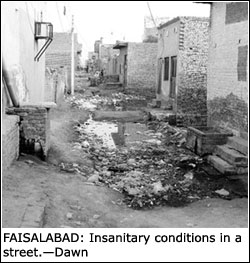 THE government quarters, especially hospitals, appear complacent about the management and control of mosquito-borne diseases because many stagnant water ponds are still there in the district, including the city areas, despite instructions of the health department to drain them immediately.
As dengue fever spread in the country claiming a number of lives most of them in Sindh, theoretical measures instead of practical steps are being taken by the provincial and district governments. Dirty water ponds are one of the major sources of mosquito breeding. Two cases of dengue fever have been detected in the district so far and the number of such patients in Punjab has reached 80.
The provincial government sent a letter to all hospitals of Punjab on Oct 17 asking them to do their best to provide treatment to suspected dengue fever patients. The health department through this letter asked the medical superintendents that stagnant water ponds must be drained and dried and sufficient quantity of anti-malarial medicine in stock be ensured. Besides, hospitals were directed to take measures of vector control, environmental management, biological control and chemoprophylaxis.
District coordination officer Azam Salman told Dawn that only 50 per cent areas of the district have sanitation facility but “we took all the required measures and Wasa officials were directed to drain stagnant water ponds.”
Scores of areas, including Rashidabad, Saifabad, Warispura, Jamil Park, Sharifpura, Maqbool Road, Nishatabad, Kokianwala, Hussainpura, Shahdab Colony, Judgewala, Munirabad have big dirty ponds, which need special attention of the government. These have become breeding grounds for mosquitoes and citizens are in danger. Stagnant ponds in densely populated areas are a serious threat.
One Mohammad Tahir Najfi said, “We have raised our voice against lack of sanitation but as usual our voice went unheard.”
The government could not come up with a complete solution to this epidemic and issued a directive only to placate the World Health Organisation that Pakistan took effective measures to control the disease, another person said. He demanded that health professionals and the government should come up with concrete measures to eradicate the disease once and for all.
It is being claimed by health professionals that the menace has passed its peak showing a rapid decline in most parts of the country. But people are still much concerned because of the deaths in Karachi due to dengue fever. They are also not satisfied with the fumigation drive launched by the district government some days ago and said everybody could see that a number of areas have not been sprayed to control the threat of dengue fever.
Regarding the fumigation drive, a district officer, requesting anonymity, said that the spray task appeared impossible for the administration, as it had no required machinery. “We have contacted different departments and begged for equipment to save precious lives.”
A doctor working in allied hospitals said, “So far we have not heard of any team, either from the city district government or the provincial or federal governments, having started any work to check the areas that could be causing trouble in connection with the spread of dengue fever.”
“We have an acute shortage of funds, which clearly indicates the inability of the hospitals to take precautionary measures.” He said that vector control, environmental management, biological control and chemoprophylaxis, required funds but no government quarter bothered to ask the hospital administration for monetary assistance. “But we did what we could. However, being doctors we are not satisfied with these arrangements.”
An officer said not a single high-up recounted the measures taken by hospitals to cope with the menace. A Wasa official said that many areas in the district had no sanitation system and people on their own had developed stagnant water ponds in their nearby localities.