0
0

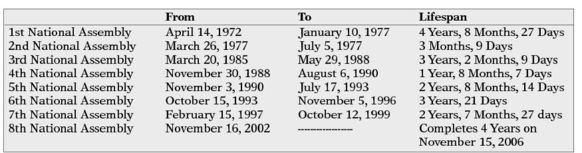
ISLAMABAD, Nov 16: The National Assembly Thursday entered its last and fifth parliamentary year becoming the only second legislative body to achieve this distinction in the 36-year parliamentary history starting from the first general election held under the Legal Framework Order (LFO) of military ruler Gen Yahya Khan in 1970.
The nation underwent eight general elections during this period, but not even a single National Assembly could complete its five-year constitutional term.
Besides this, the present National Assembly also has some interesting features like it has the highest number of 342 members, including 60 reserved seats for women. This is for the first time in the country’s history that women in such a large number are present in the lower house of parliament.
Moreover, this assembly also has the unique distinction of electing three persons as prime minister from the same party — Mir Zafarullah Khan Jamali, Chaudhry Shujaat Hussain and Shaukat Aziz.
Another unique feature of the assembly was tabling of four no-confidence motions, two against the speaker and one each against the prime minister and the deputy speaker.
Before the present assembly, the first National Assembly that came into existence as a result of 1970 elections had completed four parliamentary years. This was the first assembly elected on adult franchise and population basis. It consisted of 313 members, 169 from East Pakistan and 144 from West Pakistan, including 13 reserved seats for women.
However, the first session of the National Assembly was held on April 14, 1972 at the State Bank Building, Islamabad. The delay in the holding of the first session was caused by the separation of East Pakistan. It was the same assembly with Z. A. Bhutto as parliamentary leader that passed the 1973 Constitution.
Despite the tenure of the assembly being five years, Mr Bhutto announced the holding of elections ahead of schedule and advised the president to dissolve the National Assembly on January 10, 1977.
The lifespan of Bhutto’s assembly was four years, eight months and 27 days, which is still the longest period.
The life of the second assembly that came into being after the controversial 1977 election proved to be the shortest in the parliamentary history, as it existed for only three months and nine days starting from March 26 to July 5, 1977, the day when the then chief of the army staff, Gen Ziaul Haq, imposed martial law and suspended the 1973 Constitution.
The late Zia conducted the first-ever non-party election in 1985 and the third National Assembly started functioning on March 20, 1985 with the late Mohammad Khan Junejo as leader of house. However, Junejo’s assembly could last for three years, two months and nine days when Gen Zia used dissolved it on May 29, 1988 under Article 58-2(B).
The nation went to another election, but this time party- based, after the death of Ziaul Haq in a plane crash near Bahawalpur in August 1988.
The assembly that came into being on November 30, 1988 could not complete even two years when the late former president Ghulam Ishaq Khan dismissed Benazir Bhutto’s government on August 6, 1990 on charges of corruption and announced new election. The lifespan of Ms Bhutto’s first assembly was one year, eight months and seven days.
The general election for the next assembly was held on October 24, 1990 and the first session was held on November 3, 1990. Ms Bhutto’s main opponent, Nawaz Sharif, became the prime minister. However, this assembly also failed to complete its tenure.
The assembly was dissolved by the then president, Ghulam Ishaq Khan, on April 18, 1993. The dissolution was challenged in the Supreme Court which restored the assembly on May 26, 1993. The assembly was, however, again dissolved by the president on the advice of Mr Sharif on July 17, 1993. The total life of the Sharif’s first assembly was two years, eight months and 14 days.
Pakistan People’s Party (PPP) once again succeeded in forming its government after the 1993 election and the members of the sixth National Assembly took oath on October 15, 1993.
Ms Bhutto’s second assembly also could not complete its tenure and it was dissolved by the then president Sardar Farooq Leghari on November 5, 1996. The life span of this assembly was three years and 21 days.
The seventh National Assembly started functioning on February 15, 1997 after the election which provided a two-third majority to Nawaz Sharif and he became prime minister for the second time.
The life of this assembly was two years, seven months and 27 days when Army Chief General Musharraf dismissed the Nawaz Sharif government on October 12, 1999 in a dramatic military coup.
Gen Musharraf conducted the election in October 2002 in the light of the Supreme Court’s decision that had set a three-year deadline for him for this purpose. The present MNAs took oath on November 16, 2002 and their five-year tenure will end on November 15, next year.